Loading...
Done
Tibetan Mastiff

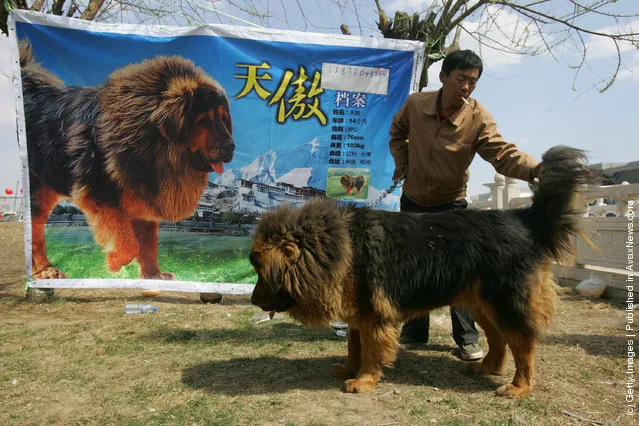
“The Tibetan Mastiff also known as Do-khyi (variously translated as “home guard”, “door guard”, “dog which may be tied”, “dog which may be kept”), reflects its use as a guardian of herds, flocks, tents, villages, monasteries, and palaces, much as the old English ban-dog (also meaning tied dog) was a dog tied outside the home as a guardian. However, in nomad camps and in villages, the Do-khyi is traditionally allowed to run loose at night and woe be unto the stranger who walks abroad after dark”. – Wikipedia

Photo: A man displays a Tibetan Mastiff he raised during the Tibetan Mastiff exposition on April 7, 2007 in Langfang of Hebei Province, China. (Photo by China Photos/Getty Images)
Details
05 Oct 2011 14:27:00
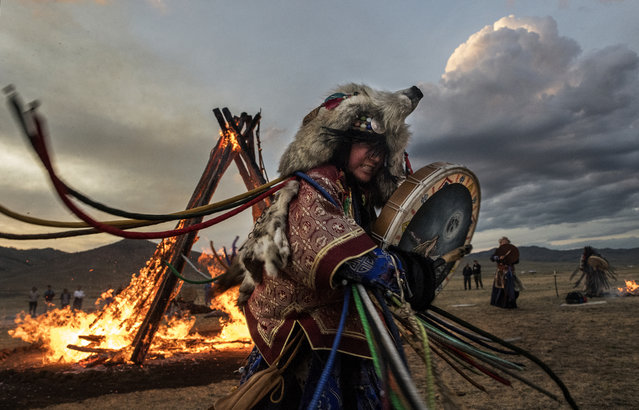
A Mongolian Shamaness or Buu, beats her drum while taking part with others in a fire ritual meant to summon spirits to mark the period of the Summer Solstice in the grasslands on June 22, 2018 outside Ulaanbaatar, Mongolia. (Photo by Kevin Frayer/Getty Images)

A Mongolian Shamaness or Buu, beats her drum while taking part with others in a fire ritual meant to summon spirits to mark the period of the Summer Solstice in the grasslands on June 22, 2018 outside Ulaanbaatar, Mongolia. Banned for 70 years under Communist rule, shamanism has seen a resurgence in Mongolia since 1992, when the ancient practice became protected by the country's Constitution. Known as Tengrism, in which Shamans channel ancestral spirits, it is widely regarded as Mongolia's national religion and part of its indigenous identity. (Photo by Kevin Frayer/Getty Images)
Details
30 Jun 2018 00:05:00
An Indian Hindu devotee pours milk on a snake as an offering during the annual Nag Panchami festival, dedicated to the worship of snakes outside the Nagvasuki temple, in Allahabad, on July 28, 2017. (Photo by Sanjay Kanojia/AFP Photo)

An Indian Hindu devotee pours milk on a snake as an offering during the annual Nag Panchami festival, dedicated to the worship of snakes outside the Nagvasuki temple, in Allahabad, on July 28, 2017. Officially the snake charmers' profession is banned in India, but many in the country offered prayers and milk blessings to cobras and other deadly serpents on July 28 in an annual tribute. The 800,000 charmers and their young apprentices come to the fore for the Nag Panchami festival which dates back several centuries. (Photo by Sanjay Kanojia/AFP Photo)
Details
31 Jul 2017 09:17:00
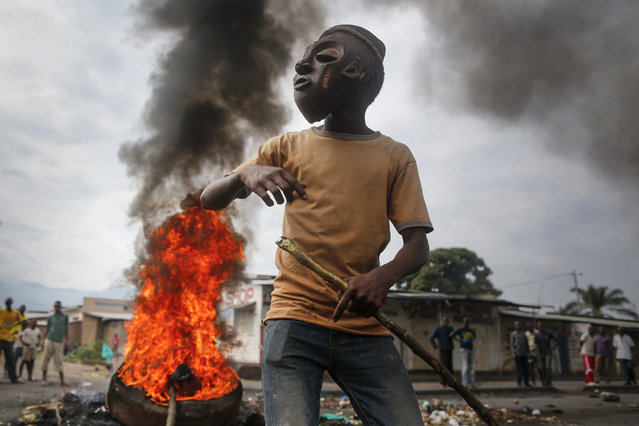
A masked Burundian protester faces soldiers in front of a burning barricade during an anti-government demonstration against President Pierre Nkurunziza's bid for a third term in the capital Bujumbura, Burundi, 25 May 2015. (Photo by Dai Kurokawa/EPA)

A masked Burundian protester faces soldiers in front of a burning barricade during an anti-government demonstration against President Pierre Nkurunziza's bid for a third term in the capital Bujumbura, Burundi, 25 May 2015. Street protests continued on 25 May as the United Nations Secretary-General Ban Ki-moon condemned the killing of the leader of the oppsition party Union for Peace and Development (UPD) Zedi Feruzi who opposed Nkurunziza's bid. (Photo by Dai Kurokawa/EPA)
Details
26 May 2015 11:10:00
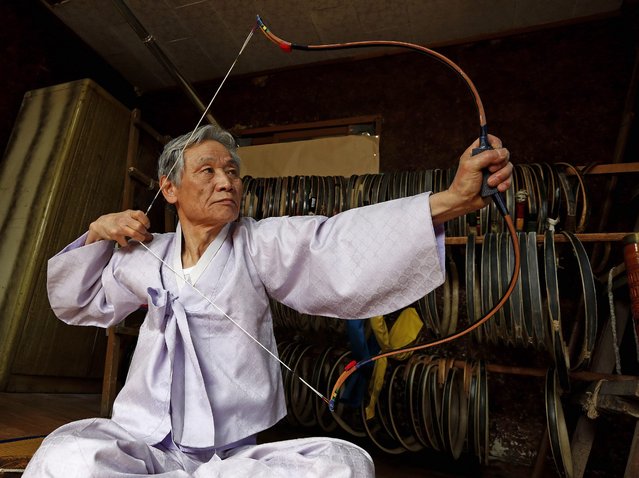
South Korean traditional bow artisan Kwon Yeong-Hak works on a bow in his workshop in Yecheon-gun, Gyeongsangbuk-do, South Korea, 26 February 2015. (Photo by Jeon Heon-Kyun/EPA)

South Korean traditional bow artisan Kwon Yeong-Hak works on a bow in his workshop in Yecheon-gun, Gyeongsangbuk-do, South Korea, 26 February 2015. Kwon Yeong-Hak still crafts his bows in the traditional way, carrying on a four-generation family business. The Gakgung bow, of which Kwon is one of the last remaining artisans, is unique to Korea, and is constructed with a variety of materials, including water buffalo horn, oak, bamboo and cattle spinal sinew. A ban on the import of water buffalo horns has put the Gakgung tradition at risk. (Photo by Jeon Heon-Kyun/EPA)
Details
24 Mar 2015 09:54:00
A model stands next to a BMW X6 AC Schnitzer car at Auto China 2012 in Beijing in this April 24, 2012 file photo. Amid the razzmatazz, music and crowds at the Shanghai autoshow on Monday, hundreds of attractive young women, and men, mingled among the stands and company booths, introducing the newest sedans and handing out pamphlets. (Photo by Jason Lee/Reuters)

A model stands next to a BMW X6 AC Schnitzer car at Auto China 2012 in Beijing in this April 24, 2012 file photo. Amid the razzmatazz, music and crowds at the Shanghai autoshow on Monday, hundreds of attractive young women, and men, mingled among the stands and company booths, introducing the newest sedans and handing out pamphlets. For years, models have been a staple at China's big autoshows – as much of a draw as the latest car models themselves. 2015 is different – the organisers have banned models from the Shanghai show. (Photo by Jason Lee/Reuters)
Details
21 Apr 2015 11:01:00
A member of a local swimming club holds a Russian national flag as he dives in at the start of a 24-hour swimming marathon near the western Siberian city of Barnaul March 29, 2014. Thirty members of the club will swim in turn during the event, held to mark Crimea becoming part of Russia, local media reported. (Photo by Andrei Kasprishin/Reuters)

A member of a local swimming club holds a Russian national flag as he dives in at the start of a 24-hour swimming marathon near the western Siberian city of Barnaul March 29, 2014. Thirty members of the club will swim in turn during the event, held to mark Crimea becoming part of Russia, local media reported. (Photo by Andrei Kasprishin/Reuters)
Details
05 Apr 2014 13:20:00
Lenticular clouds hover of the mountains of the Kamchatka Peninsula in Russia. (Photo by Denis Budkov/Caters News)

“These eerie formations in the sky may look like alien ships. But as the Daily Mail points out, they’re actually a natural occurrence called lenticular clouds”. – Claudine Zap. Photo: Lenticular clouds hover of the mountains of the Kamchatka Peninsula in Russia. (Photos by Denis Budkov/Caters News)
Details
11 Jun 2013 09:26:00