Loading...
Done
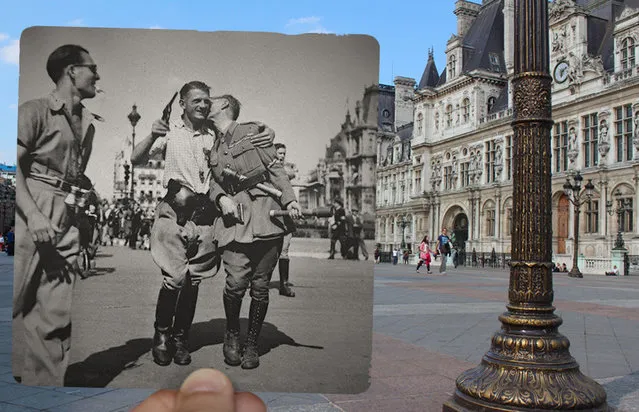
Soldiers outside the Hotel De Ville in the 1940s. (Photo by Julien Knez/Caters News)

It is already one of the world’s most iconic cities, but this incredible collection shows how much Paris has changed over the course of the past century. The collection, by French photographer Julien Knez, shows Paris in the 1940s against a backdrop of how the same places look today. Knez says he put the striking collection together to celebrate the 71st anniversary of the city’s liberation from Nazi control in August 1944. Here: Soldiers outside the Hotel De Ville in the 1940s. (Photo by Julien Knez/Caters News)
Details
07 May 2015 13:16:00
A participant in costume and make-up poses for a photo during a Halloween parade at Walibi park in Wavre, Belgium, October 31, 2018. (Photo by Yves Herman/Reuters)

A participant in costume and make-up poses for a photo during a Halloween parade at Walibi park in Wavre, Belgium, October 31, 2018. (Photo by Yves Herman/Reuters)
Details
05 Nov 2018 00:05:00
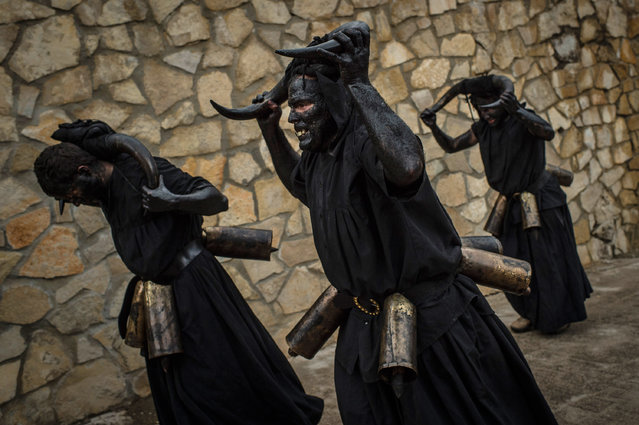
People with his face covered in oil and soot and carrying bull horns representing a devil join a carnival festival on February 14, 2015 in Luzon, Spain. (Photo by David Ramos/Getty Images)

People with his face covered in oil and soot and carrying bull horns representing a devil join a carnival festival on February 14, 2015 in Luzon, Spain. (Photo by David Ramos/Getty Images)
Details
15 Feb 2015 15:09:00
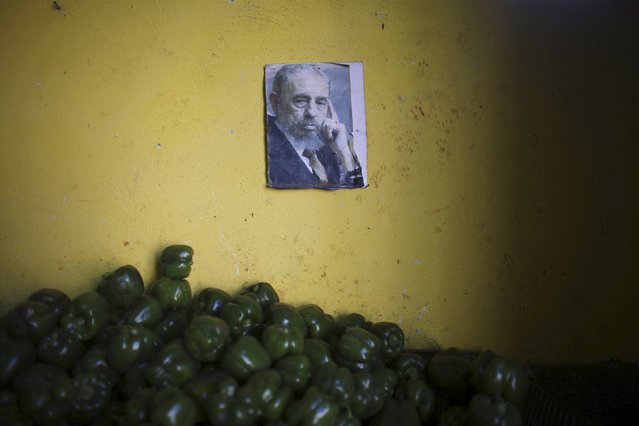
A photograph of Cuba's former President Fidel Castro decorates a wall inside a state-run market in Havana, March 8, 2016. (Photo by Alexandre Meneghini/Reuters)

A photograph of Cuba's former President Fidel Castro decorates a wall inside a state-run market in Havana, March 8, 2016. (Photo by Alexandre Meneghini/Reuters)
Details
15 Mar 2016 13:48:00
A member of the Qinghai Acrobatic Troupe checks her hair with a smartphone during a media preview for the world premiere of cabaret show “Shanghai Mimi” as part of Sydney Festival in Chinatown, central Sydney, Australia, 08 January 2019. Sydney Festival 2019 runs from 09 to 27 January and will feature theatre, dance, circus, music, visual arts and talks from international and local artists. (Photo by Steven Saphore/EPA/EFE)

A member of the Qinghai Acrobatic Troupe checks her hair with a smartphone during a media preview for the world premiere of cabaret show “Shanghai Mimi” as part of Sydney Festival in Chinatown, central Sydney, Australia, 08 January 2019. Sydney Festival 2019 runs from 09 to 27 January and will feature theatre, dance, circus, music, visual arts and talks from international and local artists. (Photo by Steven Saphore/EPA/EFE)
Details
10 Jan 2019 00:07:00
Montreal Canadiens defenseman Arber Xhekaj (72) fights with Ottawa Senators forward Mark Kastelic (47) during the first period at the Bell Centre in Montreal, Quebec on October 4, 2022. (Photo by Eric Bolte/USA TODAY Sports)

Montreal Canadiens defenseman Arber Xhekaj (72) fights with Ottawa Senators forward Mark Kastelic (47) during the first period at the Bell Centre in Montreal, Quebec on October 4, 2022. (Photo by Eric Bolte/USA TODAY Sports)
Details
12 Oct 2022 03:54:00
A man steers with his legs while riding a motorcycle on a road in Vietnam's northern Hoa Binh province, outside Hanoi, October 15, 2015. (Photo by Reuters/Kham)

A man steers with his legs while riding a motorcycle on a road in Vietnam's northern Hoa Binh province, outside Hanoi, October 15, 2015. (Photo by Reuters/Kham)
Details
23 Nov 2015 08:01:00
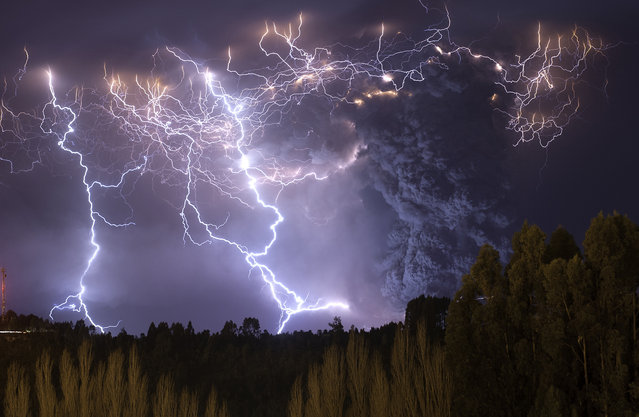
The eruption of Cordon Caulle began on June 4, 2011, located in the Region of Los Rios in Chile. For about 12 months, people and animals became accustomed to living with the daily fall of ash, which also caused problems in the air traffic in South America. The explosions and lightning during first days of the eruption could be seen from hundreds of miles around. This photograph was taken on the second night of eruption from the town of Lago Ranco. (Photo and caption by Francisco Negroni/National Geographic Traveler Photo Contest)

The eruption of Cordon Caulle began on June 4, 2011, located in the Region of Los Rios in Chile. For about 12 months, people and animals became accustomed to living with the daily fall of ash, which also caused problems in the air traffic in South America. The explosions and lightning during first days of the eruption could be seen from hundreds of miles around. This photograph was taken on the second night of eruption from the town of Lago Ranco. (Photo and caption by Francisco Negroni/National Geographic Traveler Photo Contest)

ATTENTION! All pictures are presented in high resolution. To see Hi-Res images – just TWICE click on any picture. In other words, click small picture – opens the BIG picture. Click BIG picture – opens VERY BIG picture.
Details
23 Jun 2013 11:24:00