“These Rajasthani sisters were sitting on the staircase inside their house relaxing and enjoy a cup of masala chai”. (Photo by Firdaus Hadzri/National Geographic Travel Photographer of the Year Contest)
Revellers take part in the annual block party known as “Casa Comigo” (Marry Me), during carnival festivities in Sao Paulo, Brazil on February 15, 2020. (Photo by Rahel Patrasso/Reuters)
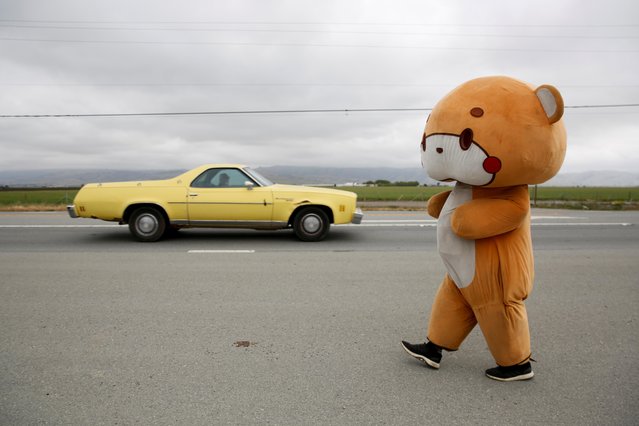
Jesse Larios, 33, from Los Angeles, wears a bear suit while walking along Hollister Road in Gilroy, California, U.S., April 21, 2021. Larios, also known as Bear Sun on social media, is walking from his home in Los Angeles to San Francisco while wearing the bear suit as a social media fundraising event. (Photo by Brittany Hosea-Small/Reuters)
Three workers prepare to paint some traditional umbrellas in Bogor, Indonesia in the second decade of October 2023. The daily wage is the equivalent of the cost of selling one umbrella to a tourist. (Photo by Achmad Mikami/Solent News)
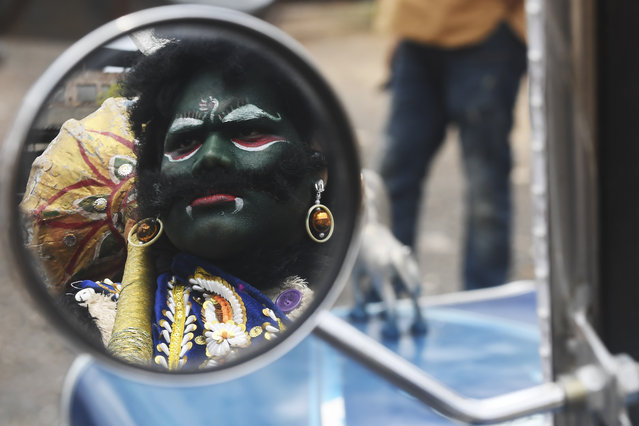
The reflection of a man dressed as Hindu deity of death Yamaraj (R) to raise awareness about the coronavirus is seen on the wing mirror of a vintage car during a government-imposed nationwide lockdown as a preventive measure against the COVID-19 coronavirus, in Kolkata on April 24, 2020. (Photo by Dibyangshu Sarkar/AFP Photo)
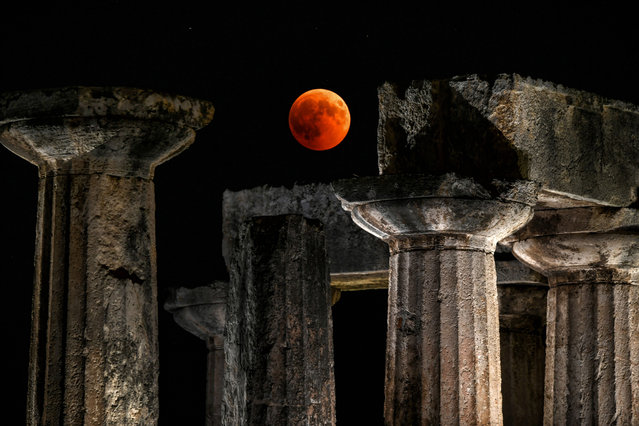
A picture shows the full moon during a “blood moon” eclipse over the temple of Apollo in Corinth on July 27, 2018. The longest “blood moon” eclipse this century began on July 27, coinciding with Mars' closest approach in 15 years to treat skygazers across the globe to a thrilling celestial spectacle. (Photo by Valerie Gache/AFP Photo)
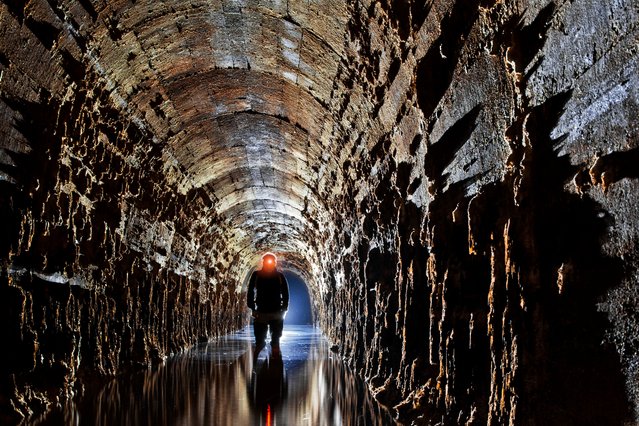
Stunning silhouettes under European cities reveal the size and splendor of the continent’s urban foundations. Photographer and content-manager Anna Arinova, 28, from Moscow, captured the awe-inspiring labyrinths in Russia and Germany. Here: Regenwurmlager, Poland. The Regenwurmlager is an extensive underground fortification area constructed by Germany in 1920s-1940s, now in western Poland, near the city of Międzyrzecz. (Photo by Anna Arinova/Caters News)
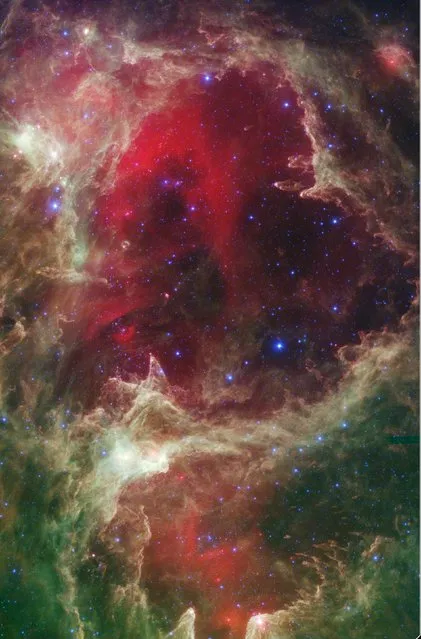
An infrared portrait from NASA's Spitzer Space Telescope which shows generations of stars is seen in this undated NASA handout image released February 14, 2013. In this wispy star-forming region, called W5, the oldest stars can be seen as blue dots in the centers of the two hollow cavities (other blue dots are background and foreground stars not associated with the region). Red shows heated dust that pervades the region's cavities, while green highlights dense clouds. (Photo by NASA/Reuters/JPL-Caltech/Harvard-Smithsonian/Handout)