Loading...
Done
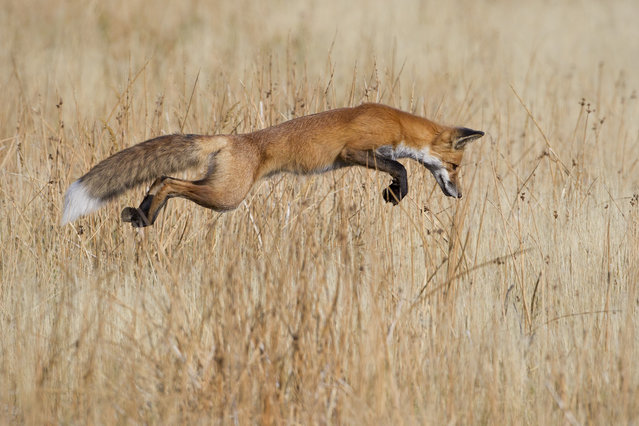
Canada: “Lucky pounce”. (Photo by Connor Stefanison/Wildlife Photographer of the Year 2013)

The winners of The London’s Natural History Museum's prestigious Wildlife Photographer of the Year for 2013 have finally been unveiled. Selected from almost 43,000 entries from 96 countries, the winners offer a glimpse of the stunning array of natural beauty on our planet. Photo: Canada: “Lucky pounce”. “Anticipating the pounce – that was the hardest part”, says Connor, who had come to Yellowstone National Park, Wyoming, USA, in search of wildlife as much as the spectacular landscape. He had found this fox, his first ever, on his last day in the park. It was so absorbed in hunting that Connor had plenty of time to get out of the car and settle behind a rock. It quartered the grassland, back and forth, and then started staring intently at a patch of ground, giving Connor just enough warning of the action to come. When it sprung up, Connor got his shot. And when it landed, the fox got his mouse. (Photo by Connor Stefanison/Wildlife Photographer of the Year 2013)
Details
17 Oct 2013 08:12:00
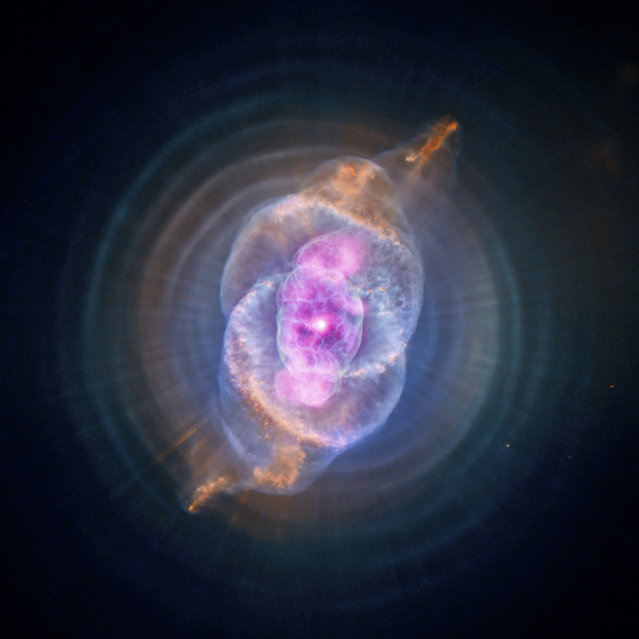
This image is NGC 6543 known as the Cat's Eye Nebula as it appears to the Chandra X-Ray Observatory and Hubble Telescope. A planetary nebula is a phase of stellar evolution that the sun should experience several billion years from now, when it expands to become a red giant and then sheds most of its outer layers, leaving behind a hot core that contracts to form a dense white dwarf star. This image was released October 10, 2012. (Photo by J. Kastner/NASA/CXC/RIT)

This image is NGC 6543 known as the Cat's Eye Nebula as it appears to the Chandra X-Ray Observatory and Hubble Telescope. A planetary nebula is a phase of stellar evolution that the sun should experience several billion years from now, when it expands to become a red giant and then sheds most of its outer layers, leaving behind a hot core that contracts to form a dense white dwarf star. This image was released October 10, 2012. (Photo by J. Kastner/NASA/CXC/RIT)
Details
15 Apr 2013 10:09:00


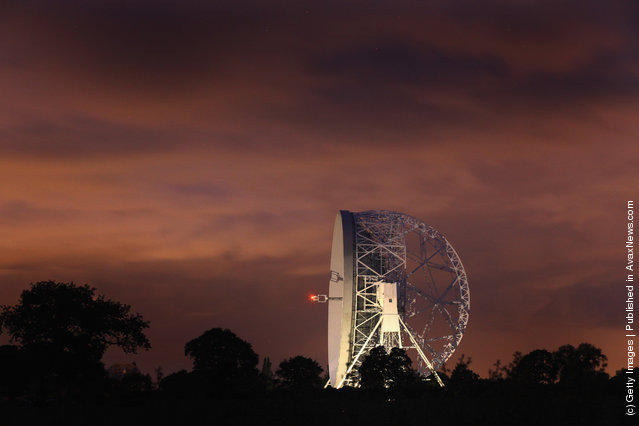
“The Lovell Telescope is a radio telescope at Jodrell Bank Observatory, near Goostrey, Cheshire in the north-west of England. When it was constructed in 1955, the telescope was the largest steerable dish radio telescope in the world at 76.2 m (250 ft) in diameter; it is now the third largest, after the Green Bank telescope in West Virginia, USA, and the Effelsberg telescope in Germany. It was originally known as the 250 ft (76 m) telescope or the Radio Telescope at Jodrell Bank, before becoming the Mark I telescope around 1961 when future telescopes (the Mark II, III, and IV) were being discussed. It was renamed to the Lovell Telescope in 1987 after Bernard Lovell, and became a Grade I listed building in 1988. The telescope forms part of the MERLIN and European VLBI Network arrays of radio telescopes”. – Wikipedia

Photo: The Lovell Telescope listens to the night sky for radio signals from space at Jodrell Bank on June 22, 2011 in Holmes Chapel, England. Jodrell Bank Centre for Astrophysics and it's world famous Lovell Telescope is on the shortlist of Britain's submission for Unesco World Heritage Site status. (Photo by Christopher Furlong/Getty Images)
Details
24 Jun 2011 09:34:00
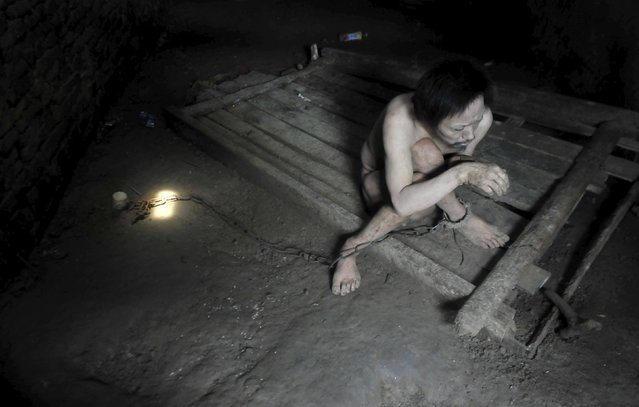
Tong Jieping, 44-year-old mentally disabled patient, is chained by his foot inside his room, in Qunxing village of Wangjiang county, Anhui province, China, July 14, 2015. Tong was diagnosed mentally ill when he was in his 20s. His parents, both in their 70s, could not afford the medical treatments so they had to lock him up in chains to prevent him from running away, according to Tong's family. (Photo by Reuters/Stringer)

Tong Jieping, 44-year-old mentally disabled patient, is chained by his foot inside his room, in Qunxing village of Wangjiang county, Anhui province, China, July 14, 2015. Tong was diagnosed mentally ill when he was in his 20s. His parents, both in their 70s, could not afford the medical treatments so they had to lock him up in chains to prevent him from running away, according to Tong's family. (Photo by Reuters/Stringer)
Details
15 Jul 2015 11:33:00
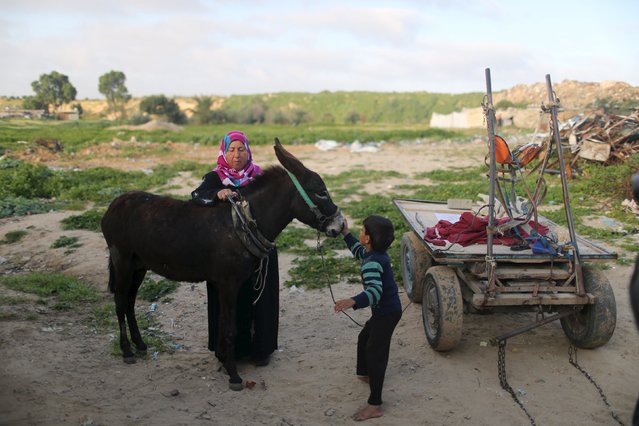
Palestinian woman Jihan Abu Muhsen prepares her donkey with her son Kareem before going work collecting bricks for sale from sites of demolished buildings, at her dwelling in Khan Younis in the southern Gaza Strip March 8, 2016. Abu Muhsen gathers bricks from the sites of demolished buildings and sells them to recycling factories. She earns around 20 shekels ($5) a day and her 10-year-old son Mohammad helps her when he is not at school. (Photo by Ibraheem Abu Mustafa/Reuters)

Palestinian woman Jihan Abu Muhsen prepares her donkey with her son Kareem before going work collecting bricks for sale from sites of demolished buildings, at her dwelling in Khan Younis in the southern Gaza Strip March 8, 2016. Abu Muhsen gathers bricks from the sites of demolished buildings and sells them to recycling factories. She earns around 20 shekels ($5) a day and her 10-year-old son Mohammad helps her when he is not at school. (Photo by Ibraheem Abu Mustafa/Reuters)
Details
19 Apr 2016 13:32:00
Nepalese women performs ritual as they take a holy bath in the Bagmati River, during the Rishi Panchami festival, in Kathmandu, Nepal September 18, 2015. Rishi Panchami is observed on the last day of Teej when women worship Sapta Rishi (Seven Saints) to ask for forgiveness for sins committed during their menstrual periods throughout the year. (Photo by Navesh Chitrakar/Reuters)

Nepalese women performs ritual as they take a holy bath in the Bagmati River, during the Rishi Panchami festival, in Kathmandu, Nepal September 18, 2015. Rishi Panchami is observed on the last day of Teej when women worship Sapta Rishi (Seven Saints) to ask for forgiveness for sins committed during their menstrual periods throughout the year. The Hindu religion considers menstruation as a representation of impurity and women are prohibited from taking part in religious practices during their monthly menstruations. (Photo by Navesh Chitrakar/Reuters)
Details
21 Sep 2015 12:23:00
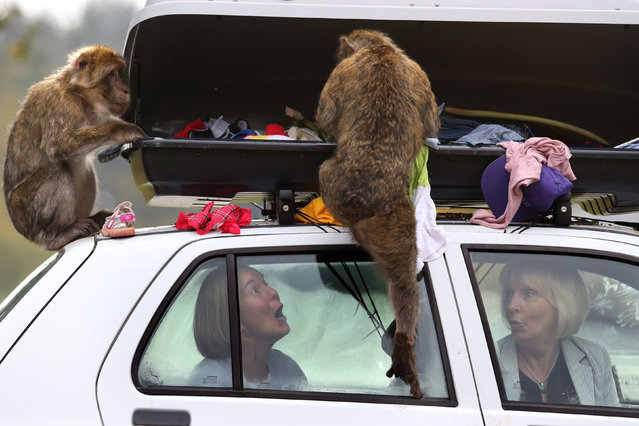
Sasha Muir and Margaret Davidson sit in a car as some of the 30 barbary macaques, known as the Middle Hill Troop after living between the top of Gibraltar rock and the town, show what happens when motorists forget to lock their luggage compartments, as Scotland’s only monkey drive-through section opens at Blair Drummond safari park in Stirling, Scotland on October 8, 2015. (Photo by Andrew Milligan/PA Wire)

Sasha Muir and Margaret Davidson sit in a car as some of the 30 barbary macaques, known as the Middle Hill Troop after living between the top of Gibraltar rock and the town, show what happens when motorists forget to lock their luggage compartments, as Scotland’s only monkey drive-through section opens at Blair Drummond safari park in Stirling, Scotland on October 8, 2015. (Photo by Andrew Milligan/PA Wire)
Details
13 Oct 2015 08:03:00
A woman attends a boxing class at Princess Women's Boxing Club in Shanghai December 3, 2014. Women have boxed as long as the sport has existed but for years they were relegated out of national and international competitions in many countries around the world. Female boxers entered the ring in an exhibition match at the 1904 Olympic Games, but it was more than a century later when they were given the green light to make their Olympic debut in London in 2012. (Photo by Carlos Barria/Reuters)

A woman attends a boxing class at Princess Women's Boxing Club in Shanghai December 3, 2014. Women have boxed as long as the sport has existed but for years they were relegated out of national and international competitions in many countries around the world. Female boxers entered the ring in an exhibition match at the 1904 Olympic Games, but it was more than a century later when they were given the green light to make their Olympic debut in London in 2012. (Photo by Carlos Barria/Reuters)
Details
10 Dec 2014 12:46:00