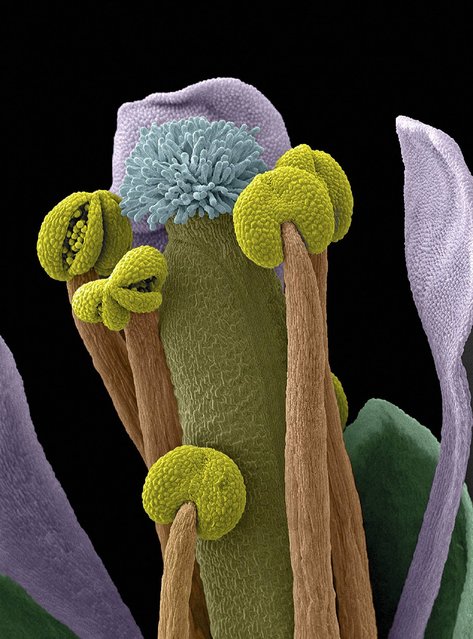
Beautiful, strange and occasionally alarming pictures from the shortlist for this year’s Wellcome image awards – which celebrate the very best in science photography and imaging – from an x-ray of a bat to a micrograph of a kidney stone. The exhibition opens on 12 March at three science centres and the Museum of Science and Industry in Manchester. Photo: Scanning electron micrograph (SEM) of an Arabidopsis thaliana flower, also commonly known as thale cress. Some of the anthers are open, revealing pollen grains ready for dispersal. Arabidopsis was the first plant to have its entire genome sequenced and is widely used as a model organism in molecular and plant biology. Horizontal width of image is 1200 microns. Magnification 100x. (Photo by Stefan Eberhard/Wellcome Images)
A professional bull rider participates in a bull riding exhibition at the premiere of “The Longest Ride” at the TCL Chinese Theatre on Monday, April 6, 2015, in Los Angeles. (Photo by Chris Pizzello/Invision/AP Photo)
A climber walks on the ridge beneath the eastern peak of the Gamsberg (2385 meters above sea level) near Grabs, Switzerland, Friday, October 3, 2014. (Photo by Gian Ehrenzeller/AP Photo/Keystone)
In a 200-acre-plus dump 5 kilometers north of Haiti’s capital, Port-au-Prince, hundreds of men, women and children scavenge day and night through the burning wasteland. They earn $12 to $15 a day – on a good day – for recycling plastics as well as clothing, household items and aluminum (for smelting). Some 5,000 tons of waste is created each day in the Port-au-Prince area. (Photo and caption by Giles Clarke/Getty Images Reportage)
This image taken from video provided by TVBS shows a commercial airplane clipping an elevated roadway just before it careened into a river in Taipei, Taiwan, Wednesday, February 4, 2015. The ATR-72 prop-jet aircraft had 58 people aboard. (Photo by AP Photo/TVBS)
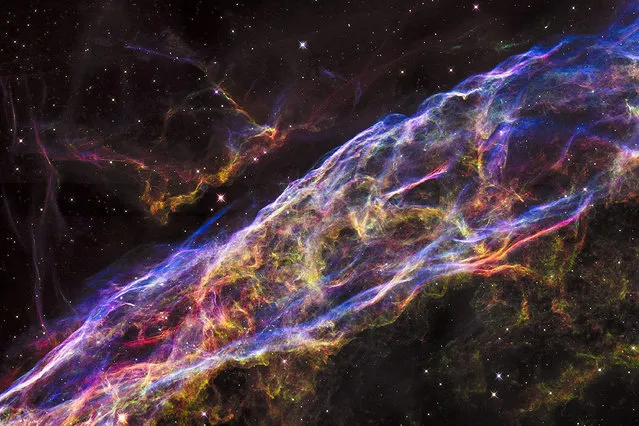
A small section of the expanding remains of the Veil Nebula, a massive star that exploded about 8,000 years ago. The entire nebula is 110 light-years across, covering six full moons on the sky as seen from Earth, and resides about 2,100 light-years away in the constellation Cygnus, the Swan. (Photo by Reuters/NASA/ESA/Hubble)