Loading...
Done
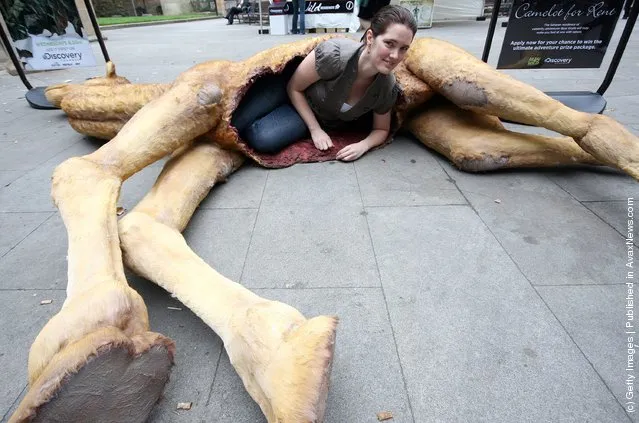
Passer inspects Camelot, a replica camel carcass simulating that used by adventurer Bear Grylls to shelter in the Sahara desert during an episode of the Discovery Channel's Man Vs. Wild

“Bear Grylls, (born Edward Michael Grylls, 7 June 1974) is an English adventurer, writer and television presenter. He is best known for his television series Man vs. Wild, known as Born Survivor in the United Kingdom. He was the youngest Briton to climb Mount Everest, doing so at age 23. In July 2009, Grylls was appointed the youngest ever Chief Scout at the age of 35”. – Wikipedia

Photos: Passer inspects “Camelot”, a replica camel carcass simulating that used by adventurer Bear Grylls to shelter in the Sahara desert during an episode of the Discovery Channel's “Man Vs. Wild”, in Wynyard Park on March 1, 2010 in Sydney, Australia. (Photo by Discovery Channel via Getty Images)
Details
04 Aug 2011 11:24:00
Participants compete in a wife-carrying championship in Tapiobicske, Hungary, August 7, 2021. Some 40 Hungarian husbands, with their wives on their backs, clambered over rough terrain on Saturday in the nation's second wife-carrying contest. (Photo by Marton Monus/Reuters)

Participants compete in a wife-carrying championship in Tapiobicske, Hungary, August 7, 2021. Some 40 Hungarian husbands, with their wives on their backs, clambered over rough terrain on Saturday in the nation's second wife-carrying contest. (Photo by Marton Monus/Reuters)
Details
09 Apr 2022 05:33:00
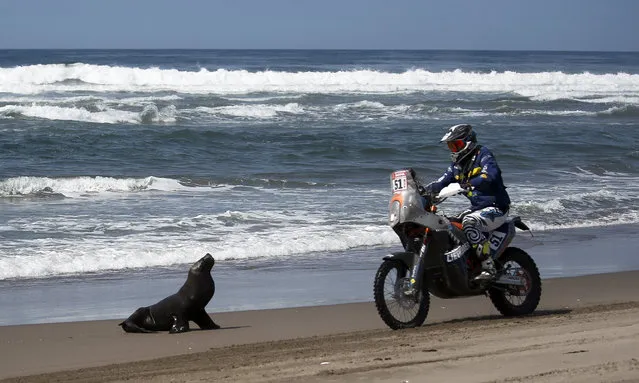
Dutch driver Hans Jos Liefhebber on his KTM drives next to a seal during the fifth stage of the 2018 Dakar Rally, between San Juan de Marcona and Arequipa, on the beach of Puerto Lomas, Peru, 10 January 2018. The 2018 Dakar says goodbye to the dunes with its fifth and final stage over the Peruvian desert and begins to take height as it enters the Andean mountain range, heading for Bolivia. (Photo by David Fernandez/EPA/EFE)

Dutch driver Hans Jos Liefhebber on his KTM drives next to a seal during the fifth stage of the 2018 Dakar Rally, between San Juan de Marcona and Arequipa, on the beach of Puerto Lomas, Peru, 10 January 2018. The 2018 Dakar says goodbye to the dunes with its fifth and final stage over the Peruvian desert and begins to take height as it enters the Andean mountain range, heading for Bolivia. (Photo by David Fernandez/EPA/EFE)
Details
17 Jan 2018 07:50:00
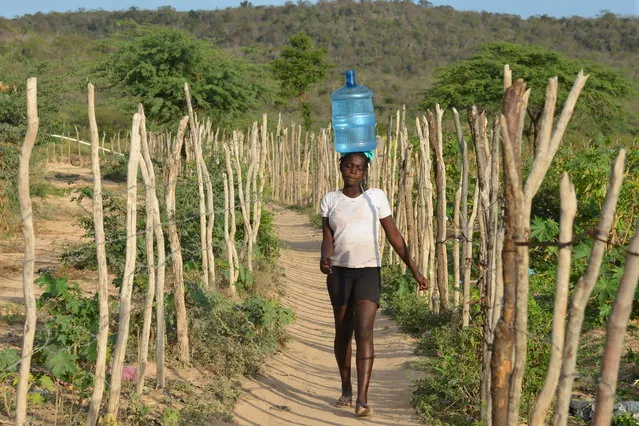
In this March 21, 2015 photo, 15-year-old Guerline Augustin carries river water on her head, back to a borderland encampment outside the southeast Haitian town of Anse-a-Pitres, Haiti. (Photo by David McFadden/AP Photo)

In this March 21, 2015 photo, 15-year-old Guerline Augustin carries river water on her head, back to a borderland encampment outside the southeast Haitian town of Anse-a-Pitres, Haiti. The encampment is filled with people who either fled or were forcibly removed from the neighboring Dominican Republic amid an immigration crackdown. Within the next month, authorities hope to move nearly 2,400 people out of six encampments by providing subsidies for them to rent homes for a year in southeastern Haiti. The International Organization for Migration is coordinating the effort with $2 million from a U.N. emergency fund. (Photo by David McFadden/AP Photo)
Details
31 Mar 2016 11:20:00


“Rapa das Bestas is the name of an operation that involves cutting the manes of the horses that are performed in the curros (enclosed which retain the horses) held in various locations in Galicia (Spain).

The best known is the Rapa das Bestas of Sabucedo, in the city hall of A Estrada, which lasts three days: the First Saturday, Sunday and Monday in July. In fact, the name given to the celebration (Rapa das Bestas of Sabucedo), while in most places speaking about curros, including curros de Valga, etc”. – Wikipedia

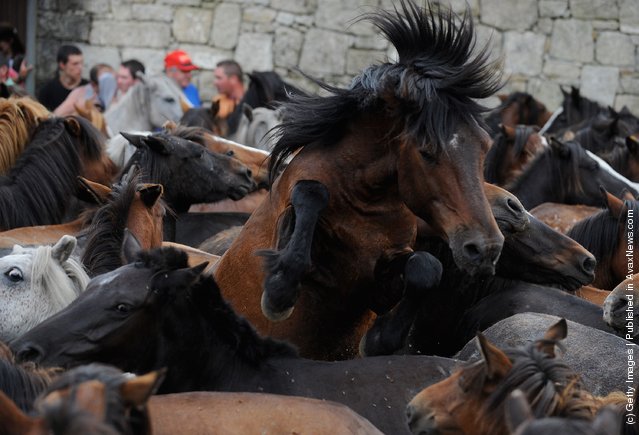
Photo: A wild horse leaps up during the Rapa das Bestas (shearing of the beasts) festival on July 2, 2011 in Sabucedo, Spain. Hundreds of wild horses are rounded up from the mountains and trimmed and marked in the corral. (Photo by Denis Doyle/Getty Images)
Details
03 Jul 2011 12:30:00
A glass building mirrors the sky in Singapore as the sun goes down over the city. (Photo by Fong Qi Wei/Thoughtful Photography)

Intrigued by photographing time, Singapore-based photographer Fong Qi Wei created single, composite pictures from a sequence of images spanning 2-4 hours. He concentrated on capturing sunrises and sunsets as they evolved over different landscapes, seascapes, and cityscapes. He then digitally stitched the images together to get a snapshot of time passing over the scene for his series “Time is a Dimension”. “Most paintings and photographs are an instance of time”, Wei explained in his artist’s statement. “That’s not the way the world works. We experience a sequence of time, and that’s why a video is somehow more compelling than a freeze frame”. (Photo by Fong Qi Wei/Thoughtful Photography)
Details
19 Aug 2014 10:28:00
A close-up shot of dews of a soldier fly on August 2014, in Banten, Indonesia. Wildlife photographer takes incredible close-up images of tiny bugs. Yudy Sauw has captured close-up images of creepy crawlies – revealing their disturbing faces. The insects have an assortment bulging eyes and sharp pincers and look grotesque in the face-to-face shots. The miniature-models include a soldier fly, a red ant and a longhorn beetle. (Photo by Yudy Sauw/Barcroft Media)

A close-up shot of dews of a soldier fly on August 2014, in Banten, Indonesia. Wildlife photographer takes incredible close-up images of tiny bugs. Yudy Sauw has captured close-up images of creepy crawlies – revealing their disturbing faces. The insects have an assortment bulging eyes and sharp pincers and look grotesque in the face-to-face shots. The miniature-models include a soldier fly, a red ant and a longhorn beetle. The 33-year-old photographed the bugs at his home studio in Banten, Indonesia, placing them 2-10 centimeters away from the camera. (Photo by Yudy Sauw/Barcroft Media)
Details
22 Aug 2014 12:42:00
Longsheng Rice Terraces

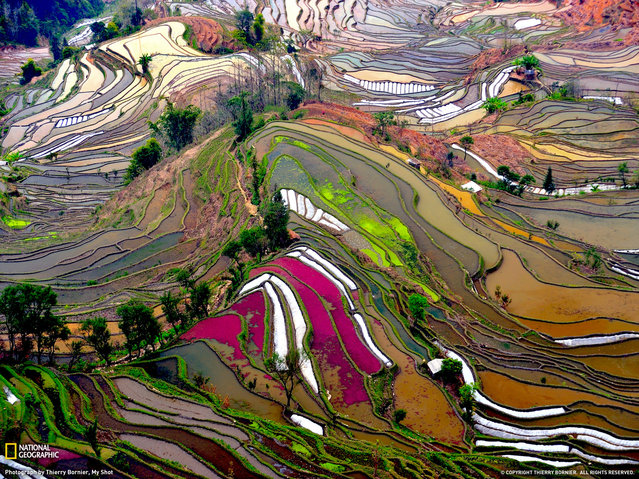
The Longsheng Rice Terraces are located in Longsheng County, about 100 km (2 hours drive) from Guilin, Guangxi, China. The most popular are Ping An Rice Terrace and Jinkeng Rice Terrace. The terraced fields are built along the slope winding from the riverside up to the mountain top, the highest part being 880 m in elevation while the lowest part is 380 m[citation needed]. The coiling line that starts from the mountain foot up to the mountain top divides the mountain into layers of water glittering in the sun in spring, layers of green rice shoots in summer, layers of golden rice in fall, and layers of silvery frost in winter. The terraced fields were mostly built during the Ming Dynasty, about 500 years ago.
Details
18 Oct 2013 12:45:00