Loading...
Done
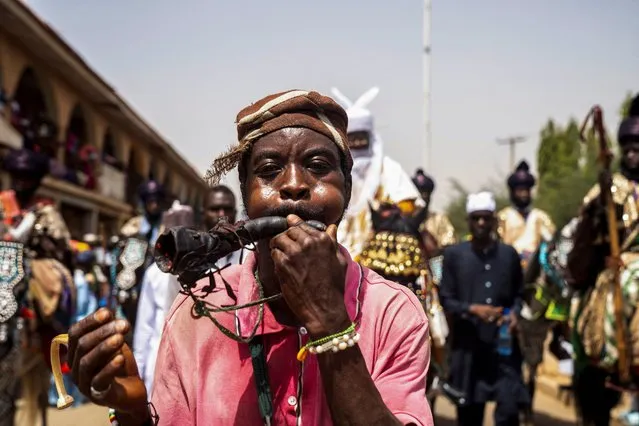
A Muslim faithful celebrates during the Eid al-Fitr festival, marking the end of the fasting month of Ramadan, in Kaduna, Nigeria on April 10, 2024. (Photo by Marvellous Durowaiye/Reuters)

A Muslim faithful celebrates during the Eid al-Fitr festival, marking the end of the fasting month of Ramadan, in Kaduna, Nigeria on April 10, 2024. (Photo by Marvellous Durowaiye/Reuters)
Details
16 Apr 2024 06:23:00
Change, 26, who is non-binary, poses next to their friend wearing pink, rainbow-decorated boots at the Pink Dot Rally in Singapore on June 24, 2023. (Photo by Edgar Su/Reuters)

Change, 26, who is non-binary, poses next to their friend wearing pink, rainbow-decorated boots at the Pink Dot Rally in Singapore on June 24, 2023. (Photo by Edgar Su/Reuters)
Details
01 Oct 2024 04:20:00
Bronze whaler shark (Carcharhinus brachyurus), caught in traditional seine net and released by fisherman, Muizenberg beach, Cape Town, South Africa on October 11, 2016. Action shots have captured fishermen trying to free a potentially deadly Bronze Whaler shark who was caught in their nets. The incredible images show the eight-foot-long 500-pound predator lunging its mouth towards the fishermen who are desperately trying to pull it back into the safety of the sea by its tail. Eventually they succeeded. (Photo by Chris and Monique Fallows/NPL)

Bronze whaler shark (Carcharhinus brachyurus), caught in traditional seine net and released by fisherman, Muizenberg beach, Cape Town, South Africa on October 11, 2016. Action shots have captured fishermen trying to free a potentially deadly Bronze Whaler shark who was caught in their nets. The incredible images show the eight-foot-long 500-pound predator lunging its mouth towards the fishermen who are desperately trying to pull it back into the safety of the sea by its tail. Eventually they succeeded. (Photo by Chris and Monique Fallows/NPL)
Details
13 Oct 2016 11:51:00


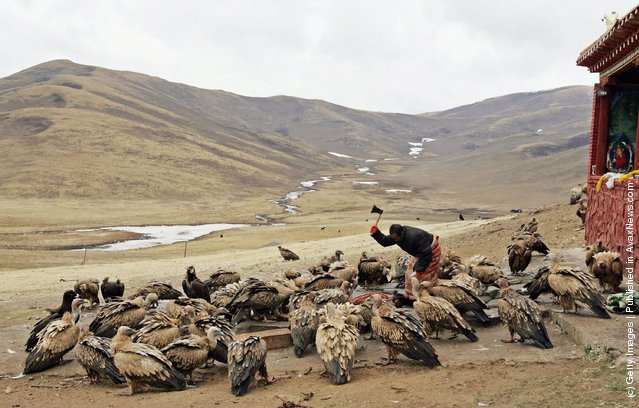
“Sky burial or ritual dissection was once a common funerary practice in Tibet wherein a human corpse is cut in specific locations and placed on a mountaintop, exposing it to the elements or the mahabhuta and animals – especially to birds of prey. The location of the sky burial preparation and place of execution are understood in the Vajrayana traditions as charnel grounds. In Tibet the practice is known as jhator, which literally means, «giving alms to the birds»”. – Wikipedia

Photo: A burial master chops bones of a body to feed vultures during a celestial burial ceremony on April 19, 2006 in Dari County of Guoluo Prefecture, Qinghai Province, northwest China. Celestial burial is a traditional funeral of Tibetan people, which began in the 7th century. (Photo by China Photos/Getty Images)
Details
18 Jun 2011 12:12:00
Multicolored nets are set under olive trees to collect the olives on November 27, 2013 in Castagniers, southeastern France. (Photo by Valery Hache/AFP Photo)

Multicolored nets are set under olive trees to collect the olives on November 27, 2013 in Castagniers, southeastern France. (Photo by Valery Hache/AFP Photo)
Details
02 Dec 2013 11:47:00
A woman looks out of a dusty window after boarding a bus to be transported to see the casket of Nelson Mandela at the Union Buildings in Pretoria, South Africa, Wednesday December 11, 2013. On Thursday, December 5, 2013, Mandela died at the age of 95. (Photo by Markus Schreiber/AP Photo)

A woman looks out of a dusty window after boarding a bus to be transported to see the casket of Nelson Mandela at the Union Buildings in Pretoria, South Africa, Wednesday December 11, 2013. On Thursday, December 5, 2013, Mandela died at the age of 95. (Photo by Markus Schreiber/AP Photo)
Details
13 Dec 2013 08:21:00
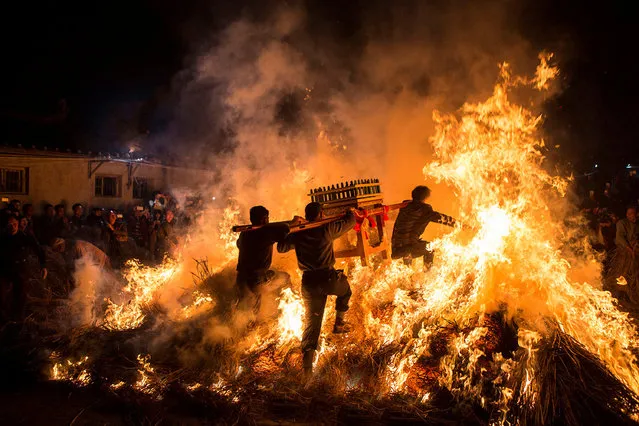
Men carrying a shrine jump over a bon fire, which means a wish for good luck during a traditional Chinese lunar new year celebration in Jieyang, Guangdong province, China, February 2, 2017. (Photo by Reuters/China Daily)

Men carrying a shrine jump over a bon fire, which means a wish for good luck during a traditional Chinese lunar new year celebration in Jieyang, Guangdong province, China, February 2, 2017. (Photo by Reuters/China Daily)
Details
09 Feb 2017 00:06:00
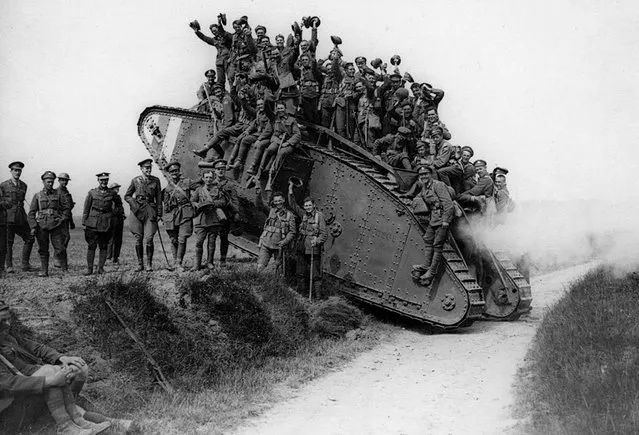
These black-and-white photos are taken from the new book “Armoured Warfare in the First World War 1916 – 1918” by Anthony Tucker-Jones and published by Pen & Sword Military. “Interestingly the British, French and Germans took completely different approaches with varying results”. The British military produced “Little Willie” in Autumn 1915 weighing 18 tonnes, which had a crew of two plus four gunners. “Inspired by a tracked artillery tractor “Little Willie” was referred to as a water tank – hence the name tank – to ensure secrecy”, said Anthony. “This led to the strange looking Mark I with its peculiar rhomboid shape, designed to cross trenches with guns in sponsons on either side. The Germans saw the tank as unchivalrous and were slow to grasp its utility. They favoured the Stormtrooper (specialist soldiers used to infiltrate enemy trenches) and artillery, not the tank”, said Anthony. “However, they didn’t hesitate to make use of captured British tanks. Although the tank helped secure victory and German soldiers dubbed it “Germany’s Downfall” the country was ultimately brought to its knees by the Allies blockade”. Here: British troops hitch a ride on a Mark IV after the massed tank fleet spearheading attack at Cambrai on November 20, 1917. (Photo by Anthony Tucker-Jones/Mediadrumworld.com)

These black-and-white photos are taken from the new book “Armoured Warfare in the First World War 1916 – 1918” by Anthony Tucker-Jones and published by Pen & Sword Military. Here: British troops hitch a ride on a Mark IV after the massed tank fleet spearheading attack at Cambrai on November 20, 1917. (Photo by Anthony Tucker-Jones/Mediadrumworld.com)
Details
23 Feb 2017 00:02:00