Loading...
Done
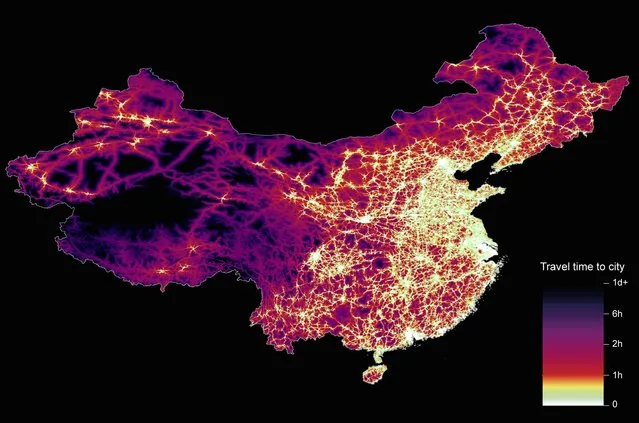
From Britain to China to Mali, new maps showing travel times to the nearest urban centre reveal huge differences between countries. Using Open Street Map and Google, a University of Oxford team have created a visual breakdown that suggests major inequalities when it comes to commuting. Here: China. The dataset used for China was unique as it relied solely on Open Street Map, due to restrictions on accessing Google data. The population is densely concentrated in the east and accessibility is increased, whereas rural provinces in the west remain remote. (Photo by Daniel Weiss/Jennifer Rozier/Malaria Atlas Project/University of Oxford )

From Britain to China to Mali, new maps showing travel times to the nearest urban centre reveal huge differences between countries. Using Open Street Map and Google, a University of Oxford team have created a visual breakdown that suggests major inequalities when it comes to commuting. Here: China. The dataset used for China was unique as it relied solely on Open Street Map, due to restrictions on accessing Google data. The population is densely concentrated in the east and accessibility is increased, whereas rural provinces in the west remain remote. (Photo by Daniel Weiss/Jennifer Rozier/Malaria Atlas Project/University of Oxford)
Details
12 Jan 2018 06:43:00
Performers dressed as Pikachu, the popular animation Pokemon series character, perform in the Pikachu parade in Yokohama on August 7, 2016. Some 50 life-size Pikachu characters, the most famous from the Pokemon game, marched along the city’s waterfront street as visitors took mobile phone pictures and videos of them in scorching sunshine. Some participants said they attended the event to search for rare characters of Pokemon – a word short for “pocket monster” – for the megahit smartphone app, which was launched in several countries around the world last month. (Photo by Kazuhiro Nogi/AFP Photo)

Performers dressed as Pikachu, the popular animation Pokemon series character, perform in the Pikachu parade in Yokohama on August 7, 2016. Some 50 life-size Pikachu characters, the most famous from the Pokemon game, marched along the city’s waterfront street as visitors took mobile phone pictures and videos of them in scorching sunshine. Some participants said they attended the event to search for rare characters of Pokemon – a word short for “pocket monster” – for the megahit smartphone app, which was launched in several countries around the world last month. (Photo by Kazuhiro Nogi/AFP Photo)
Details
08 Aug 2016 10:41:00
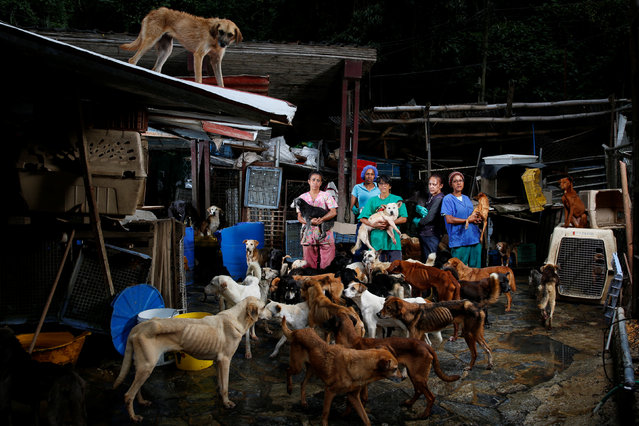
(L-R) Maria Silva, Milena Cortes, Maria Arteaga, Jackeline Bastidas and Gissy Abello pose for a picture at the Famproa dogs shelter where they work, in Los Teques, Venezuela, August 25, 2016. Venezuelans struggling to feed their families let alone their pets are dumping animals on the streets, in parks and at makeshift homes overrun with scrawny animals amid an economic crisis. An hour from Caracas in Los Teques, hundreds of dogs bark and run around the streets scavenging for food outside a makeshift shelter. People come by every few hours to hand over scrawny dogs which are fed by volunteers every day. Venezuela is undergoing a major economic and social crisis, with shortages of basic foods and medicines. Triple digit inflation is hitting everybody hard, including those who own pets. (Photo by Carlos Garcia Rawlins/Reuters)

(L-R) Maria Silva, Milena Cortes, Maria Arteaga, Jackeline Bastidas and Gissy Abello pose for a picture at the Famproa dogs shelter where they work, in Los Teques, Venezuela, August 25, 2016. Venezuelans struggling to feed their families let alone their pets are dumping animals on the streets, in parks and at makeshift homes overrun with scrawny animals amid an economic crisis. An hour from Caracas in Los Teques, hundreds of dogs bark and run around the streets scavenging for food outside a makeshift shelter. (Photo by Carlos Garcia Rawlins/Reuters)
Details
08 Sep 2016 10:01:00
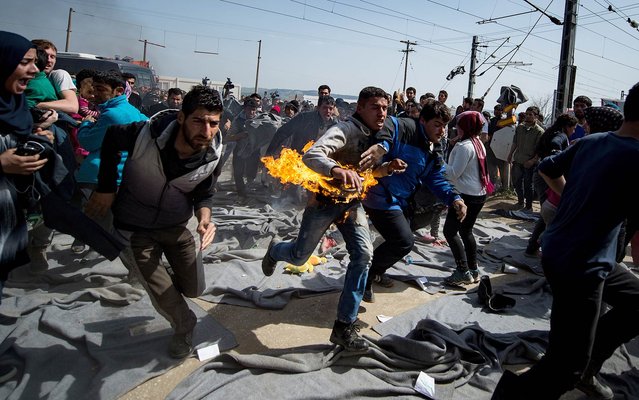
A man runs after he tried to put himself on fire during a protest at a makeshift camp at the Greek-Macedonian border near the village of Idomeni on March 22, 2016. Greece will not be able to start sending refugees back to Turkey from March 20, 2016, the government said, as the country struggles to implement a key deal aimed at easing Europe's migrant crisis. The numbers are daunting: officials said as of Saturday there were 47,500 migrants in Greece, including 8,200 on the islands and 10,500 massed at the Idomeni camp on the Macedonian border. (Photo by Andrej Isakovic/AFP Photo)

A man runs after he tried to put himself on fire during a protest at a makeshift camp at the Greek-Macedonian border near the village of Idomeni on March 22, 2016. Greece will not be able to start sending refugees back to Turkey from March 20, 2016, the government said, as the country struggles to implement a key deal aimed at easing Europe's migrant crisis. The numbers are daunting: officials said as of Saturday there were 47,500 migrants in Greece, including 8,200 on the islands and 10,500 massed at the Idomeni camp on the Macedonian border. (Photo by Andrej Isakovic/AFP Photo)
Details
23 Mar 2016 12:25:00
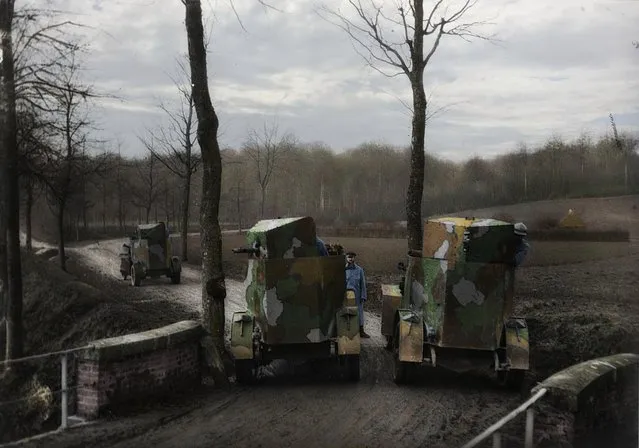
The expertly colourised shots were brought to life by French bank technician, Frédéric Duriez (51). The images were provided by the Valois collection which belongs to the BDIC. “By colourising these photos, I reduce the time that separates us today from this conflict”, said Frédéric. “A black and white photo does not attract the attention of young people, if you colour it, then people will look at it with curiosity. After this, we see the greater the misery and distress of these French fighters”. The total number of casualties in WW1 was more that 38 million. By the end of the war, over eight-million men had been called up to fight in the French army. France suffered 4.2 million casualties during the war with 1.3 million people dead. Here: Car cannon sections in firing position, Auxi-le-Château. (Photo by Frédéric Duriez/BDIC/Mediadrumworld.com)

The expertly colourised shots were brought to life by French bank technician, Frédéric Duriez (51). The images were provided by the Valois collection which belongs to the BDIC. “By colourising these photos, I reduce the time that separates us today from this conflict”, said Frédéric. Here: Car cannon sections in firing position, Auxi-le-Château. (Photo by Frédéric Duriez/BDIC/Mediadrumworld.com)
Details
03 May 2017 08:41:00
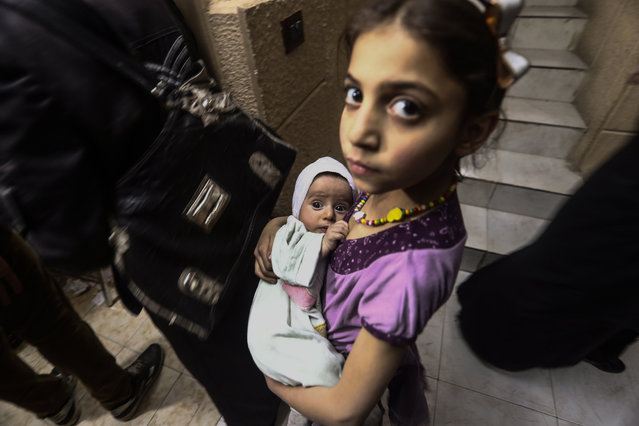
A little girl holding her newborn sister waits for their turn in a queue during a vaccination campaign under the supervision of the Syrian Arab Red Crescent (SARC) humanitarian nonprofit organization, in the besieged Syrian town of Douma, Syria, 23 May 2017. According to a statement from SARC, in the city of Douma some 12,809 children under the age of five were immunized in a vaccination campaign to prevent measles and poliomyelitis. The campaign was the first of its kind with the participation of 100 volunteers. SARC has been delivering vaccines to 17 health centers approved for vaccination campaigns in towns and villages in the Eastern Ghouta area. (Photo by Mohammed Badra/EPA)

A little girl holding her newborn sister waits for their turn in a queue during a vaccination campaign under the supervision of the Syrian Arab Red Crescent (SARC) humanitarian nonprofit organization, in the besieged Syrian town of Douma, Syria, 23 May 2017. According to a statement from SARC, in the city of Douma some 12,809 children under the age of five were immunized in a vaccination campaign to prevent measles and poliomyelitis. The campaign was the first of its kind with the participation of 100 volunteers. SARC has been delivering vaccines to 17 health centers approved for vaccination campaigns in towns and villages in the Eastern Ghouta area. (Photo by Mohammed Badra/EPA)
Details
13 Jun 2017 07:55:00
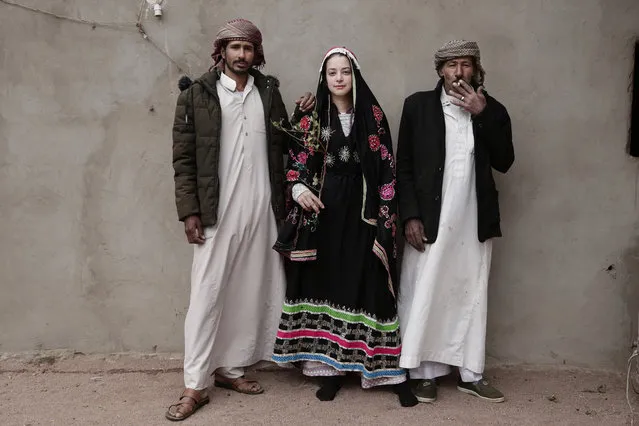
In this March 31, 2019 photo, an Egyptian student borrows a Bedouin wedding dress to pose for a photograph with Bedouin men from the Hamada tribe, in Wadi Sahw, Abu Zenima, in South Sinai, Egypt. Four Bedouin women are for the first time leading tours in Egypt’s Sinai Peninsula, breaking new ground in their deeply conservative community, where women almost never work outside the home or interact with outsiders.  The tourists can only be women, and the tours can’t go overnight. Each day before the sun sets, the group returns to the Hamada’s home village in Wadi Sahu, a narrow desert valley. (Photo by Nariman El-Mofty/AP Photo)

In this March 31, 2019 photo, an Egyptian student borrows a Bedouin wedding dress to pose for a photograph with Bedouin men from the Hamada tribe, in Wadi Sahw, Abu Zenima, in South Sinai, Egypt. Four Bedouin women are for the first time leading tours in Egypt’s Sinai Peninsula, breaking new ground in their deeply conservative community, where women almost never work outside the home or interact with outsiders. The tourists can only be women, and the tours can’t go overnight. Each day before the sun sets, the group returns to the Hamada’s home village in Wadi Sahu, a narrow desert valley. (Photo by Nariman El-Mofty/AP Photo)
Details
11 Apr 2019 00:01:00
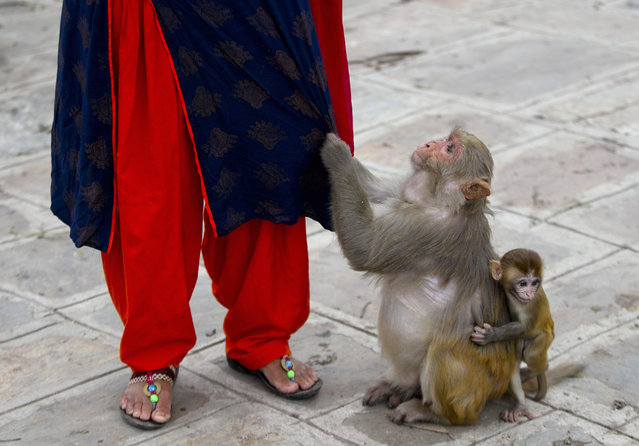
In this July 8, 2019, photo, a monkey pulls on the clothes of Saraswati Dangol as she arrives to feed monkeys in the forest near Pashupatinath temple in Kathmandu, Nepal. For the past four years, Dangol has been bringing the bread every day to feed the monkeys. As soon as they see her with her white sack, they gather around her, some patiently waiting for their turn while others less patiently snatching the bread from her hands. Many of Dangol's regulars are elderly, or are mother or baby monkeys who are unable to fight for their share of food in the wild. (Photo by Niranjan Shrestha/AP Photo)

In this July 8, 2019, photo, a monkey pulls on the clothes of Saraswati Dangol as she arrives to feed monkeys in the forest near Pashupatinath temple in Kathmandu, Nepal. For the past four years, Dangol has been bringing the bread every day to feed the monkeys. As soon as they see her with her white sack, they gather around her, some patiently waiting for their turn while others less patiently snatching the bread from her hands. Many of Dangol's regulars are elderly, or are mother or baby monkeys who are unable to fight for their share of food in the wild. (Photo by Niranjan Shrestha/AP Photo)
Details
26 Jul 2019 00:03:00