Loading...
Done
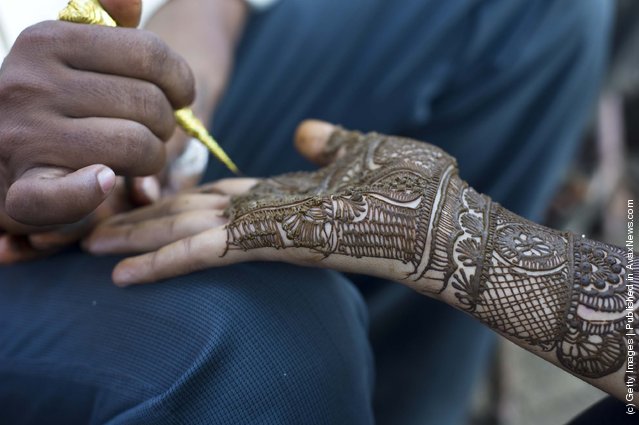
Application of henna or “Mehndi”  to a girls hand in a market in Jaipur, India

“Mehndi or menhdi is the application of henna as a temporary form of skin decoration in India, as well as by expatriate communities from the country. The word mehndi is derived from the Sanskrit word mendhikā. The use of mehndi and turmeric is described in the earliest Vedic ritual books. Haldi (Staining oneself with turmeric paste) as well as mehndi are important Vedic customs as a symbolic representation of the Outer and the Inner Sun. Vedic customs are meant to awaken the “inner light” and so the gold of the inner Sun has an important symbolic function”. – Wikipedia

Photo: Application of henna or “Mehndi” to a girls hand in a market on October 18, 2010 in Jaipur, India. (Photo by Simon de Trey-White/Getty Images)
Details
23 Nov 2011 13:33:00
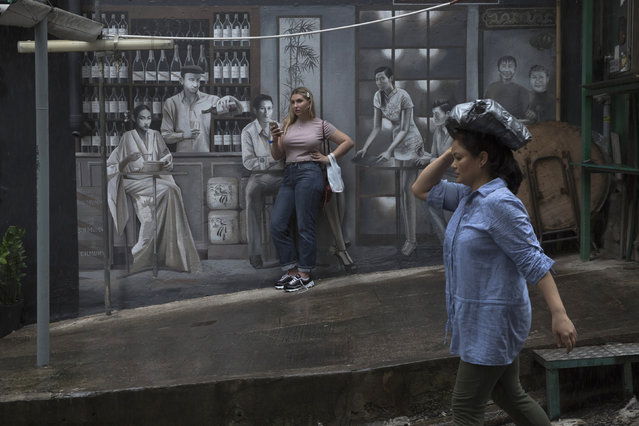
In this June 12, 2017 photo, a woman stands in front of a mural on the slope in Central district, Hong Kong. (Photo by Kin Cheung/AP Photo)

In this June 12, 2017 photo, a woman stands in front of a mural on the slope in Central district, Hong Kong. Once known as Victoria after the British queen, Hong Kong island's waterfront formed the core of the British settlement after Hong Kong island was handed over as a colony in 1842. Today as Hong Kong approaches the 20th anniversary of its return to China, it remains a bustling commercial and financial center as well as the location of the main government offices. However, along the streets that angle sharply upward toward the mountains above, a more relaxed pace of life endures. (AP Photo/Kin Cheung)
Details
28 Jun 2017 08:18:00
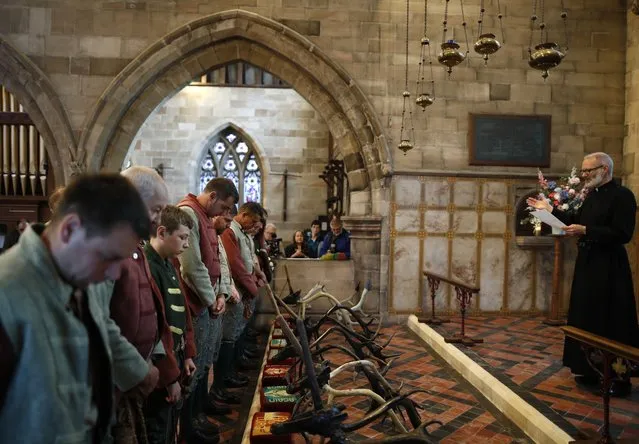
Reverend Simon Davis prays with the dancers before the Abbots Bromley Horn Dance in Abbots Bromley, Britain, September 12, 2016. The Abbots Bromley Horn Dance is an English folk dance dating back to the Middle Ages. The dance takes place each year in Abbots Bromley, a village in Staffordshire, England. The modern version of the dance involves reindeer antlers, a hobby horse, Maid Marian, and a Fool. According to some, the use of antlers suggests an Anglo-Saxon origin along with other native Anglo-Saxon traditions that have survived into modern times in various forms. (Photo by Darren Staples/Reuters)

Reverend Simon Davis prays with the dancers before the Abbots Bromley Horn Dance in Abbots Bromley, Britain, September 12, 2016. The Abbots Bromley Horn Dance is an English folk dance dating back to the Middle Ages. (Photo by Darren Staples/Reuters)
Details
13 Sep 2016 09:36:00
Members of Japan's idol group “Virtual Currency Girls” wearing cryptocurrency-themed masks perform in their debut stage in Tokyo, Japan, January 12, 2018. Japan and South Korea are home to some of the bigger digital exchanges, with investors piling in as growth in bitcoin and other cryptocurrencies soared last year, provoking regulators' concerns. (Photo by Kim Kyung-Hoon/Reuters)

Members of Japan's idol group “Virtual Currency Girls” wearing cryptocurrency-themed masks perform in their debut stage in Tokyo, Japan, January 12, 2018. Japanese female idols have teamed up to form the ‘Virtual Currency Girls’ group to promote the knowledge of cryptocurrencies through entertainment. Each of its 8 members represents a cryptocurrency: bitcoin cash, bitcoin, ether, neo, nem, ripple, mona, and cardano. (Photo by Kim Kyung-Hoon/Reuters)
Details
15 Jan 2018 03:15:00
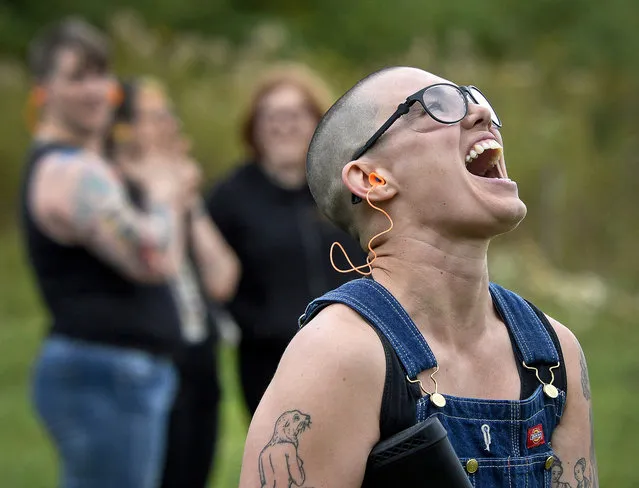
In this October 8, 2017, photo, Emily Lynch reacts to hitting her first clay target during a training session for the Trigger Warning Queer & Trans Gun Club in Victor, N.Y. A gay, lesbian and transgender group concerned that extremists have become more emboldened and dangerous have decided to take up arms. The gun club meets once a month to shoot long guns in a field in upstate New York. (Photo by Adrian Kraus/AP Photo)

In this October 8, 2017, photo, Emily Lynch reacts to hitting her first clay target during a training session for the Trigger Warning Queer & Trans Gun Club in Victor, N.Y. A gay, lesbian and transgender group concerned that extremists have become more emboldened and dangerous have decided to take up arms. The gun club meets once a month to shoot long guns in a field in upstate New York. (Photo by Adrian Kraus/AP Photo)
Details
26 Oct 2017 08:07:00
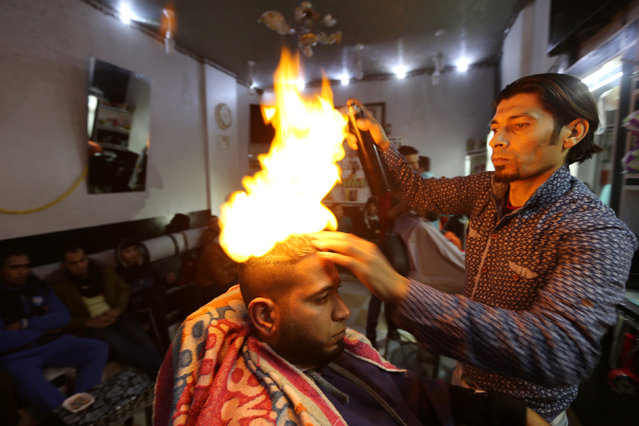
Palestinian barber Ramadan Odwan styles and straightens the hair of a customer with fire at his salon in Rafah, in the southern Gaza Strip February 2, 2017. In Ramadan Odwan's barbershop in Gaza, hair isn't just blow-dried, it's blowtorch-dried. “People have gone crazy about it, many people are curious to go through the experience and they are not afraid”, he told Reuters. “People here love adventures”. Odwan, 37, is not the first stylist in the world to use flame to straighten hair, but his craft is unique in the Gaza Strip. In his salon in the southern Gaza town of Rafah, Odwan applied what he described as a protective liquid coating to a customer's hair – he declined to disclose its contents – before aiming for the head and pressing the button on a small blowtorch. “I control how long I apply fire, I keep it on and off for 10 seconds or 15 seconds. It is completely safe and I have not encountered any accident since I started it two months ago”, Odwan added. Odwan charges 20 shekels ($5.20) for a haircut and fire-straightening. A barber for the past 18 years, he said part of the reason he uses the technique is to show that Palestinian barbers are as “professional as those out there around the world”. (Photo by Ibraheem Abu Mustafa/Reuters)

Palestinian barber Ramadan Odwan styles and straightens the hair of a customer with fire at his salon in Rafah, in the southern Gaza Strip February 2, 2017. In Ramadan Odwan's barbershop in Gaza, hair isn't just blow-dried, it's blowtorch-dried. “People have gone crazy about it, many people are curious to go through the experience and they are not afraid”, he told Reuters. “People here love adventures”. (Photo by Ibraheem Abu Mustafa/Reuters)
Details
11 Feb 2017 00:05:00
Floating on clear deep water and reflections near the cave entrance. Visitors can either bring their own kayaks or rent boats from the local community to paddle deep inside the cave and marvel at its wonders on March 2015 at Tham Khoun Ex, Laos. Tham Khoun Xe, commonly known as the Xe Bang Fai River Cave, in Laos, has over 15km of passages filled with awe-inspiring views and wide expanses of water. (Photo by John Spies/Barcroft Media/ABACAPress)

Floating on clear deep water and reflections near the cave entrance. Visitors can either bring their own kayaks or rent boats from the local community to paddle deep inside the cave and marvel at its wonders on March 2015 at Tham Khoun Ex, Laos. Tham Khoun Xe, commonly known as the Xe Bang Fai River Cave, in Laos, has over 15km of passages filled with awe-inspiring views and wide expanses of water. Photographer, John Spies, 59, captured scenes from the entrances of the huge underground river passages, intricate cave formations and views from a passage high above the water. The cave is formed by the Xe Bang Fai river, a major tributary of the Mekong and in the dry season can be traversed using inflatable kayaks. (Photo by John Spies/Barcroft Media/ABACAPress)
Details
11 Apr 2015 09:56:00
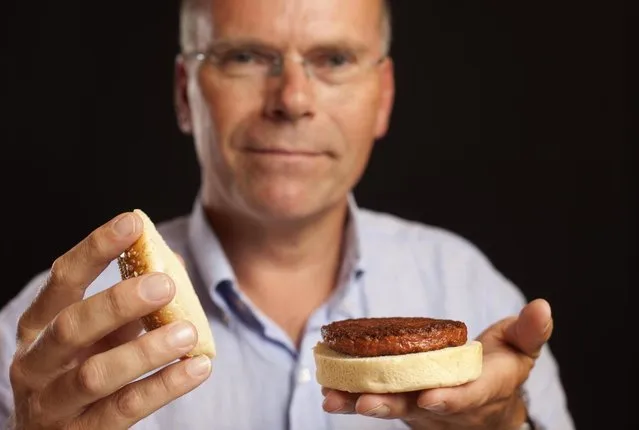
In this handout image provided by Ogilvy, a burger made from cultured beef, which has been developed by Professor Mark Post of Maastricht University in the Netherlands (pictured) is shown to the media during a press conference on August 5, 2013 in London, England. Cultured Beef could help solve the coming food crisis and combat climate change with commercial production of Cultured Beef beginning within ten to twenty years. (Photo by David Parry via Getty Images)

In this handout image provided by Ogilvy, a burger made from cultured beef, which has been developed by Professor Mark Post of Maastricht University in the Netherlands (pictured) is shown to the media during a press conference on August 5, 2013 in London, England. The in-vitro burger, cultured from cattle stem cells, the first example of what its creator says could provide an answer to global food shortages and help combat climate change, was fried in a pan and tasted by two volunteers. The burger is the result of years of research by Dutch scientist Mark Post, a vascular biologist at the University of Maastricht, who is working to show how meat grown in petri dishes might one day be a true alternative to meat from livestock.The meat in the burger has been made by knitting together around 20,000 strands of protein that has been cultured from cattle stem cells in Post's lab. (Photo by David Parry)
Details
06 Aug 2013 08:48:00