Loading...
Done
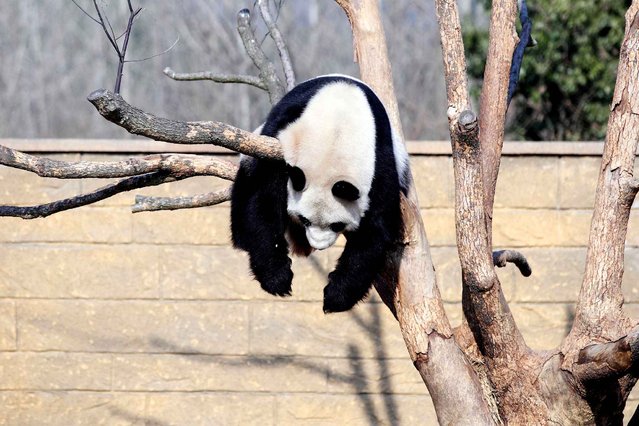
This picture taken on January 1, 2014 shows giant panda “Li Li” sleeping on a tree in Hangzhou Wild Animal World in Hangzhou, east China's Zhejiang province. Giant pandas, notorious for their low s*x drive, are among the world's most endangered animals. Fewer than 1,600 pandas remain in the wild, mainly in China's Sichuan province, with a further 300 in captivity around the world. (Photo by AFP Photo)

This picture taken on January 1, 2014 shows giant panda “Li Li” sleeping on a tree in Hangzhou Wild Animal World in Hangzhou, east China's Zhejiang province. Giant pandas, notorious for their low s*x drive, are among the world's most endangered animals. Fewer than 1,600 pandas remain in the wild, mainly in China's Sichuan province, with a further 300 in captivity around the world. (Photo by AFP Photo)
Details
04 Jan 2014 14:58:00
Russian artist Maria Gazanova (L) works on her "The Alive Painting" art work during the Art Krasnoyarsk annual festival in Siberian city of Krasnoyarsk, Russia November 4, 2015. (Photo by Ilya Naymushin/Reuters)

Russian artist Maria Gazanova (L) works on her "The Alive Painting" art work during the Art Krasnoyarsk annual festival in Siberian city of Krasnoyarsk, Russia November 4, 2015. (Photo by Ilya Naymushin/Reuters)
Details
06 Nov 2015 15:07:00
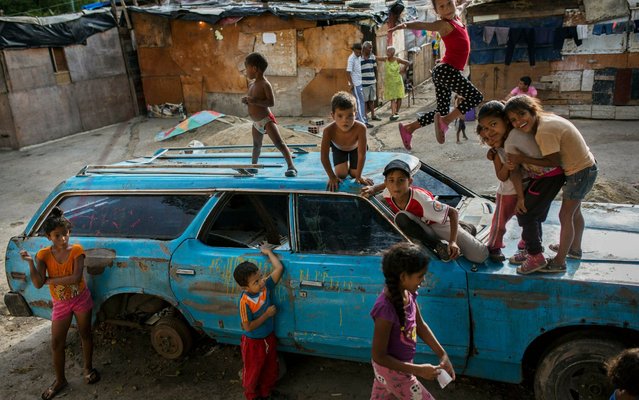
Children play on top of an abandoned car at the “Aguerridos Liberator” shanty town in Caracas, Venezuela, Thursday, May 9, 2019. (Photo by Rodrigo Abd/AP Photo)

Children play on top of an abandoned car at the “Aguerridos Liberator” shanty town in Caracas, Venezuela, Thursday, May 9, 2019. (Photo by Rodrigo Abd/AP Photo)
Details
28 May 2019 00:05:00
In this Wednesday, May 23, 2012 photograph, a young deer and a cat share a moment in Feench village near Jodhpur, Rajasthan state, India

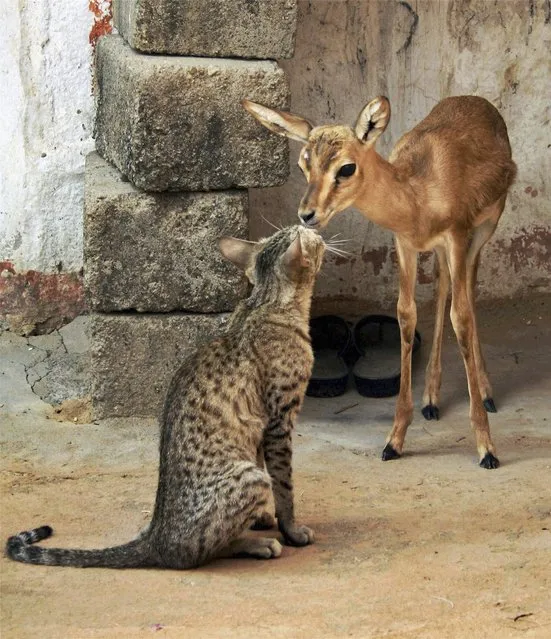
In this Wednesday, May 23, 2012 photograph, a young deer and a cat share a moment in Feench village near Jodhpur, Rajasthan state, India. (Photo by AP Photo)
Details
16 Jun 2012 11:07:00
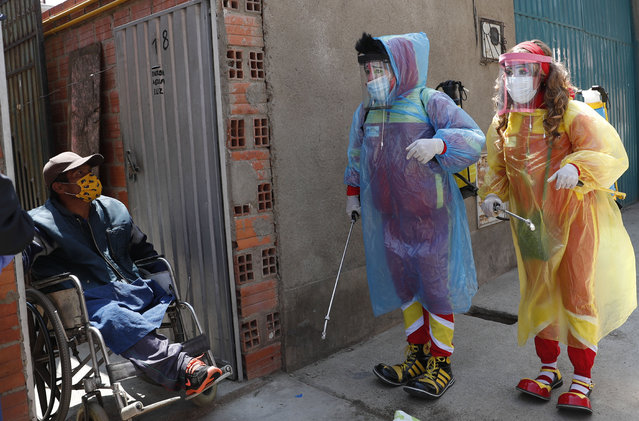
Clowns Perlita and Tapetito, wearing protective gear amid the new coronavirus pandemic, speak with resident Enrique Zeballos as they arrive to disinfect his home free of charge, in El Alto, Bolivia, Friday, September 11, 2020. The lack of traditional employment for the clowns due to the pandemic has led them towards other avenues of making money. But for people with limited income they provide their disinfection services free of charge. (Photo by Juan Karita/AP Photo)

Clowns Perlita and Tapetito, wearing protective gear amid the new coronavirus pandemic, speak with resident Enrique Zeballos as they arrive to disinfect his home free of charge, in El Alto, Bolivia, Friday, September 11, 2020. The lack of traditional employment for the clowns due to the pandemic has led them towards other avenues of making money. But for people with limited income they provide their disinfection services free of charge. (Photo by Juan Karita/AP Photo)
Details
13 Sep 2020 00:07:00
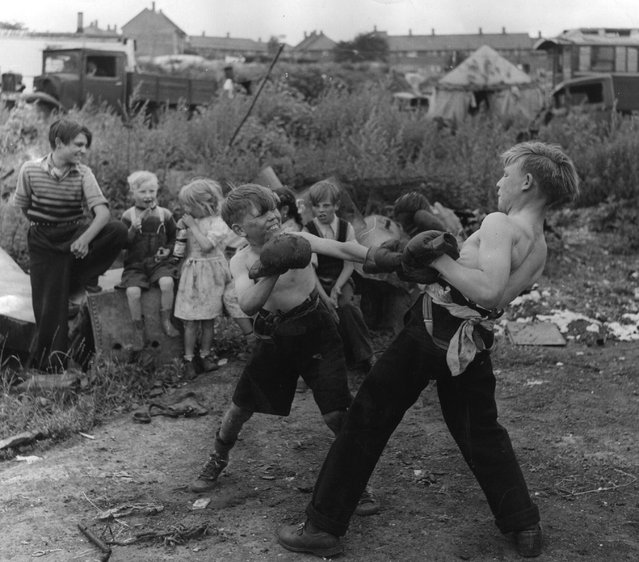
The unromantic gypsies. Children boxing in a gypsy camp in Kent, England on July 1, 1951. Like all boys these gypsy lads like to try their hand at boxing. Encouraged by their friends they fight it out on Corke's Meadow. Few Romanies now live a life of wandering romance. Most are like the three hundred squatters of Corke's Meadow, Kent, which is part of a “gypsy problem” that involves about 100,000 today. Of those about 25,000 can be rightly called gypsies, the rest are Mumpers and Posh-rats and Hobos. Corke's Meadow has both kinds. “Picture Post” cameraman Bert Hardy photographs the Corke's Meadow gypsies in their encampment. (Photo by Hulton-Deutsch Collection/Corbis via Getty Images)

The unromantic gypsies. Children boxing in a gypsy camp in Kent, England on July 1, 1951. Like all boys these gypsy lads like to try their hand at boxing. Encouraged by their friends they fight it out on Corke's Meadow. Few Romanies now live a life of wandering romance. Most are like the three hundred squatters of Corke's Meadow, Kent, which is part of a “gypsy problem” that involves about 100,000 today. Of those about 25,000 can be rightly called gypsies, the rest are Mumpers and Posh-rats and Hobos. Corke's Meadow has both kinds. “Picture Post” cameraman Bert Hardy photographs the Corke's Meadow gypsies in their encampment. (Photo by Hulton-Deutsch Collection/Corbis via Getty Images)
Details
12 Mar 2017 00:01:00
Freshmen in Zhengzhou Institute of Aeronautical Industry Management head bottles of mineral water for upright stand during military training on September 17, 2015 in Zhengzhou, Henan Province of China. More than 6,800 freshmen in the school are required to take part in the military training. (Photo by ChinaFotoPress/ChinaFotoPress via Getty Images)

Freshmen in Zhengzhou Institute of Aeronautical Industry Management head bottles of mineral water for upright stand during military training on September 17, 2015 in Zhengzhou, Henan Province of China. More than 6,800 freshmen in the school are required to take part in the military training. (Photo by ChinaFotoPress/ChinaFotoPress via Getty Images)
Details
02 Oct 2015 08:02:00
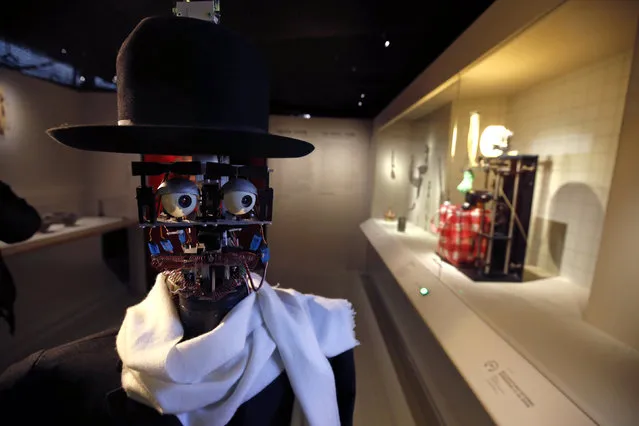
The Berenson robot strolls among visitors during the exhibition “Persona : Oddly Human” at the Quai Branly museum in Paris, France, February 23, 2016. The Berenson robot, developed in France in 2011, is the brainchild of anthropologist Denis Vidal and robotics engineer Philippe Gaussier. Its programming allows it to record reactions of museum visitors to certain pieces of art and then use the data to develop its own unique taste, which allows “Berenson” to judge whether or not it likes a certain work of art within an exhibition. (Photo by Philippe Wojazer/Reuters)

The Berenson robot strolls among visitors during the exhibition “Persona : Oddly Human” at the Quai Branly museum in Paris, France, February 23, 2016. The Berenson robot, developed in France in 2011, is the brainchild of anthropologist Denis Vidal and robotics engineer Philippe Gaussier. Its programming allows it to record reactions of museum visitors to certain pieces of art and then use the data to develop its own unique taste, which allows “Berenson” to judge whether or not it likes a certain work of art within an exhibition. (Photo by Philippe Wojazer/Reuters)
Details
25 Feb 2016 12:26:00