Loading...
Done
A girl of the Amazonian Tatuyo tribe poses while waiting to sell crafts to tourists in her village in the Rio Negro (Black River) near Manaus city, a World Cup host city, June 23, 2014. Because of their proximity to host city Manaus and their warm welcome, the Tatuyo have enjoyed three weeks of brisk business thanks to the World Cup. Usually, they host between 10 and 30 tourists a day. During the World Cup, this number has rocketed to 250 a day, They have become richer and other communities now come to them to sell them juices and fishes. (Photo by Andres Stapff/Reuters)

A girl of the Amazonian Tatuyo tribe poses while waiting to sell crafts to tourists in her village in the Rio Negro (Black River) near Manaus city, a World Cup host city, June 23, 2014. Because of their proximity to host city Manaus and their warm welcome, the Tatuyo have enjoyed three weeks of brisk business thanks to the World Cup. Usually, they host between 10 and 30 tourists a day. During the World Cup, this number has rocketed to 250 a day, They have become richer and other communities now come to them to sell them juices and fishes. (Photo by Andres Stapff/Reuters)
Details
27 Jun 2014 10:30:00
Serbian police officers of the Special Anti-Terrorist Unit pose for a picture in their base outside Belgrade October 8, 2014. (Photo by Marko Djurica/Reuters)

Serbian police officers of the Special Anti-Terrorist Unit pose for a picture in their base outside Belgrade October 8, 2014. When the killing of an unarmed black teenager by a white policeman in Ferguson, Missouri, in August sparked sometimes violent protests, the response of police in camouflage gear and armoured vehicles wielding stun grenades and assault rifles seemed more like a combat operation than a public order measure. Some U.S. police departments have recently acquired U.S. military-surplus hardware from wars abroad, but there are many law enforcers around the world whose rules of engagement also allow the use of lethal force with relatively few restrictions. But for every regulation that gives police wide scope to use firearms, there is another code that sharply limits their use. In Serbia, police may use measures ranging from batons to special vehicles, water cannon and tear gas on groups of people who have gathered illegally and are behaving in a way that is violent or could cause violence, but they may use firearms only when life is endangered. (Photo by Marko Djurica/Reuters)
Details
27 Nov 2014 14:53:00
A giant Santa Claus, created and worn by local artist Ed Terrell, 66, walks home with his son and assistant, Rupanuga, 18, following a ceremony to decorate a scraggly Christmas tree with a single red Bulb in Reading, Pennsylvania, December 7, 2014. A ceremony to decorate the scraggly Christmas tree in Reading, Pennsylvania with a single red bulb, much like Charlie Brown's tree in the animated holiday classic, was postponed to Sunday from Saturday because of rain and cold temperatures, officials said. (Photo by Mark Makela/Reuters)

A giant Santa Claus, created and worn by local artist Ed Terrell, 66, walks home with his son and assistant, Rupanuga, 18, following a ceremony to decorate a scraggly Christmas tree with a single red Bulb in Reading, Pennsylvania, December 7, 2014. A ceremony to decorate the scraggly Christmas tree in Reading, Pennsylvania with a single red bulb, much like Charlie Brown's tree in the animated holiday classic, was postponed to Sunday from Saturday because of rain and cold temperatures, officials said. Officials decided to hold a re-dedication ceremony, which will include a Spanish and English reading from the movie's screenplay, and decorate it with a single red bulb, as in the 1965 animated television special, “A Charlie Brown Christmas”. (Photo by Mark Makela/Reuters)
Details
13 Dec 2014 12:05:00
Michael Grant, 28, “Philly Jesus”, carries a 12 foot cross 8 miles through this blighted area of North Philadelphia towards LOVE Park in Center City as part of a Christmas walk to spread the true message of the holiday in Philadelphia, Pennsylvania December 20, 2014. As many as a half dozen others joined him for numerous miles as he trekked southward down Broad Street.  Some shouted “Praise Jesus!” and “Thank you for doing this!” at the sight. (Photo by Mark Makela/Reuters)

Michael Grant, 28, “Philly Jesus”, carries a 12 foot cross 8 miles through this blighted area of North Philadelphia towards LOVE Park in Center City as part of a Christmas walk to spread the true message of the holiday in Philadelphia, Pennsylvania December 20, 2014. As many as a half dozen others joined him for numerous miles as he trekked southward down Broad Street. Some shouted “Praise Jesus!” and “Thank you for doing this!” at the sight. Nearly everyday for the last 8 months, Grant has dressed as Jesus Christ, and walked the streets of Philadelphia to share the Christian gospel by example. He quickly acquired the nickname of “Philly Jesus”, which he has gone by ever since. (Photo by Mark Makela/Reuters)
Details
24 Dec 2014 14:13:00
Life in lockdown: Schoolteacher Marzio Toniolo, 35, takes a picture of his two-year-old daughter Bianca painting his toenails as they while away time at home in San Fiorano, one of the original “red zone” towns in northern Italy that has now been extended to the whole country, as his wife, Bianca's mum Chiara Zuddas looks out from their balcony, March 20, 2020. Toniolo has been documenting how his family has dealt with being under quarantine since it began for them in February. (Photo by Marzio Toniolo via Reuters)

Life in lockdown: Schoolteacher Marzio Toniolo, 35, takes a picture of his two-year-old daughter Bianca painting his toenails as they while away time at home in San Fiorano, one of the original “red zone” towns in northern Italy that has now been extended to the whole country, as his wife, Bianca's mum Chiara Zuddas looks out from their balcony, March 20, 2020. Toniolo has been documenting how his family has dealt with being under quarantine since it began for them in February. (Photo by Marzio Toniolo via Reuters)
Details
09 Apr 2020 00:03:00
Mayu adjusts Koiku’s kimono, as Koiku wears a protective face mask while posing for a photograph, before they work at a party where they will entertain with other geisha at Japanese luxury restaurant Asada in Tokyo, Japan, June 23, 2020. The coronavirus pandemic has made Tokyo's geisha fear for their centuries-old profession as never before. Though the number of geisha - famed for their witty conversation, beauty and skill at traditional arts - has been falling for years, they were without work for months due to Japan's state of emergency and now operate under awkward social distancing rules. Engagements are down 95 percent, and come with new rules: no pouring drinks for customers or touching them even to shake hands, and sitting 2 meters apart. Masks are hard to wear with their elaborate wigs, so they mostly don't. “I was just full of anxiety”, said Mayu, 47. “I went through my photos, sorted my kimonos ... The thought of a second wave is terrifying”. (Photo by Kim Kyung-Hoon/Reuters)

Mayu adjusts Koiku’s kimono, as Koiku wears a protective face mask while posing for a photograph, before they work at a party where they will entertain with other geisha at Japanese luxury restaurant Asada in Tokyo, Japan, June 23, 2020. (Photo by Kim Kyung-Hoon/Reuters)
Details
23 Jul 2020 00:03:00
People release floating lanterns during the festival of Yee Peng in the northern capital of Chiang Mai, Thailand November 14, 2016. Yi Peng refers to the full moon day in the second month according to the Lanna lunar calendar (the twelfth month according to the Thai lunar calendar). Swarms of Lanna-style sky lanterns are launched into the air where they resemble large shoals of giant fluorescent jellyfish gracefully floating through the sky. The festival is meant as a time for tham bun, to make merit. Khom loi are made from a thin fabric, such as rice paper, stretched over a bamboo or wire frame, to which a candle or fuel cell is attached. When the fuel cell is lit, the resulting hot air is trapped inside the lantern and creates enough lift for the khom loi to float up into the sky. (Photo by Athit Perawongmetha/Reuters)

People release floating lanterns during the festival of Yee Peng in the northern capital of Chiang Mai, Thailand November 14, 2016. Yi Peng refers to the full moon day in the second month according to the Lanna lunar calendar (the twelfth month according to the Thai lunar calendar). Swarms of Lanna-style sky lanterns are launched into the air where they resemble large shoals of giant fluorescent jellyfish gracefully floating through the sky. The festival is meant as a time for tham bun, to make merit. Khom loi are made from a thin fabric, such as rice paper, stretched over a bamboo or wire frame, to which a candle or fuel cell is attached. When the fuel cell is lit, the resulting hot air is trapped inside the lantern and creates enough lift for the khom loi to float up into the sky. (Photo by Athit Perawongmetha/Reuters)
Details
15 Nov 2016 11:54:00
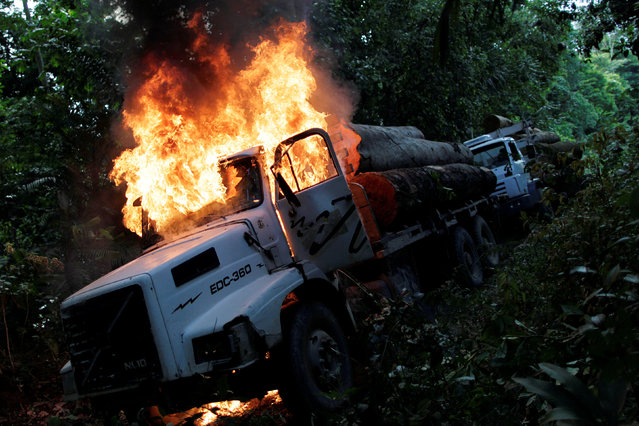
Trucks loaded with tree trunks are burned by agents of the Brazilian Institute for the Environment and Renewable Natural Resources, or Ibama, during an operation to combat illegal mining and logging, in the municipality of Novo Progresso, Para State, northern Brazil, November 11, 2016. When able to do their job, agents of the Brazilian Institute for the Environment and Renewable Natural Resources, or Ibama, are decisive, punishing illegal loggers on the spot. Nearly twice the size of India, the Amazon absorbs an estimated 2 billion tonnes of carbon dioxide per year, making its preservation vital in the fight to halt global warming. Ibama, responsible for preserving Brazil's 65 percent share of the world's largest rainforest, is one of the most important groups in that fight. But after years of surprising success, the rate of deforestation is on the rise again. Over the past four years it has risen 35 percent, as Ibama suffered from a lack of funding amid Brazil's worst recession in a century. (Photo by Ueslei Marcelino/Reuters)

Trucks loaded with tree trunks are burned by agents of the Brazilian Institute for the Environment and Renewable Natural Resources, or Ibama, during an operation to combat illegal mining and logging, in the municipality of Novo Progresso, Para State, northern Brazil, November 11, 2016. When able to do their job, agents of the Brazilian Institute for the Environment and Renewable Natural Resources, or Ibama, are decisive, punishing illegal loggers on the spot. Nearly twice the size of India, the Amazon absorbs an estimated 2 billion tonnes of carbon dioxide per year, making its preservation vital in the fight to halt global warming. (Photo by Ueslei Marcelino/Reuters)
Details
30 Nov 2016 12:36:00