Loading...
Done
Photographers: David Doubilet

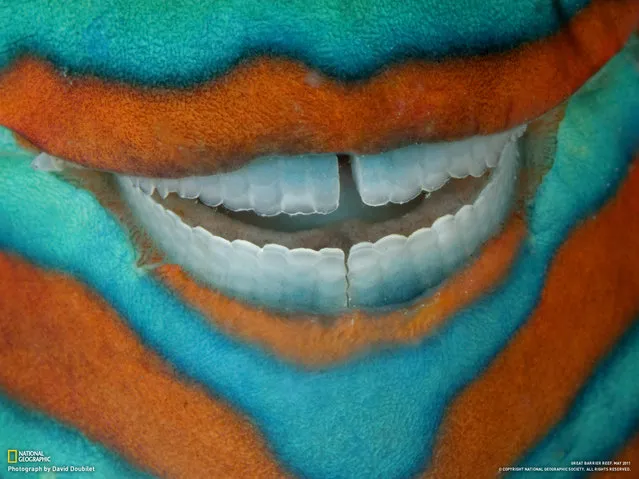
“David Doubilet (born 28 November 1946) is a well known underwater photographer known primarily for his work published in National Geographic Magazine. He was born in New York and started taking photos underwater at the young age of 12. He started with a Brownie Hawkeye in a rubber anesthesiologist's bag to keep the water out of the camera. During his summer holidays, he spent his time along the New Jersey coast. He later worked as a diver and photographer for the Sandy Hook Marine Laboratories in New Jersey. He also spent much time in the Caribbean. While a dive instructor in the Bahamas he found his motivation to capture the beauty of the sea and everything in it”. – Wikipedia. (Photo by David Doubilet/National Geographic)
Details
16 May 2012 12:21:00
The vendors show the toy of snake at the Spring Festival Temple Fair for celebrating Chinese Lunar New Year of Snake at the Temple of Earth park on February 9, 2013 in Beijing, China. The Chinese Lunar New Year of Snake also known as the Spring Festival, which is based on the Lunisolar Chinese calendar, is celebrated from the first day of the first month of the lunar year and ends with Lantern Festival on the Fifteenth day.  (Photo by Feng Li)

The vendors show the toy of snake at the Spring Festival Temple Fair for celebrating Chinese Lunar New Year of Snake at the Temple of Earth park on February 9, 2013 in Beijing, China. The Chinese Lunar New Year of Snake also known as the Spring Festival, which is based on the Lunisolar Chinese calendar, is celebrated from the first day of the first month of the lunar year and ends with Lantern Festival on the Fifteenth day. (Photo by Feng Li)
Details
10 Feb 2013 13:03:00
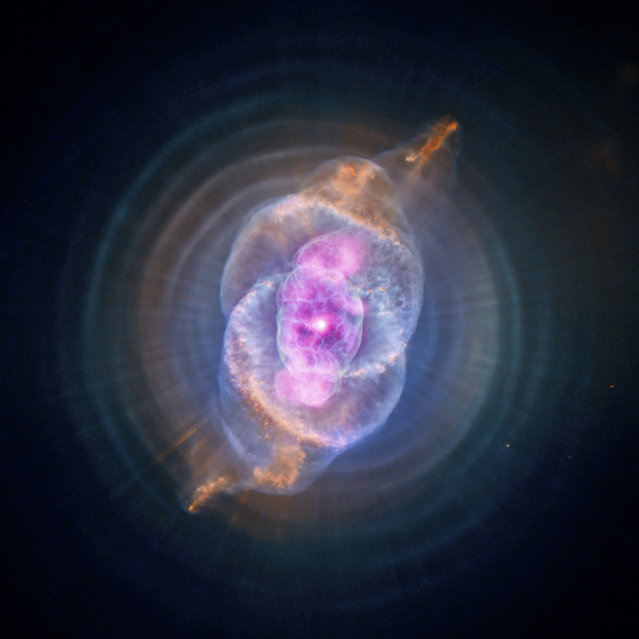
This image is NGC 6543 known as the Cat's Eye Nebula as it appears to the Chandra X-Ray Observatory and Hubble Telescope. A planetary nebula is a phase of stellar evolution that the sun should experience several billion years from now, when it expands to become a red giant and then sheds most of its outer layers, leaving behind a hot core that contracts to form a dense white dwarf star. This image was released October 10, 2012. (Photo by J. Kastner/NASA/CXC/RIT)

This image is NGC 6543 known as the Cat's Eye Nebula as it appears to the Chandra X-Ray Observatory and Hubble Telescope. A planetary nebula is a phase of stellar evolution that the sun should experience several billion years from now, when it expands to become a red giant and then sheds most of its outer layers, leaving behind a hot core that contracts to form a dense white dwarf star. This image was released October 10, 2012. (Photo by J. Kastner/NASA/CXC/RIT)
Details
15 Apr 2013 10:09:00
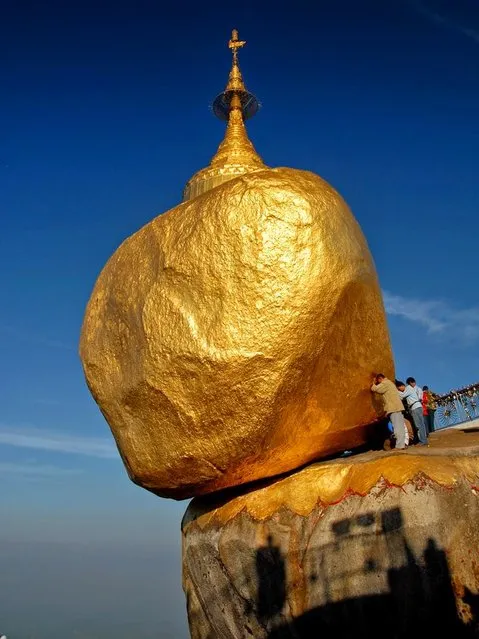
 Kyaiktiyo Pagoda AKA  Golden Rock In Burma

Kyaiktiyo Pagoda, also known as Golden Rock is a well-known Buddhist pilgrimage site in Mon State, Burma. It is a small pagoda (7.3 metres (24 ft)) built on the top of a granite boulder covered with gold leaves pasted on by devotees. According to legend, the Golden Rock itself is precariously perched on a strand of the Buddha's hair. The balancing rock seems to defy gravity, as it perpetually appears to be on the verge of rolling down the hill. The rock and the pagoda are at the top of Mt. Kyaiktiyo. It is the third most important Buddhist pilgrimage site in Burma after the Shwedagon Pagoda and the Mahamuni Pagoda. A glimpse of the "gravity defying" Golden Rock is believed to be enough of an inspiration for any person to turn to Buddhism.
Details
04 Jun 2015 11:42:00
In this June 29, 2015 photo, forlorn buildings are seen at Hashima Island, commonly known as Gunkanjima, which means “Battleship Island”, off Nagasaki, Nagasaki Prefecture, southern Japan. (Photo by Eugene Hoshiko/AP Photo)

In this June 29, 2015 photo, forlorn buildings are seen at Hashima Island, commonly known as Gunkanjima, which means “Battleship Island”, off Nagasaki, Nagasaki Prefecture, southern Japan. The island is one of 23 old industrial facilities seeking UNESCO's recognition as world heritage “Sites of Japan's Meiji Industrial Revolution” meant to illustrate Japan's rapid transformation from a feudal farming society into an industrial power at the end of the 19th century. UNESCO's World Heritage Committee is expected to approve the proposal during a meeting being held in Bonn, Germany, through July 9. (Photo by Eugene Hoshiko/AP Photo)
Details
01 Jul 2015 13:41:00
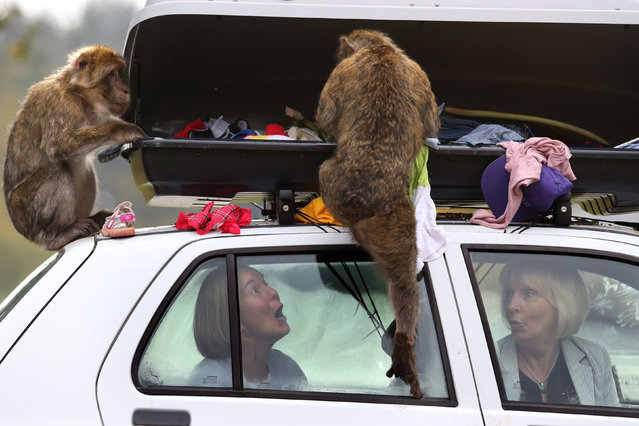
Sasha Muir and Margaret Davidson sit in a car as some of the 30 barbary macaques, known as the Middle Hill Troop after living between the top of Gibraltar rock and the town, show what happens when motorists forget to lock their luggage compartments, as Scotland’s only monkey drive-through section opens at Blair Drummond safari park in Stirling, Scotland on October 8, 2015. (Photo by Andrew Milligan/PA Wire)

Sasha Muir and Margaret Davidson sit in a car as some of the 30 barbary macaques, known as the Middle Hill Troop after living between the top of Gibraltar rock and the town, show what happens when motorists forget to lock their luggage compartments, as Scotland’s only monkey drive-through section opens at Blair Drummond safari park in Stirling, Scotland on October 8, 2015. (Photo by Andrew Milligan/PA Wire)
Details
13 Oct 2015 08:03:00
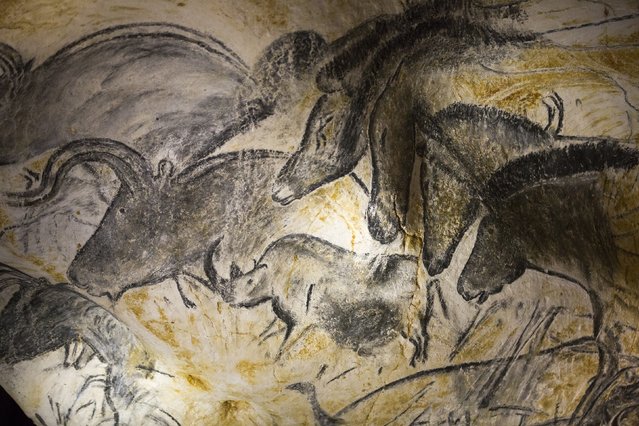
A replica of pre-historic drawings showing horses, rhinoceros and aurochs is seen on a wall during a press visit at the site of the Cavern of Pont-d'Arc project in Vallon Pont d'Arc April 8, 2015. (Photo by Robert Pratta/Reuters)

A replica of pre-historic drawings showing horses, rhinoceros and aurochs is seen on a wall during a press visit at the site of the Cavern of Pont-d'Arc project in Vallon Pont d'Arc April 8, 2015. The Cavern of Pont-d'Arc project is a replica of the pre-historic Decorated Cave of Pont-d'Arc known as Grotte Chauvet, in Vallon Pont-d'Arc in the Ardeche region, containing the world's earliest known art which was recently named a UNESCO World Heritage site. The facsimile cavern, which condenses some 8000m² of the original site into 3000m², will display faithful reproductions of paintings and engravings and will be inaugurated on April 10 and will open to the public on April 25. (Photo by Robert Pratta/Reuters)
Details
09 Apr 2015 14:23:00
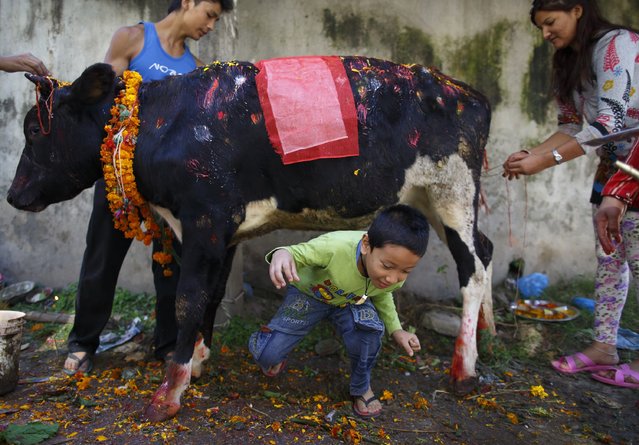
A boy crawls under a cow during a religious ceremony celebrating the Tihar festival, also called Diwali, in Kathmandu, October 23, 2014. Hindus all over Nepal are celebrating the festival during which they worship cows, which are considered a maternal figure, and other animals. Also known as the festival of lights, devotees worship the goddess of wealth Laxmi by illuminating and decorating their homes using garlands, oil lamps, candles and colourful light bulbs. (Photo by Navesh Chitrakar/Reuters)

A boy crawls under a cow during a religious ceremony celebrating the Tihar festival, also called Diwali, in Kathmandu, October 23, 2014. Hindus all over Nepal are celebrating the festival during which they worship cows, which are considered a maternal figure, and other animals. Also known as the festival of lights, devotees worship the goddess of wealth Laxmi by illuminating and decorating their homes using garlands, oil lamps, candles and colourful light bulbs. (Photo by Navesh Chitrakar/Reuters)
Details
25 Oct 2014 13:23:00