Loading...
Done
US President Donald J. Trump holds a roundtable meeting with Hispanic leaders in the cabinet room before signing an Executive Order in the Rose Garden of the White House in Washington, DC, USA, on 09 July 2020. (Photo by Samuel Corum/EPA/EFE/Pool)

US President Donald J. Trump holds a roundtable meeting with Hispanic leaders in the cabinet room before signing an Executive Order in the Rose Garden of the White House in Washington, DC, USA, on 09 July 2020. (Photo by Samuel Corum/EPA/EFE/Pool)
Details
18 Jul 2020 00:05:00
Mayu adjusts Koiku’s kimono, as Koiku wears a protective face mask while posing for a photograph, before they work at a party where they will entertain with other geisha at Japanese luxury restaurant Asada in Tokyo, Japan, June 23, 2020. The coronavirus pandemic has made Tokyo's geisha fear for their centuries-old profession as never before. Though the number of geisha - famed for their witty conversation, beauty and skill at traditional arts - has been falling for years, they were without work for months due to Japan's state of emergency and now operate under awkward social distancing rules. Engagements are down 95 percent, and come with new rules: no pouring drinks for customers or touching them even to shake hands, and sitting 2 meters apart. Masks are hard to wear with their elaborate wigs, so they mostly don't. “I was just full of anxiety”, said Mayu, 47. “I went through my photos, sorted my kimonos ... The thought of a second wave is terrifying”. (Photo by Kim Kyung-Hoon/Reuters)

Mayu adjusts Koiku’s kimono, as Koiku wears a protective face mask while posing for a photograph, before they work at a party where they will entertain with other geisha at Japanese luxury restaurant Asada in Tokyo, Japan, June 23, 2020. (Photo by Kim Kyung-Hoon/Reuters)
Details
23 Jul 2020 00:03:00
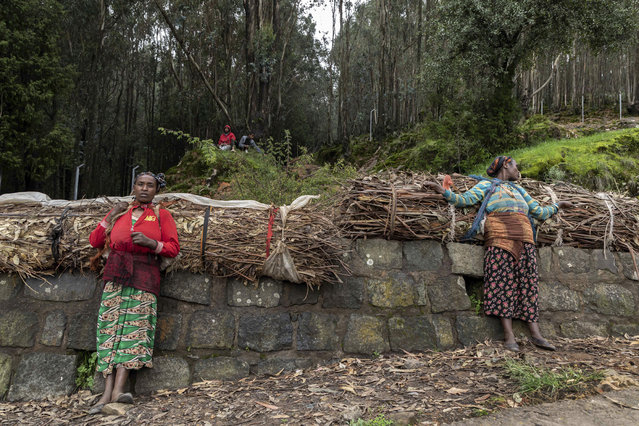
Mare Sorie, left, and her friend Tsehaynesh Golja, right, take a rest as they carry bundles of firewood from the forest around Entoto mountain near Addis Ababa, Ethiopia Friday, July 17, 2020. (Photo by Mulugeta Ayene/AP Photo)

Mare Sorie, left, and her friend Tsehaynesh Golja, right, take a rest as they carry bundles of firewood from the forest around Entoto mountain near Addis Ababa, Ethiopia Friday, July 17, 2020. (Photo by Mulugeta Ayene/AP Photo)
Details
03 Aug 2020 00:03:00
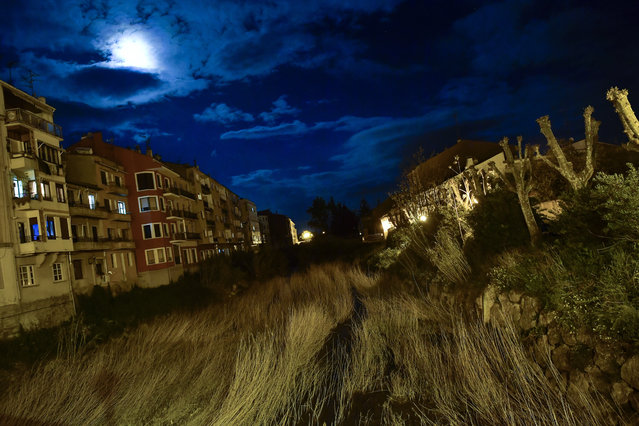
A moon light illuminates the sky through the clouds over a large line of grass between some home houses in the small village of Tafalla, northern Spain, Tuesday, May 1, 2018. (Photo by Alvaro Barrientos/AP Photo)

A moon light illuminates the sky through the clouds over a large line of grass between some home houses in the small village of Tafalla, northern Spain, Tuesday, May 1, 2018. (Photo by Alvaro Barrientos/AP Photo)
Details
25 Sep 2018 00:05:00
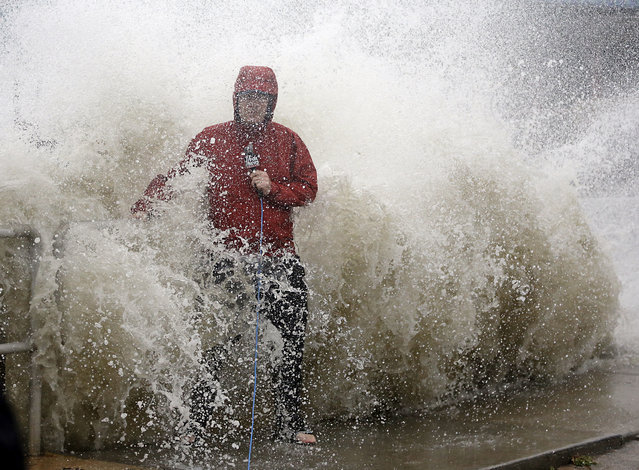
A news reporter doing a stand up near a sea wall in Cedar Key, Fla., is covered by an unexpected wave as Hurricane Hermine nears the Florida coast, Thursday, September 1, 2016. Hurricane Hermine gained new strength Thursday evening and roared ever closer to Florida's Gulf Coast, where rough surf began smashing against docks and boathouses and people braced for the first direct hit on the state from a hurricane in over a decade. (Photo by John Raoux/AP Photo)

A news reporter doing a stand up near a sea wall in Cedar Key, Fla., is covered by an unexpected wave as Hurricane Hermine nears the Florida coast, Thursday, September 1, 2016. Hurricane Hermine gained new strength Thursday evening and roared ever closer to Florida's Gulf Coast, where rough surf began smashing against docks and boathouses and people braced for the first direct hit on the state from a hurricane in over a decade. (Photo by John Raoux/AP Photo)
Details
02 Sep 2016 13:17:00
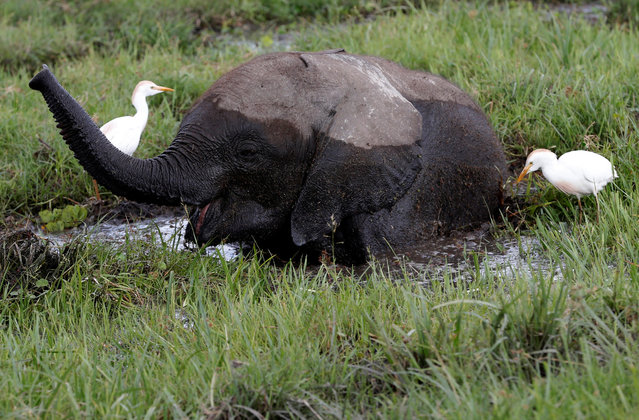
A baby elephant eats in a swamp in Amboseli national park, Kenya, March 19, 2017. (Photo by Goran Tomasevic/Reuters)

A baby elephant eats in a swamp in Amboseli national park, Kenya, March 19, 2017. (Photo by Goran Tomasevic/Reuters)
Details
26 Mar 2017 08:35:00
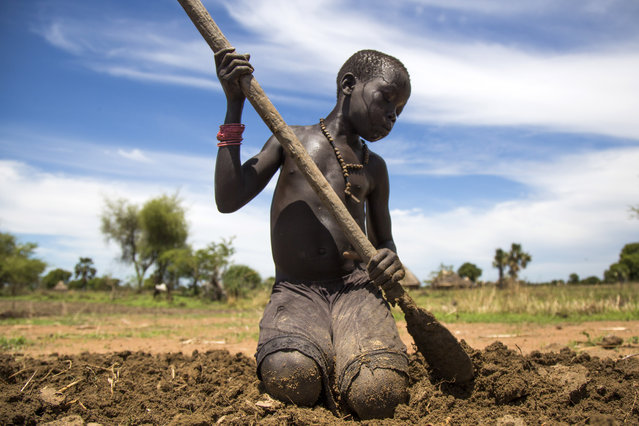
Nyibol Lual, 13 years old, helps her family to prepare the land for cultivation on May 31, 2017, in Panthau, Northern Bahr al Ghazal, South Sudan. The family has a small land where they cultivate sorghum. An estimated 63 per cent of the population in Northern Bahr al Ghazal is experiencing severe food insecurity, according to the latest Integrated Food Security Phase Classification (IPC) report. The situation is particularly bad in Aweil West and Aweil South counties, where the exhaustion of household food stocks and growing dependence on financially inaccessible markets have left the population facing Emergency levels of food insecurity. (Photo by Albert Gonzalez Farran/AFP Photo)


Nyibol Lual, 13 years old, helps her family to prepare the land for cultivation on May 31, 2017, in Panthau, Northern Bahr al Ghazal, South Sudan. The family has a small land where they cultivate sorghum. An estimated 63 per cent of the population in Northern Bahr al Ghazal is experiencing severe food insecurity, according to the latest Integrated Food Security Phase Classification (IPC) report. The situation is particularly bad in Aweil West and Aweil South counties, where the exhaustion of household food stocks and growing dependence on financially inaccessible markets have left the population facing Emergency levels of food insecurity. (Photo by Albert Gonzalez Farran/AFP Photo)

Details
01 Jun 2017 10:10:00
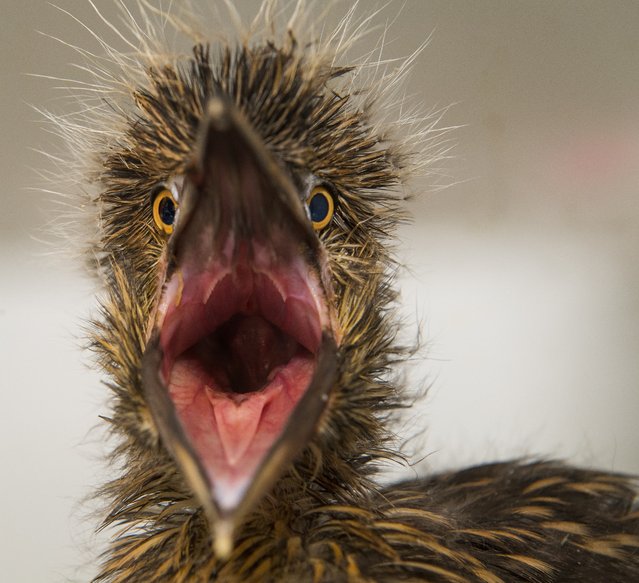
A baby Black-crowned Night Heron squawks in its incubator while being cared for at City Wildlife rescue and rehabilitation center in Washington, DC on May 31, 2017. The heron is one of several that have been brought to CW by the staff at The National Zoo over the past few years. The heron is a native bird and has made an established rookery inside the zoo grounds over a hundred years ago.  Every year at this time, some of the chicks get pushed or fall out of the nest and require human care.  Because the birds are native and not part of the Smithsonian collection, they partnered with CW to rehabilitate the herons for re-release back to the flock inside Zoo. They're reintroduced back to their flock so that they can migrate together in the Fall. The Black-crowned heron usually migrates from the DC area down to southeast North Carolina, some going as far as Jacksonville, FL in winter. The Black-crowned heron is the species of greatest conservation need in the District of Columbia because their numbers are in such rapid decline due to habitat loss. (Photo Linda Davidson/The Washington Post)

A baby Black-crowned Night Heron squawks in its incubator while being cared for at City Wildlife rescue and rehabilitation center in Washington, DC on May 31, 2017. The heron is one of several that have been brought to CW by the staff at The National Zoo over the past few years. (Photo Linda Davidson/The Washington Post)
Details
04 Jun 2017 08:04:00