Loading...
Done
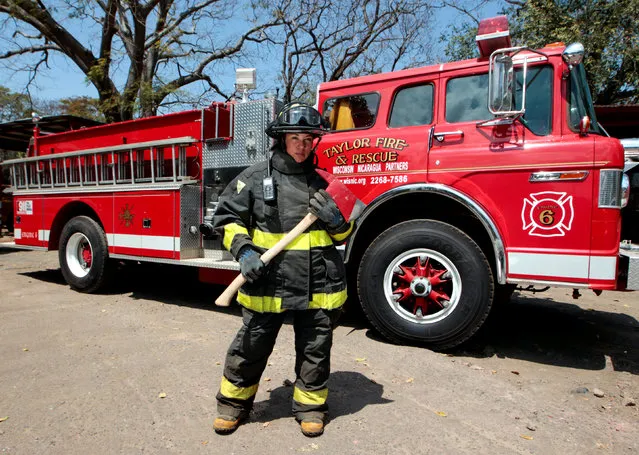
Yolaina Chavez Talavera, 31, a firefighter, poses for a photograph in front of a truck at a fire station in Managua, Nicaragua, February 22, 2017. “In my early days as a female firefighter, men, my team mates, thought that I would not last long in the organisation due to the hard training. However, in practice I showed them that I am able to take on tasks at the same level as men. I think women must fight to break through in all areas, in the midst of the machismo that still persists in Nicaragua and in Hispanic countries”, Talavera said. (Photo by Oswaldo Rivas/Reuters)

Wednesday March 8 marks International Women's Day, with festivals, concerts and exhibitions among the numerous events planned around the world to celebrate the achievements of women in society. The annual event has been held since the early 1900s and traditionally promotes a different theme each year, with this year's edition calling on people to #BeBoldForChange and push for a more gender-inclusive working world. Reuters photographers have been speaking with women in a range of professions around the world about their experiences of gender inequality. Here: Yolaina Chavez Talavera, 31, a firefighter, poses for a photograph in front of a truck at a fire station in Managua, Nicaragua, February 22, 2017. (Photo by Oswaldo Rivas/Reuters)
Details
04 Mar 2017 00:06:00
Underwater pictures show the 23-year-old diver cosying up to a range of animals. (Photo by Amelia Klonaris/Mediadrumworld)

Dublin student beat depression by befriending sharks, stingrays and pigs in the Bahamas. Awesome underwater pictures show the 23-year-old diver cosying up to a range of animals including turtles, stingray and sharks. The sunny selfies were taken in the Bahamas by Stuart’s Cove dive instructor and native of the island, Amelia Klonaris – who beat depression by embracing her incredible beach paradise lifestyle. (Photo by Amelia Klonaris/Mediadrumworld)
Details
01 Jul 2017 07:38:00
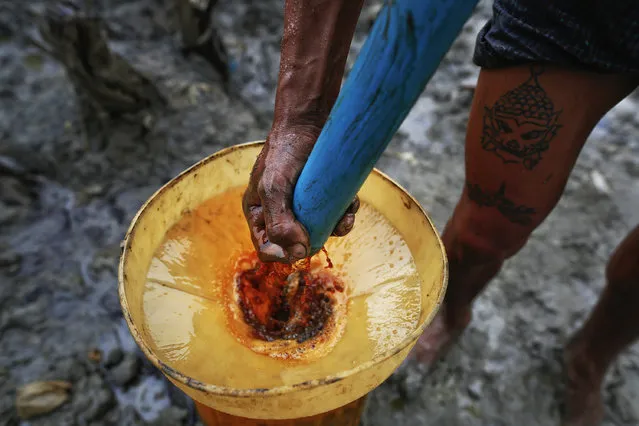
Ko Min, 26, manually extracts oil from one of three 300 feet deep wells he works on in the Minhla township of the Magwe district October 27, 2013. Everyday, Ko Min makes around $30 extracting crude oil from three small wells after he bought rights to use them for close to $1000 from a farmer who owns the land. (Photo by Damir Sagolj/Reuters)

Ko Min, 26, manually extracts oil from one of three 300 feet deep wells he works on in the Minhla township of the Magwe district October 27, 2013. Everyday, Ko Min makes around $30 extracting crude oil from three small wells after he bought rights to use them for close to $1000 from a farmer who owns the land. In Myanmar, an impoverished country rich with natural resources, people from poor communities find ways to supplement their income by exploiting such resources, such as the Minhla township, traditionally rich with oil, often using primitive and dangerous methods. (Photo by Damir Sagolj/Reuters)
Details
21 Apr 2014 10:06:00
In this Friday, January 9, 2015 photo, bathhouse worker Omid Riahi, 39, scrubs a man to remove dead skin, at the Ghebleh public bathhouse, in Tehran, Iran. The steamy air and curved tiled walls of Iran's famed public bathhouses, some rinsing and massaging patrons for hundreds of years, slowly may wash away as interest in them wanes. (Photo by Ebrahim Noroozi/AP Photo)

In this Friday, January 9, 2015 photo, bathhouse worker Omid Riahi, 39, scrubs a man to remove dead skin, at the Ghebleh public bathhouse, in Tehran, Iran. The steamy air and curved tiled walls of Iran's famed public bathhouses, some rinsing and massaging patrons for hundreds of years, slowly may wash away as interest in them wanes. The bathhouses, known as “hammams” in Persian, find themselves in rough financial times as modern conveniences now allow showers and baths in most homes across the Islamic Republic. (Photo by Ebrahim Noroozi/AP Photo)
Details
03 Apr 2015 12:40:00
A view of traditional bolinhos de bacalhau (fried codfish balls) in Rio de Janeiro, Brazil, May 7, 2016. (Photo by Sergio Moraes/Reuters)

If the most popular foods of Rio de Janeiro have one thing in common, it is their informality. You can find fine restaurants in the city, but they do not set Rio apart from other places. What does set it apart, and what invariably brings its residents, known as "Cariocas," together is the unpretentious food they eat in bright, loud, crowded bars and restaurants, on busy street corners, or after a day at the beach. Here: A view of traditional bolinhos de bacalhau (fried codfish balls) in Rio de Janeiro, Brazil, May 7, 2016. (Photo by Sergio Moraes/Reuters)
Details
05 Aug 2016 13:20:00
We're getting some feedback: “Hi, I have a question. Why is it that 90% of your posts are about women? You don't seem to acknowledge the existence of men unless they were migrants. You're seriously telling me that you can't find a few great accomplishments that MEN are making?? If this is a feminist website I think you should make that public. I've been viewing your posts since 2010 I think, since you first created avaxnews. Now I'm seriously considering blocking you guys”.


And we can reply: We like women more and for that humbly beg for your forgiveness. In general you are right. We promise to rectify the situation somehow.
Details
17 Sep 2018 17:53:00
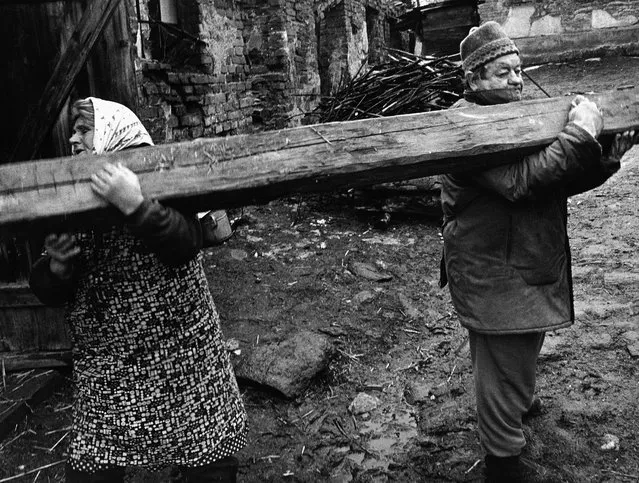
A love story with two log choppers. “In 1993, I was working on a project about life in the Olomouc region of Czechoslovakia. One day, I came to the village of Dlouhá Loučka-Křivá and went into a courtyard where I saw two old people, a husband and wife, sawing firewood for winter. They were working quietly, concentrating. I watched them fetch a beam from a wrecked barn, but they didn’t discuss how they planned to carry it to the saw. The woman faced one way, the man the other. When they realised, the woman eventually turned and followed her husband. The picture I took is the picture of many relationships – when each partner wants something different, but they have to come to an agreement, pull together eventually”. (Photo by Jindrich Streit)

A love story with two log choppers. “In 1993, I was working on a project about life in the Olomouc region of Czechoslovakia. One day, I came to the village of Dlouhá Loučka-Křivá and went into a courtyard where I saw two old people, a husband and wife, sawing firewood for winter. They were working quietly, concentrating. I watched them fetch a beam from a wrecked barn, but they didn’t discuss how they planned to carry it to the saw. The woman faced one way, the man the other. When they realised, the woman eventually turned and followed her husband. The picture I took is the picture of many relationships – when each partner wants something different, but they have to come to an agreement, pull together eventually”. (Photo by Jindrich Streit)
Details
04 Aug 2016 12:34:00
Camp director and “duck walk” inventor Rodin Gilbert Flores, 2nd R) teaches aspiring beauty queens how to “duck walk” at a beauty boot camp in Manila in this picture taken on March 8, 2015. From wading in muddy Philippine rice paddies, former housemaid Janicel Lubina now struts down runways for the country's top designers, and is poised to be crowned among the world's most beautiful. (Photo by Noel Celis/AFP Photo)

Camp director and “duck walk” inventor (Rodin Gilbert Flores, 2nd R) teaches aspiring beauty queens how to “duck walk” at a beauty boot camp in Manila in this picture taken on March 8, 2015. From wading in muddy Philippine rice paddies, former housemaid Janicel Lubina now struts down runways for the country's top designers, and is poised to be crowned among the world's most beautiful. Lubina is a star recruit in one of Manila's beauty pageant boot camps, where shy, lanky teenage girls from remote farming provinces are transformed into poised Barbie dolls who can preach about world peace in six-inch heels. (Photo by Noel Celis/AFP Photo)
Details
15 Mar 2015 06:51:00