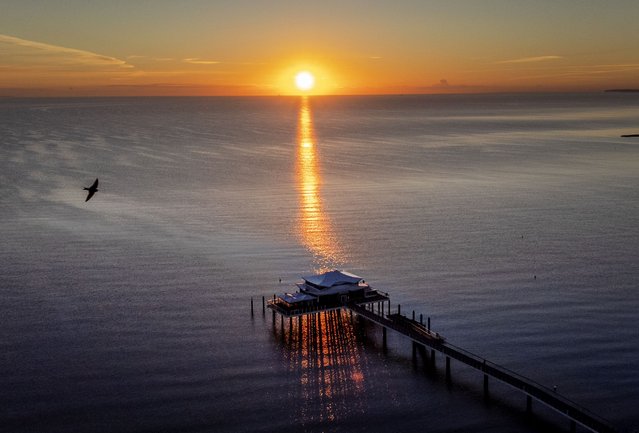
The sun rises over the Baltic Sea and a pier with a tea house in Timmendorfer Strand, Germany, Sunday, August 7, 2022. (Photo by Michael Probst/AP Photo)
Polish artist Agnieszka Pilat poses with the artwork of her robot painting dogs – Basia Spot and Bunny Spot – who have become artists painting on canvases with their paws, at the launch of the National Gallery of Victoria (NGV) Triennial 2023 in Melbourne on April 5, 2023. Pilat works with the Boston Dynamics dogs, training them to paint autonomously through AI technology individually and collaboratively, and will be part of more than 100 local and international artists, designers and collectives presenting at the exhibition opening in December. (Photo by William West/AFP Photo)
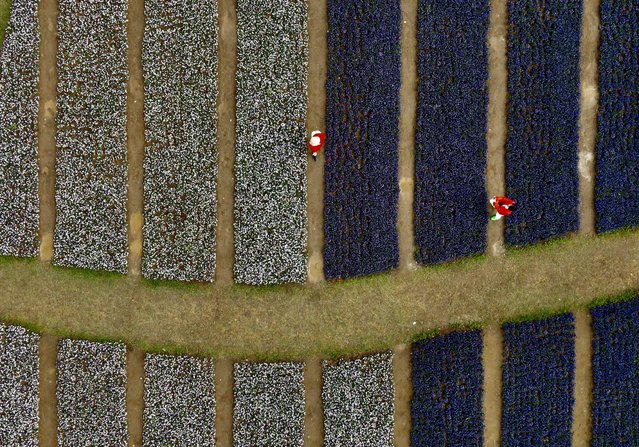
An aerial view of the figure of a Catrina skull made with 18,000 Cempasuchil flowers (Mexican marigold) is on display at the Church of Santa Prisca as part of Day of the Dead celebrations, in Taxco, Mexico on October 27, 2021. (Photo by Daniel Cardenas/Anadolu Agency via Getty Images)
A Hercules beetle, one of the largest species of its kind, in seen at the Monteverde Cloud Forest Biological Reserve, in Puntarenas, Costa Rica, on May 23, 2023. In the Monteverde cloud forest, dense fog among the lush vegetation is increasingly rare and temperatures are increasing each year due to climate change. (Photo by Ezequiel Becerra/AFP Photo)
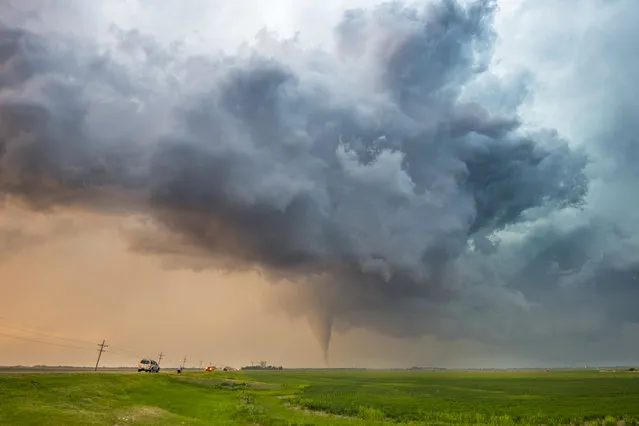
“The Sunsetter”. An EF-4 tornado rips through the open space of farmland near Rozel, Kansas. This tornado moves slowly but powerful towards the setting sun an gets its beautiful color right before sunset. Storm Chasers are spotting on the left side. Photo location: Rozel, Kansas. (Photo and caption by Dennis Oswald/National Geographic Photo Contest)
ATTENTION! All pictures are presented in high resolution. To see Hi-Res images – just TWICE click on any picture. In other words, click small picture – opens the BIG picture. Click BIG picture – opens VERY BIG picture.
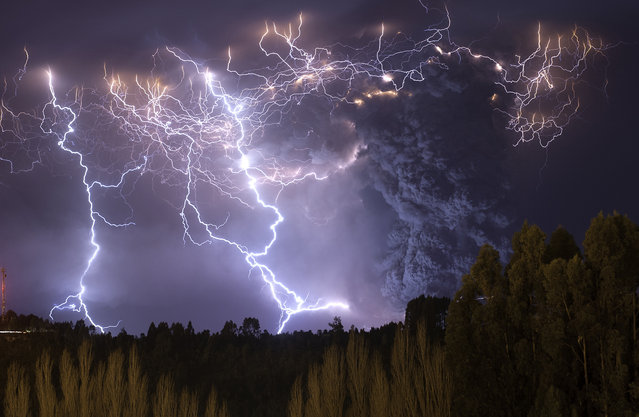
The eruption of Cordon Caulle began on June 4, 2011, located in the Region of Los Rios in Chile. For about 12 months, people and animals became accustomed to living with the daily fall of ash, which also caused problems in the air traffic in South America. The explosions and lightning during first days of the eruption could be seen from hundreds of miles around. This photograph was taken on the second night of eruption from the town of Lago Ranco. (Photo and caption by Francisco Negroni/National Geographic Traveler Photo Contest)
ATTENTION! All pictures are presented in high resolution. To see Hi-Res images – just TWICE click on any picture. In other words, click small picture – opens the BIG picture. Click BIG picture – opens VERY BIG picture.