Loading...
Done


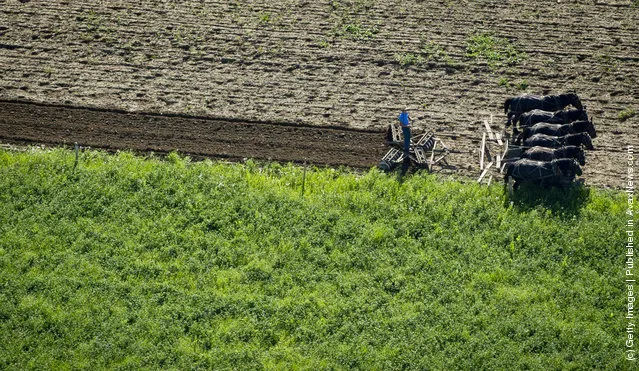
“The Amish, sometimes referred to as Amish Mennonites, are a group of Christian church fellowships that form a subgroup of the Mennonite churches. The Amish are known for simple living, plain dress, and reluctance to adopt many conveniences of modern technology”. – Wikipedia

Photo: An Amish farmer plows his field behind six draft horses June 2, 2011 in New Wilmington, southwestern Pennsylvania. (Photo by Jeff Swensen/Getty Images)
Details
03 Jun 2011 07:25:00
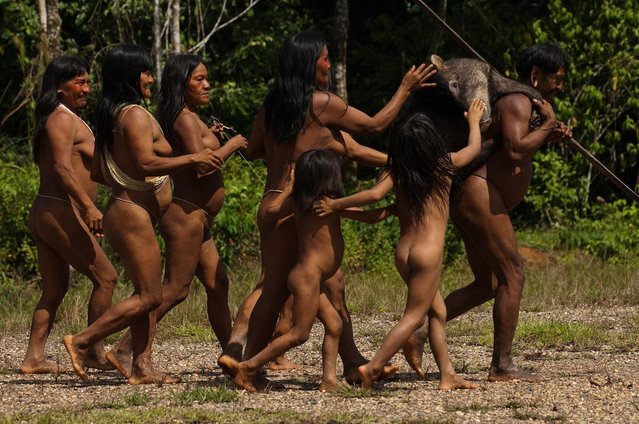
Spectacular images offering insight into the lives of the Huaorani people in the Ecuadorian Amazon have been revealed showing how they use traditional methods to hunt monkeys for food. The stunning pictures were taken by conservation photographer Pete Oxford from Torquay, Devon in the Ecuadorian Amazon. “The Huaorani Indians are a forest people highly in tune with their environment. Many are now totally acculturated since the 1950s by missionaries”, said Pete. “Today they face radical change to their culture to the proximity of oil exploration within their territory and the Yasuni National Park and Biosphere Reserve, they are vastly changed. Some still live very traditionally and for this shoot, through my Huaorani friend, a direct relative of those photographed he wanted to depict them as close to their original culture as possible. They still largely hunt with blow pipes and spears eating a lot of monkeys and peccaries”. The Huaorani are also known as the Waorani, Waodani or the Waos and are native Amerindians. Their lands are located between the Curaray and Napo rivers and speak the Huaorani language. Pete says that during his visit he was welcomed into the group and hopes that ancient cultures can be saved. Here: The tribe were seen celebrating after a hunter returned to camp with a wild pig. (Photo by Pete Oxford/Mediadrumworld.com)

Spectacular images offering insight into the lives of the Huaorani people in the Ecuadorian Amazon have been revealed showing how they use traditional methods to hunt monkeys for food. The stunning pictures were taken by conservation photographer Pete Oxford from Torquay, Devon in the Ecuadorian Amazon. Here: The tribe were seen celebrating after a hunter returned to camp with a wild pig. (Photo by Pete Oxford/Mediadrumworld.com)
Details
20 Jan 2017 07:58:00
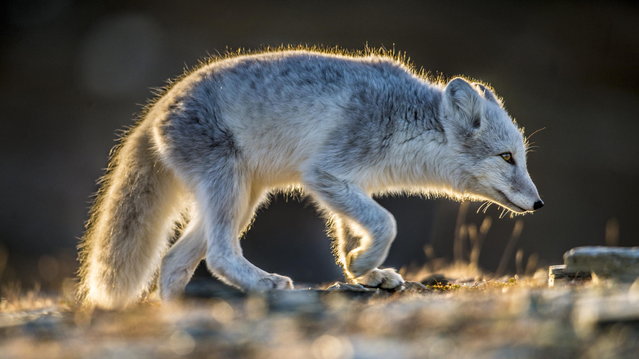
Arctic Fox. (Photo by Trond Eriksen)

“The arctic fox (Vulpes lagopus), also known as the white fox, polar fox, or snow fox, is a small fox native to the Arctic regions of the Northern Hemisphere and is common throughout the Arctic tundra biome. It is well adapted to living in cold environments. It has a deep thick fur which is brown in summer and white in winter. It averages in size at about 85.3 cm (33.6 in) in body length, with a generally rounded body shape to minimize the escape of body heat. – Wikipedia. (Photo by Trond Eriksen)
Details
26 May 2014 14:09:00
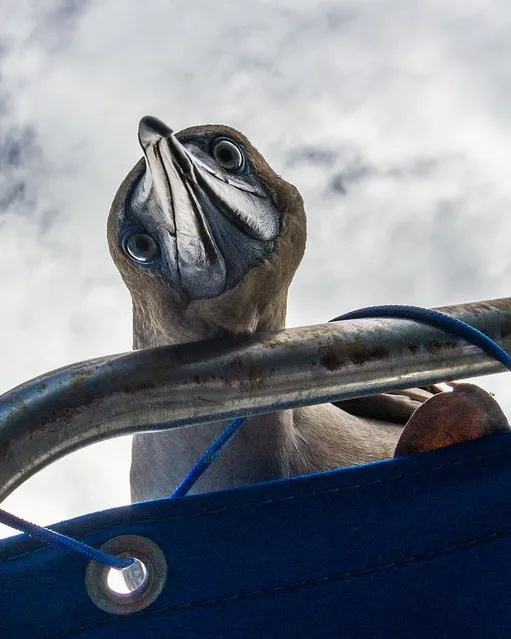
“Close-up. We had a juvenile Red-Footed Booby come visit us on the sun deck. I got some closeups with my ultrawide 11-16mm Tokina”. (Photo by Carl Fredrickson)

Situated in the Pacific Ocean some 620 miles (1,000 km) from the South American continent, these 19 islands and the surrounding marine reserve have been called a unique “living museum and showcase of evolution”. Photo: “Close-up. We had a juvenile Red-Footed Booby come visit us on the sun deck. I got some closeups with my ultrawide 11-16mm Tokina”. (Photo by Carl Fredrickson)
Details
04 Sep 2013 11:49:00
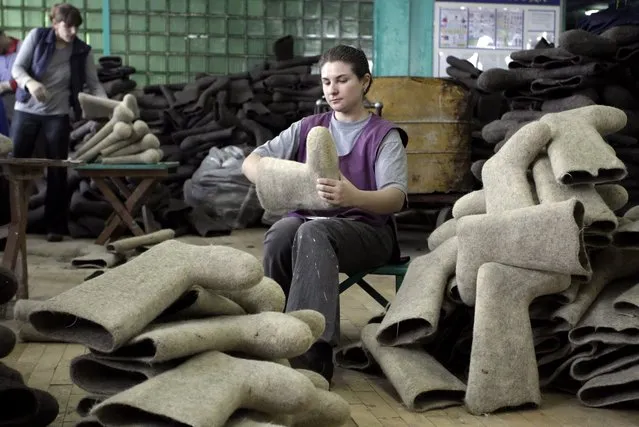
Belarusian workers works at a felt boot factory in Smilovichi, some 35km from Minsk, Belarus, 16 January 2012. (Photo by Tatyana Zenkovich/EPA)

The Smilovichi Felting Factory in Belarus was founded in 1928, when Smilovichi was a small Jewish settlement of craftsmen. Five of those craftsmen organized a small artel (a cooperative association of craftsmen who all live and work together), which produced warm boots called “valenki” for cold weather. Photo: Belarusian workers works at a felt boot factory in Smilovichi, some 35km from Minsk, Belarus, 16 January 2012. (Photo by Tatyana Zenkovich/EPA)
Details
18 Oct 2013 10:02:00
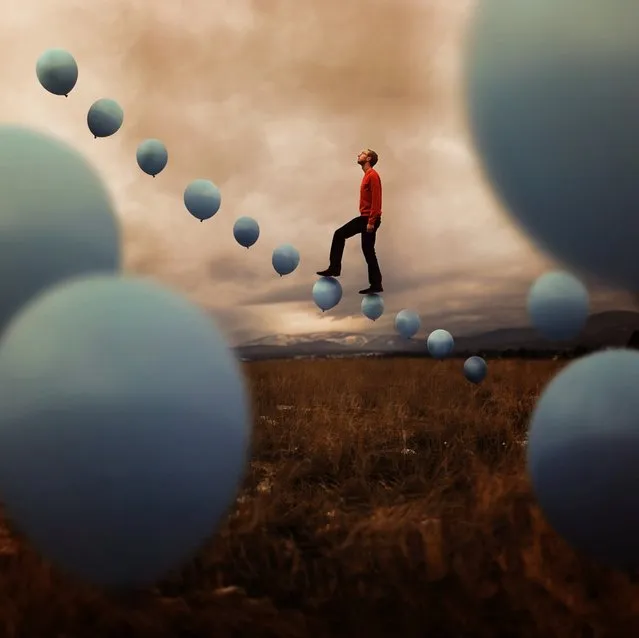
Photographers: Joel Robison Part2

“Hi! I'm Joel, I live in a valley in British Columbia's Rocky Mountains, as close to the forest as I could possibly be! I love to run, bike, jump, eat and create and I hope that you enjoy my work as much as I enjoy creating it!” – Joel Robison. (Photo by: Joel Robison; Source: Flickr)


See Also:Photographers: Joel Robison Part1
Details
01 Nov 2013 10:40:00
“Cold Feet” Project by Photographer Davide Luciano

“Animals take on human characteristics in this photo series by Davide Luciano. Davide’s goal was to achieve personification of these animals’ body parts without the use of motion. Using photography’s ability to manipulate time, Davide presents a snippet of these creature “active” lives by photographing a process, thus creating the illusion of life in these lifeless animal limbs. Recreating the uncomfortable into quizzical and whimsical photos that are bold, colorful, and always comical and satirical”. (Photos and caption by Davide Luciano)
Details
12 Mar 2014 12:08:00
Vandenberg Project by Andreas Franke

“24.27 N, 81.44 W. These coordinates mark the spot of the final resting place of an old brave soldier, the USS General Hoyt S. Vandenberg. In 2009 it underwent a complete change when the creaky steel monster became a mystical bearer of secrets. In May of that year, the Vandenberg was lowered down into the darkness of the ocean off the coast of Florida to become an artificial reef, where it would dwell in rigor mortis at a depth of 130 feet. This lively, animate, secretive nothingness, this menacing, wild emptiness would haunt and seduce the renowned Austrian photographer and passionate diver Andreas Franke...”. – The Sinking World (Photo by Andreas Franke)
Details
07 Apr 2013 09:50:00