Loading...
Done
Sixty-eight year old cross-country runner Rosie Swale-Pope is interviewed while sitting in her cart, “The Icebird”, in Upperville, Virginia March 13, 2015. Swale-Pope, who is from Great Britain and once ran an unsupported 20,000 mile run around the globe,  is currently running across the United States from New York City to San Francisco in support of cancer research. (Photo by Gary Cameron/Reuters)

Sixty-eight year old cross-country runner Rosie Swale-Pope is interviewed while sitting in her cart, “The Icebird”, in Upperville, Virginia March 13, 2015. Swale-Pope, who is from Great Britain and once ran an unsupported 20,000 mile run around the globe, is currently running across the United States from New York City to San Francisco in support of cancer research. (Photo by Gary Cameron/Reuters)
Details
18 Mar 2015 11:05:00
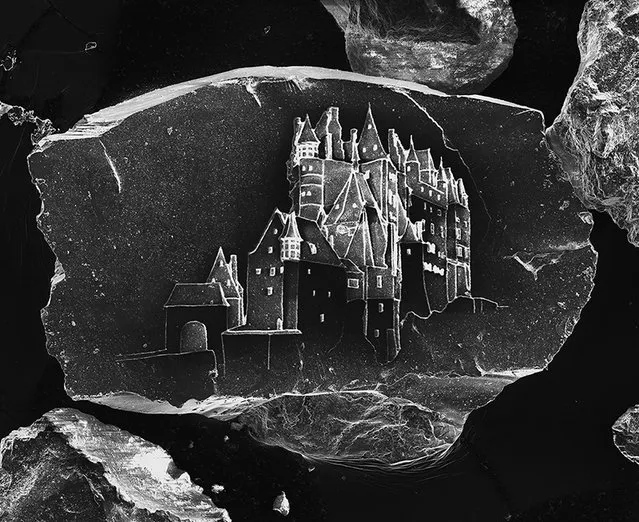
Castles Etched on Grains of Sand

Artist Vik Muniz is known for his gigantic composite installations and sculptures created from thousands of individual objects. In this new collaboration with artist and MIT researcher Marcelo Coelho, Muniz takes the opposite approach and explores the microscopic with a new series of sandcastles etched onto individual grains of sand.
Details
13 Apr 2014 08:55:00
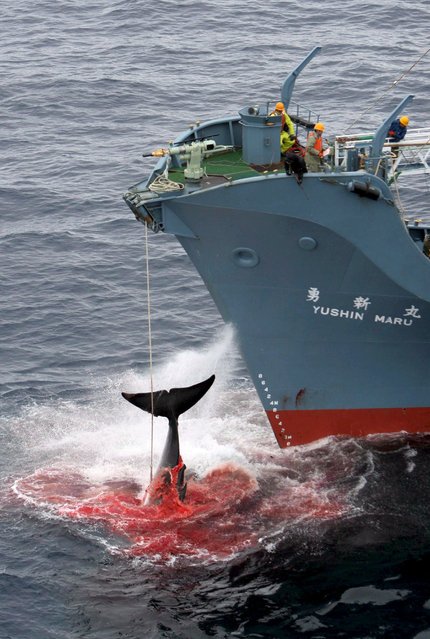
A file photograph dated 07 January 2006 and released by Greenpeace, showing the Yushin Maru, a factory ship in a Japanese whaling fleet, injuring a whale with it's first harpoon attempt. A UN court in The Hague on 31 March 2014 halted Japan's much-criticized whaling programme, ruling that it contravenes a 1986 moratorium on whale hunting. Japan must end its 'research whaling' programme, the International Court of Justice (ICJ) said. (Photo by Kate Davison/EPA)

A file photograph dated 07 January 2006 and released by Greenpeace, showing the Yushin Maru, a factory ship in a Japanese whaling fleet, injuring a whale with it's first harpoon attempt. A UN court in The Hague on 31 March 2014 halted Japan's much-criticized whaling programme, ruling that it contravenes a 1986 moratorium on whale hunting. Japan must end its 'research whaling' programme, the International Court of Justice (ICJ) said. Japan said the programme was for scientific research and permitted under international conventions. Australia had brought the case to the ICJ in 2010, charging that Japan was breaching international law by killing hundreds of whales every year for commercial purposes. Japan was “deeply disappointed” by the ruling, an unnamed government official was quoted by the Kyodo News agency as saying. But the official said Japan would stand by the ruling. (Photo by Kate Davison/EPA)
Details
01 Apr 2014 08:38:00
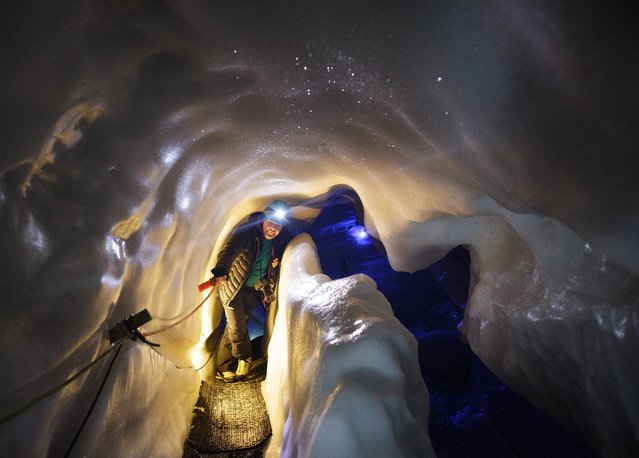
A tourist walks inside the Ice Palace glacier hollow at Hintertux glacier, located at around 3250 meters above sea level, in Zillertal, Austria, 02 March, 2016. The hollow's temperature remains constant at 0 degrees Celsius, in summer and winter alike, and is also used by the University of Innsbruck for scientific research projects. (Photo by Lisi Niesner/EPA)

A tourist walks inside the Ice Palace glacier hollow at Hintertux glacier, located at around 3250 meters above sea level, in Zillertal, Austria, 02 March, 2016. The hollow's temperature remains constant at 0 degrees Celsius, in summer and winter alike, and is also used by the University of Innsbruck for scientific research projects. (Photo by Lisi Niesner/EPA)
Details
03 Mar 2016 11:44:00
A member of the National Gendarmerie Intervention Group (GIGN) deactivates a bomb from a supposed terrorist during a training exercise in the event of a terrorist attack in collaboration with Recherche Assistance Intervention Dissuasion (RAID) and Research and Intervention Brigades (BRI) in presence of the French Interior minister Bernard Cazeneuve at la Gare Montparnasse, in central Paris on April 20, 2016. (Photo by Miguel Medina/Reuters)

A member of the National Gendarmerie Intervention Group (GIGN) deactivates a bomb from a supposed terrorist during a training exercise in the event of a terrorist attack in collaboration with Recherche Assistance Intervention Dissuasion (RAID) and Research and Intervention Brigades (BRI) in presence of the French Interior minister Bernard Cazeneuve at la Gare Montparnasse, in central Paris on April 20, 2016. (Photo by Miguel Medina/Reuters)
Details
21 Apr 2016 11:54:00
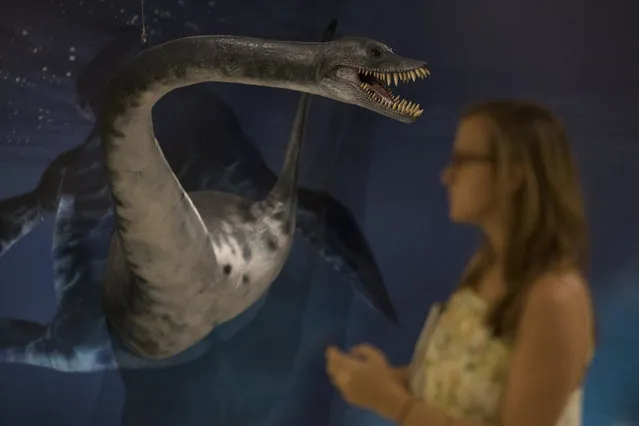
In this January 16, 2019 photo, a sculpture of a Plesiosaur is displayed at an exhibit about the studies of researchers from the National Museum made in Antartica, during a media presentation of the exhibit in Rio de Janeiro, Brazil. The National Museum will inaugurate on Jan. 17 their first exhibition after the fire, held at the building that houses the Cultural Center and Museum of Brazil's Mint. (Photo by Leo Correa/AP Photo)

In this January 16, 2019 photo, a sculpture of a Plesiosaur is displayed at an exhibit about the studies of researchers from the National Museum made in Antartica, during a media presentation of the exhibit in Rio de Janeiro, Brazil. The National Museum will inaugurate on Jan. 17 their first exhibition after the fire, held at the building that houses the Cultural Center and Museum of Brazil's Mint. (Photo by Leo Correa/AP Photo)
Details
18 Jan 2019 09:26:00
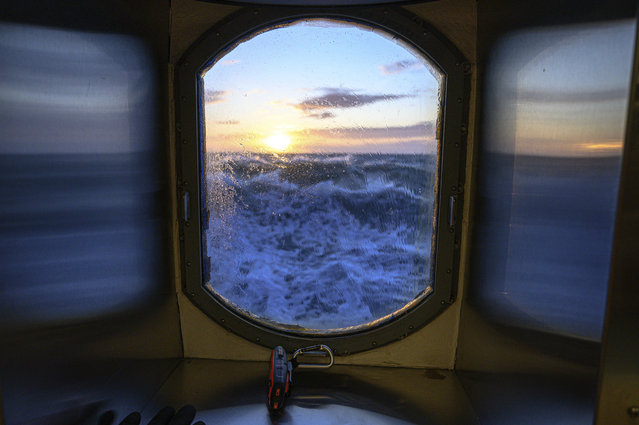
This November 8, 2019, photo provided by John Guillote shows a view from the main lab of the Sikuliaq in the Chukchi Sea. University of Washington scientists onboard the research vessel are studying the changes and how less sea ice will affect coastlines, which already are vulnerable to erosion because increased waves delivered by storms. More erosion would increase the chance of winter flooding in villages and danger to hunters in small boats. (Photo by John Guillote via AP Photo)

This November 8, 2019, photo provided by John Guillote shows a view from the main lab of the Sikuliaq in the Chukchi Sea. University of Washington scientists onboard the research vessel are studying the changes and how less sea ice will affect coastlines, which already are vulnerable to erosion because increased waves delivered by storms. More erosion would increase the chance of winter flooding in villages and danger to hunters in small boats. (Photo by John Guillote via AP Photo)
Details
26 Aug 2021 08:22:00
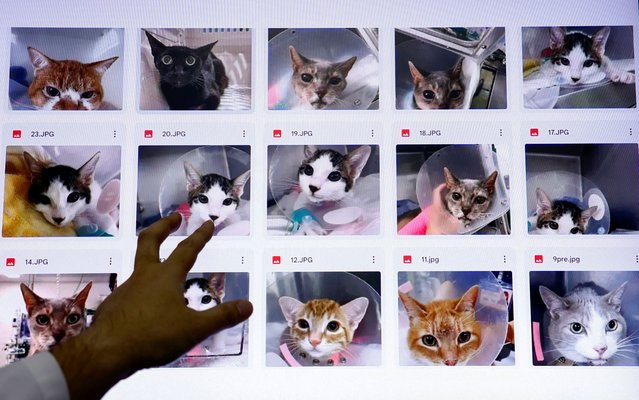
Nihon University professor and head of Nihon University Animal Medical Center Kazuya Edamura, 49, points to cat photos on a computer screen, which are used to train the AI of “CatsMe!”, an AI-driven smartphone application jointly developed by tech startup Carelogy and researchers at Nihon University that purports to tell when a cat is feeling pain, as he gives a lecture to students on diagnosing pain in cats, at the medical center in Fujisawa, south of Tokyo, Japan on June 11, 2024. (Photo by Issei Kato/Reuters)

Nihon University professor and head of Nihon University Animal Medical Center Kazuya Edamura, 49, points to cat photos on a computer screen, which are used to train the AI of “CatsMe!”, an AI-driven smartphone application jointly developed by tech startup Carelogy and researchers at Nihon University that purports to tell when a cat is feeling pain, as he gives a lecture to students on diagnosing pain in cats, at the medical center in Fujisawa, south of Tokyo, Japan on June 11, 2024. (Photo by Issei Kato/Reuters)
Details
29 Jun 2024 02:02:00