Loading...
Done
Bo (pictured) is president and co-founder of Grown Men On Bikes (GMOB), one of the oldest groups at Slow Roll. Bo spent $1,300 getting a one-off low-rider custom bike build – but that’s just the start. “Once I go back in it’s going to get big”, he says. “I’m going to get a custom seat, wheels, paint” … The finished bike could cost around $3,000 – but would still be far cheaper than pimping a car. “This is much better. It’s a community. We party”. (Photo by Nick Van Mead)

“We take rusty old junk and we put love into it”. The old Motor City has a unique style in bicycles these days: from fat wheels and fake fuel tanks to stretched cycles with powerful sound systems – and even a family-sized BBQ. “Detroit’s custom bike scene developed alongside Slow Roll, a weekly cycle ride started in 2010 by Jason Hall and Mike MacKool. Now upwards of 2,000 people turn up each Monday to cruise a different part of the city. The week I go the crowd seems evenly split between black and white, male and female, city and suburbs. It’s the most inclusive cycle event I’ve ever witnessed”. (Photo by Jason Walker/Slow Roll Monday Nights)
Details
03 Nov 2016 12:33:00
A man takes a photo of a radio antenna that's part of the Atacama Large Milimeter Array Observatory on March 12, 2013 at Llano de Chajnantor, about 43 miles (70 kilometers) from San Pedro de Atacama, Chile. The $1.5 billion ALMA facility, which had its official inauguration on March 13, is considered the world's most expensive ground-based observatory. (Photo by Felipe Trueba/EPA)

A man takes a photo of a radio antenna that's part of the Atacama Large Milimeter Array Observatory on March 12, 2013 at Llano de Chajnantor, about 43 miles (70 kilometers) from San Pedro de Atacama, Chile. The $1.5 billion ALMA facility, which had its official inauguration on March 13, is considered the world's most expensive ground-based observatory. (Photo by Felipe Trueba/EPA)
Details
03 Apr 2013 09:25:00
A devotee of the Chinese Jui Tui Shrine has his face pierced with metal rods during a street procession during the annual Vegetarian Festival in the southern Thai town of Phuket on October 19, 2015. During the festival, which begins on the first evening of the ninth lunar month and lasts nine days, religious devotees slash themselves with swords, pierce their cheeks with sharp objects and commit other painful acts to purify themselves, taking on the sins of the community. (Photo by Nicolas Asfouri/AFP Photo)

A devotee of the Chinese Jui Tui Shrine has his face pierced with metal rods during a street procession during the annual Vegetarian Festival in the southern Thai town of Phuket on October 19, 2015. During the festival, which begins on the first evening of the ninth lunar month and lasts nine days, religious devotees slash themselves with swords, pierce their cheeks with sharp objects and commit other painful acts to purify themselves, taking on the sins of the community. (Photo by Nicolas Asfouri/AFP Photo)
Details
21 Oct 2015 08:05:00
A vendor (C) cuts slaughtered dogs for sale at his roadside stall in Duong Noi village, outside Hanoi December 16, 2011. While animal rights activists have condemned eating dog meat as cruel treatment of the animals, it is still an accepted popular delicacy for some Vietnamese, as well in some other Asian countries. (Photo by Reuters/Kham)

A vendor (C) cuts slaughtered dogs for sale at his roadside stall in Duong Noi village, outside Hanoi December 16, 2011. While animal rights activists have condemned eating dog meat as cruel treatment of the animals, it is still an accepted popular delicacy for some Vietnamese, as well in some other Asian countries. Duong Noi is well-known as a dog-meat village, where hundreds of dogs are killed each day for sale as popular traditional food. Dog-eating as a custom is rooted in Vietnam and was developed as a result of poverty. One kilogram of dog meat costs about 130,000 dongs ($6.2). (Photo by Reuters/Kham)
Details
16 Jul 2013 11:40:00
Medic James E. Callahan of Pittsfield, Mass., gives mouth-to-mouth resuscitation to a dying soldier in war zone D, about 50 miles northeast of Saigon, June 17, 1967. Thirty-one men of the 1st Infantry Division were reported killed in the guerrilla ambush, with more than 100 wounded.  (Photo by Henri Huet/AP Photo)

Medic James E. Callahan of Pittsfield, Mass., gives mouth-to-mouth resuscitation to a dying soldier in war zone D, about 50 miles northeast of Saigon, June 17, 1967. Thirty-one men of the 1st Infantry Division were reported killed in the guerrilla ambush, with more than 100 wounded. (Photo by Henri Huet/AP Photo)
Details
27 Jun 2017 08:38:00
Cossack's Song “Не для меня придёт весна”

The song is presented in this publication in two different executions. The first (performed by monastic chorus) – classical, but bad. The second – national, good. Enjoy.

SEE ALSO: “Three Remarkable Cossack Songs + Bonus


Details
13 May 2013 15:54:00
Fiona McGarva holds one of the sculptures from the art installation Gratitude at The Forth Bridge at North Queensferry on September 15, 2021, ahead of going on display just outside of Edinburgh at Newhailes House and Gardens from Friday 17th September. The public art installation pays tribute to NHS staff and all key workers for their ongoing courage and dedication during the Covid-19 pandemic. (Photo by Andrew Milligan/PA Images via Getty Images)

Fiona McGarva holds one of the sculptures from the art installation Gratitude at The Forth Bridge at North Queensferry on September 15, 2021, ahead of going on display just outside of Edinburgh at Newhailes House and Gardens from Friday 17th September. The public art installation pays tribute to NHS staff and all key workers for their ongoing courage and dedication during the Covid-19 pandemic. (Photo by Andrew Milligan/PA Images via Getty Images)
Details
04 Nov 2021 08:33:00
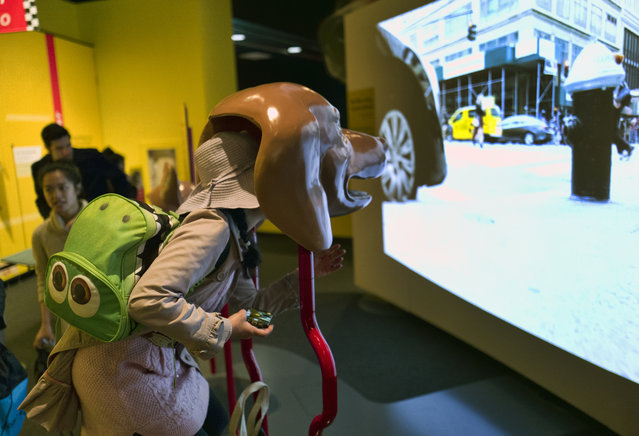
In this Tuesday, March 12, 2019 photo, a visitor takes part in an immersive experience showing visitors how dogs see from inside the head of a dog at the California Science Center in Los Angeles. A new exhibit at a Los Angeles museum examines the relationship between dogs and humans and explores why the two species seem to think so much alike and get along so well. “Dogs! A Science Tail” opens Saturday, March 16, 2019, at the California Science Center. (Photo by Richard Vogel/AP Photo)

In this Tuesday, March 12, 2019 photo, a visitor takes part in an immersive experience showing visitors how dogs see from inside the head of a dog at the California Science Center in Los Angeles. A new exhibit at a Los Angeles museum examines the relationship between dogs and humans and explores why the two species seem to think so much alike and get along so well. “Dogs! A Science Tail” opens Saturday, March 16, 2019, at the California Science Center. (Photo by Richard Vogel/AP Photo)
Details
15 Mar 2019 08:49:00