Loading...
Done
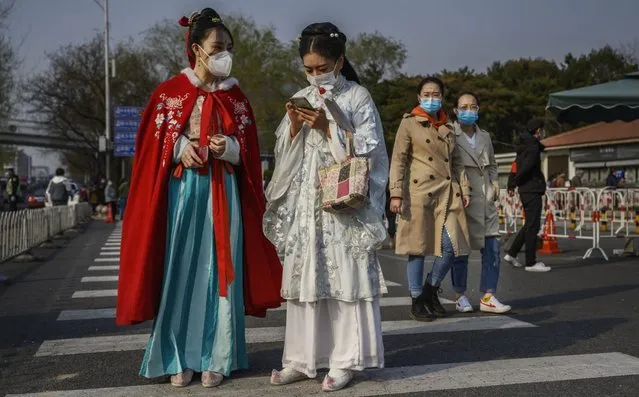
Chinese women wear protective masks as they are dressed in traditional clothing from the Qing Dynasty era outside a park on March 29, 2020 in Beijing, China. A limited section of the iconic tourist site was re-opened to the public this week allowing a smaller number of visitors to reserve tickets online in advance and to enter after passing health screening. With the pandemic hitting hard across the world, China recorded its first day with no new domestic cases of the coronavirus last week, since the government imposed sweeping measures to keep the disease from spreading. For two months, millions of people across China have been restricted in how they move from their homes, while other cities have been locked down in ways that appeared severe at the time but are now being replicated in other countries trying to contain the virus. Officials believe the worst appears to be over in China, though there are concerns of another wave of infections as the government attempts to reboot the worlds second largest economy. In Beijing, it is mandatory to wear masks outdoors, retail stores operate on reduced hours, restaurants employ social distancing among patrons, and tourist attractions at risk of drawing large crowds remain closed. Monitoring and enforcement of virus-related measures and the quarantine of anyone arriving to Beijing is carried out by neighborhood committees and a network of Communist Party volunteers who wear red arm bands. A primary concern for Chinese authorities remains the arrival of flights from Europe and elsewhere, given the exposure of passengers in regions now regarded as hotbeds for transmission. Since January, China has recorded more than 81,000 cases of COVID-19 and at least 3200 deaths, mostly in and around the city of Wuhan, in central Hubei province, where the outbreak first started. (Photo by Kevin Frayer/Getty Images)

Chinese women wear protective masks as they are dressed in traditional clothing from the Qing Dynasty era outside a park on March 29, 2020 in Beijing, China. A limited section of the iconic tourist site was re-opened to the public this week allowing a smaller number of visitors to reserve tickets online in advance and to enter after passing health screening. (Photo by Kevin Frayer/Getty Images)
Details
01 Apr 2020 00:05:00
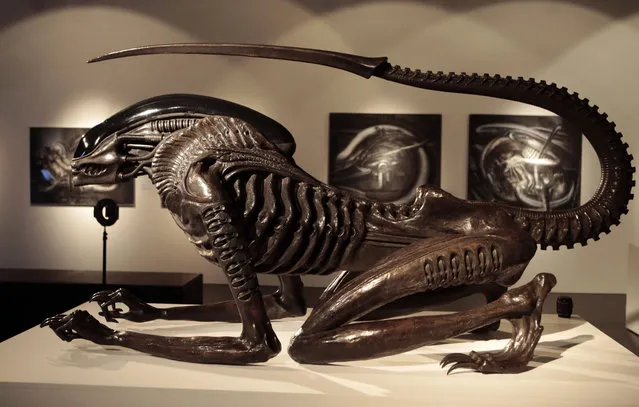
View at one of the sculptures by Swiss artist H.R. Giger during the opening of the Ars Electronica 2013 exhibition “HR Giger. The Art of Biomechanics” in Linz, Austria, 04 September 2013. (Photo by EPA/RUBRA)

View at one of the sculptures by Swiss artist H.R. Giger during the opening of the Ars Electronica 2013 exhibition “HR Giger. The Art of Biomechanics” in Linz, Austria, 04 September 2013. (Photo by EPA/RUBRA)

SEE ALSO: «Surreal Art by Alien Creator H. R. Giger»

Details
15 May 2014 12:05:00
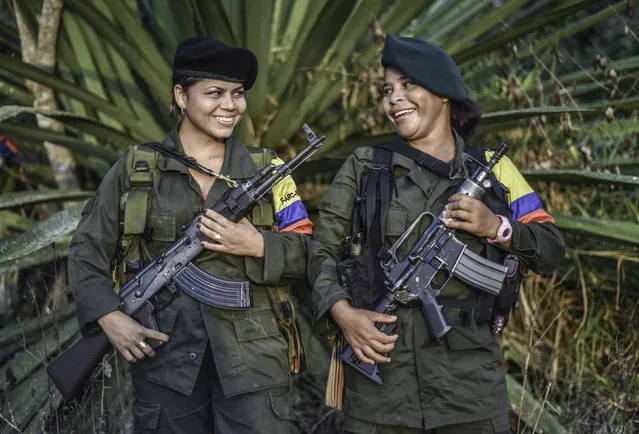
Manuela (L) and Marta, members of the Revolutionary Armed Forces of Colombia (FARC), pose for a picture at a camp in the Colombian mountains on February 18, 2016. Many of these women are willing to be reunited with the children they gave birth and then left under protection of relatives or farmers, whenever the peace agreement will put an end to the country's internal conflict. (Photo by Luis Acosta/AFP Photo)

Manuela (L) and Marta, members of the Revolutionary Armed Forces of Colombia (FARC), pose for a picture at a camp in the Colombian mountains on February 18, 2016. Many of these women are willing to be reunited with the children they gave birth and then left under protection of relatives or farmers, whenever the peace agreement will put an end to the country's internal conflict. (Photo by Luis Acosta/AFP Photo)
Details
27 Feb 2016 10:40:00
Here Goes River captures Japanese photographer Aya Fujioka’s home town of Hiroshima in 2017. The award-winning series documents the quiet, everyday spaces of the city – mundane, almost incidental scenes that are suffused with the invisible weight of the past. (Photo by Aya Fujioka)

Here Goes River captures Japanese photographer Aya Fujioka’s home town of Hiroshima in 2017. The award-winning series documents the quiet, everyday spaces of the city – mundane, almost incidental scenes that are suffused with the invisible weight of the past. (Photo by Aya Fujioka)
Details
24 Aug 2025 04:23:00
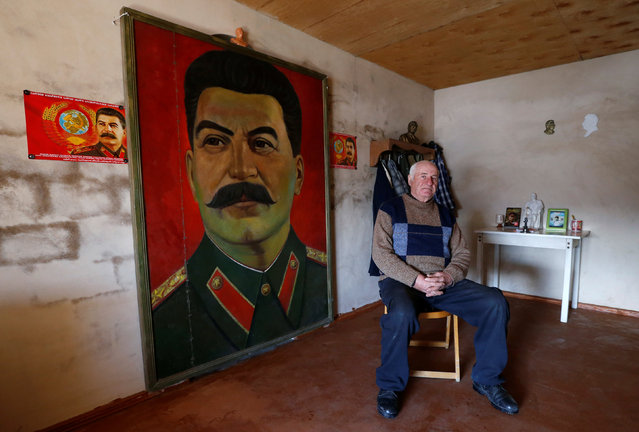
Retired builder Vasili Sidamonidze, 70, poses for a portrait at his home in Gori, Georgia, December 6, 2016. “Unfortunately, Stalin is not popular nowadays. Our people don't respect him. Only we, members of the (Communist) Party, respect him”, Sidamonidze said. “I always try to attend Stalin's birthday anniversaries in Gori. Unfortunately many people don't want to join us even if they live nearby. They look at us from their windows”. Stalin, who was born in Gori in 1878 and died in 1953, is largely reviled today in Georgia, which regained its independence during the 1991 collapse of the Soviet Union. Over the years, his memorials have been dismantled, most recently in 2010 when authorities removed a statue of the dictator from Gori's central square. But Stalin is still revered by a small group of mainly elderly supporters who stress his role in the industrialisation of the Soviet Union and in defeating Nazi Germany in World War Two. Each Dec. 21, a few dozen people mark his birthday by gathering outside a Gori museum dedicated to Stalin, where they make speeches and walk to the square where a 6-meter-high bronze statue of him once stood, calling for it to be reinstated. Opponents say it was a symbol of Moscow's still lingering shadow. In 2008, Russia fought a brief war with Georgia and recognised its breakaway regions of Abkhazia and South Ossetia as independent states. (Photo by David Mdzinarishvili/Reuters)

Retired builder Vasili Sidamonidze, 70, poses for a portrait at his home in Gori, Georgia, December 6, 2016. “Unfortunately, Stalin is not popular nowadays. Our people don't respect him. Only we, members of the (Communist) Party, respect him”, Sidamonidze said. “I always try to attend Stalin's birthday anniversaries in Gori. Unfortunately many people don't want to join us even if they live nearby. They look at us from their windows”. (Photo by David Mdzinarishvili/Reuters)
Details
17 Dec 2016 07:59:00
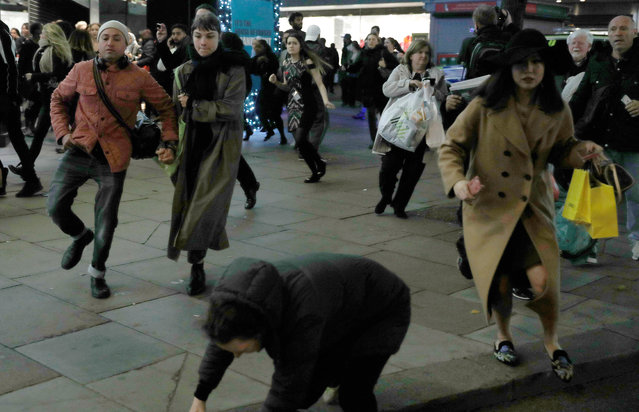
A woman stumbes as people run down Oxford Street, London, Britain, November 24, 2017. (Photo by Peter Nicholls/Reuters)

A woman stumbes as people run down Oxford Street, London, Britain, November 24, 2017. Police are responding to reports of an incident at London's Oxford Circus Tube station and have urged the public to avoid the area. (Photo by Peter Nicholls/Reuters)
Details
25 Nov 2017 08:13:00
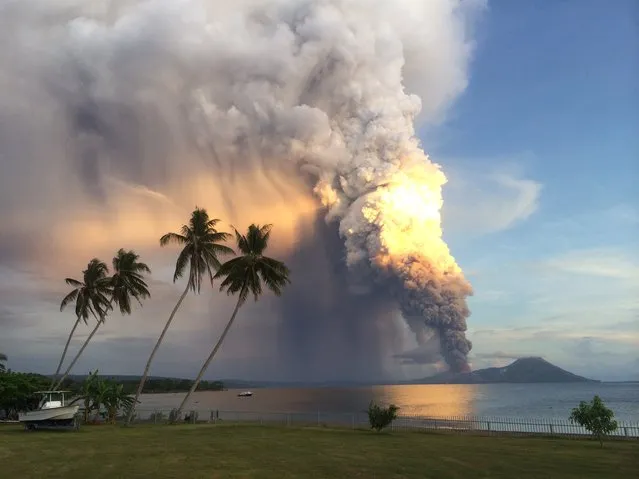
A photo taken on August 29, 2014, shows Mount Tavurvur erupting in eastern Papua New Guinea, spewing rocks and ash into the air, forcing the evacuation of local communities and international flights to be re-routed. Mount Tavurvur, which destroyed the town of Rabaul when it erupted simultaneously with nearby Mount Vulcan in 1994, rumbled to life early in the morning on the tip of the remote island of New Britain. (Photo by Oliver Bluett/AFP Photo)

A photo taken on August 29, 2014, shows Mount Tavurvur erupting in eastern Papua New Guinea, spewing rocks and ash into the air, forcing the evacuation of local communities and international flights to be re-routed. Mount Tavurvur, which destroyed the town of Rabaul when it erupted simultaneously with nearby Mount Vulcan in 1994, rumbled to life early in the morning on the tip of the remote island of New Britain. (Photo by Oliver Bluett/AFP Photo)
Details
30 Aug 2014 10:51:00
"Drawing By Victor Castillo

Victor Castillo is a Chilean painter currently residing in Los Angeles, California. He was born in Santiago, Chile in 1973.
Details
20 Jul 2015 08:50:00