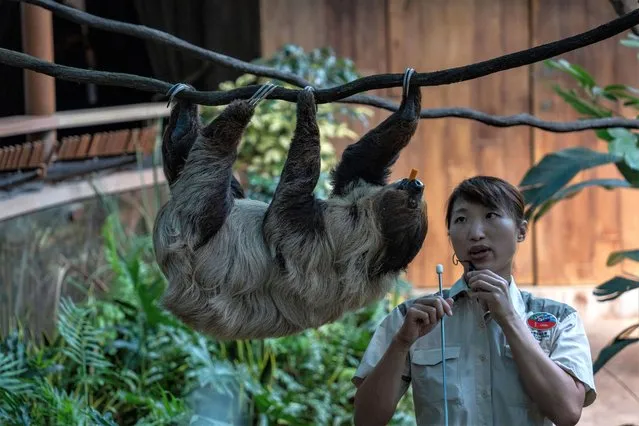
A worker stands next to a Southern Two-toed Sloth at the Sloth and Friends Studio inside Hong Kong Ocean Park on August 3, 2023 in Hong Kong, China. (Photo by Vernon Yuen/Rex Features/Shutterstock)
A man shows his tattoos at the 7th Hong Kong China International Tattoo Convention in Hong Kong on August 25, 2023. (Photo by Isaac Lawrence/AFP Photo)
Spain's midfielder #06 Aitana Bonmati challenges Switzerland's midfielder #13 Lia Walti during the UEFA Women's Nations League football match between Spain and Switzerland, at the Nuevo Arcangel stadium in Cordoba on September 26, 2023. (Photo by Cristina Quicler/AFP Photo)
Women members of the national police take part in a parade during a graduation ceremony in Bogota, Colombia on November 7, 2019. (Photo by Juan Barreto/AFP Photo)
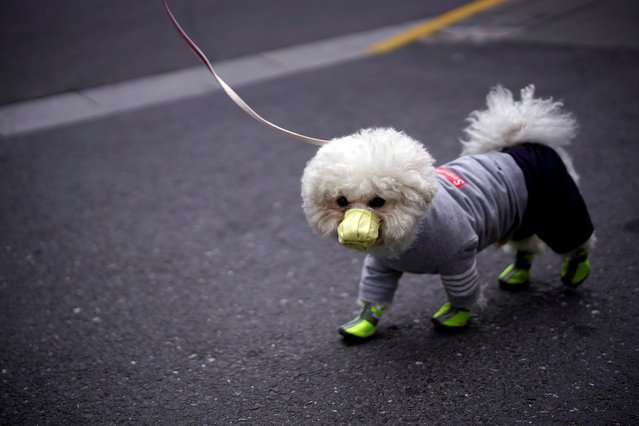
A dog wearing face mask is seen on a street as the country is hit by an outbreak of the novel coronavirus, in Shanghai, China on March 2, 2020. (Photo by Aly Song/Reuters)
Chinese women wear protective masks as they are dressed in traditional clothing from the Qing Dynasty era outside a park on March 29, 2020 in Beijing, China. A limited section of the iconic tourist site was re-opened to the public this week allowing a smaller number of visitors to reserve tickets online in advance and to enter after passing health screening. (Photo by Kevin Frayer/Getty Images)
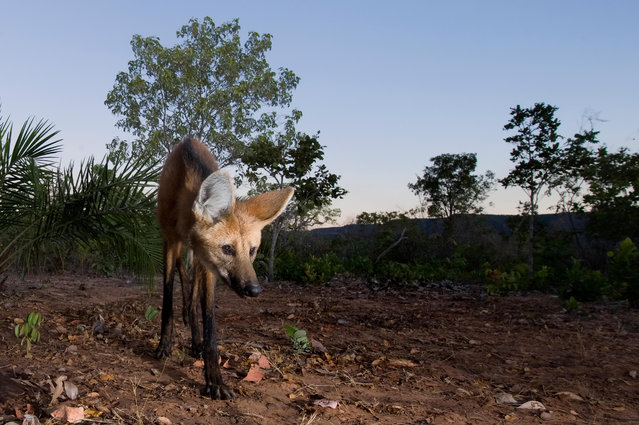
Global wildlife populations will decline by 67% by 2020 unless urgent action is taken to reduce human impact on species and ecosystems, warns the biennial Living Planet Index report from WWF (World Wide Fund for Nature) and ZSL (Zoological Society of London). From elephants to eels, here are some of the wildlife populations most affected by human activity. Here: The maned wolf is among the large mammals in the Brazilian Cerrado that are threatened by the increasing conversion of grasslands into farmland for grazing and growing crops. (Photo by Ben Cranke/Nature Picture Library/Alamy Stock Photo)
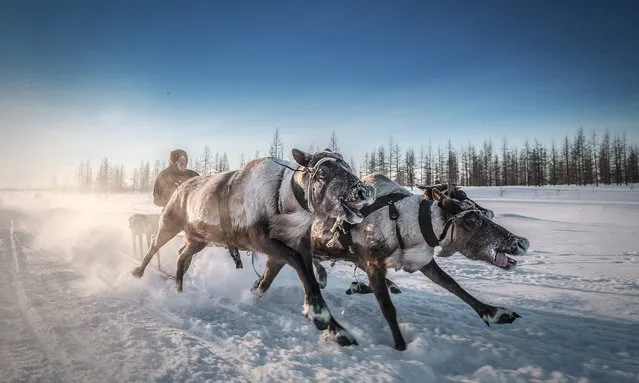
Take me away, deer, Russia. The Nenet people of Arctic Russia use reindeer and sledges as a prime mode of transport. The animals’ navigational ability means that in severe conditions they are sometimes the only hope of survival. (Photo by Kamil Nureev/Smithsonian Photo Contest)