Models backstage ahead of the St George New Generation show at Mercedes-Benz Fashion Week Australia 2015 at Carriageworks on April 16, 2015 in Sydney, Australia. (Photo by Brendon Thorne/Getty Images)
A man holds a child after rescuing him from a kindergarten affected by a fire at a commercial building, in Ningde, Fujian province, China, September 16, 2015. According to local media, more than 260 people were evacuated due to the fire, which broke out Wednesday morning. No causalities have been reported and the cause of it is still unknown. (Photo by Reuters/China Daily)
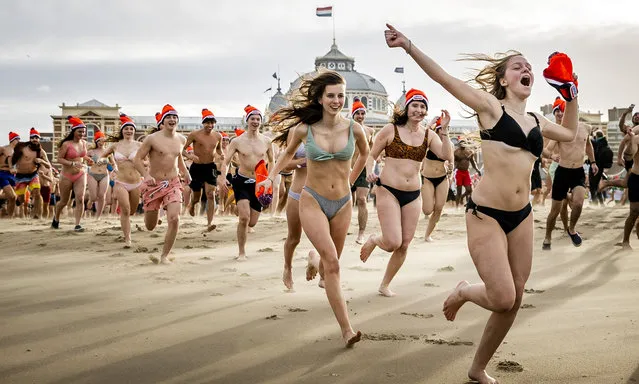
People run into the sea at the beach of Scheveningen on New Year's Day, Scheveningen, Netherlands, 01 January 2023. The traditional New Year's dive was resumed after the two previous editions were canceled due to the corona crisis. (Photo by Remko de Waal/EPA/EFE/Rex Features/Shutterstock)
English actor Emma D’Arcy, English film and television director of Argentine origin, and former storyboard artist Miguel Sapochnik, and Australian actress Milly Alcock pose with the award for Best Television Series in Drama for “House of the Dragon” at the 80th Annual Golden Globe Awards in Beverly Hills, California, U.S., January 10, 2023. (Photo by Mario Anzuoni/Reuters)
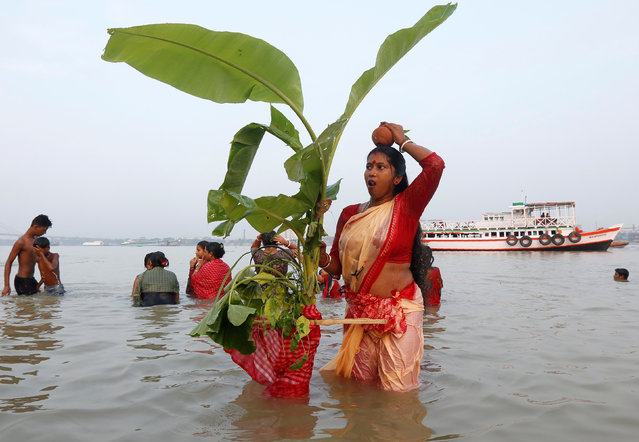
A Hindu devotee ululates as she holds a banana tree trunk after taking a dip in the waters of the Ganges river during a ritual as part of the Durga Puja festival in Kolkata, India, September 27, 2017. (Photo by Rupak De Chowdhuri/Reuters)
Felipe Dana discovered photography at age 15 when he started working as an assistant for event and commercial photographers. At the close of 2009, he decided to focus his career solely on photojournalism. Dana has focused his work on documenting the consequences of social changes in slums due to upcoming major sports events scheduled for 2014 and 2016 in Rio de Janeiro, where he currently lives and works as a staff photographer for The Associated Press. Photo: A model wears a creation from the Triya summer collection during Fashion Rio in Rio de Janeiro, Brazil, Friday, April 19, 2013. (Photo by Felipe Dana/AP Photo)
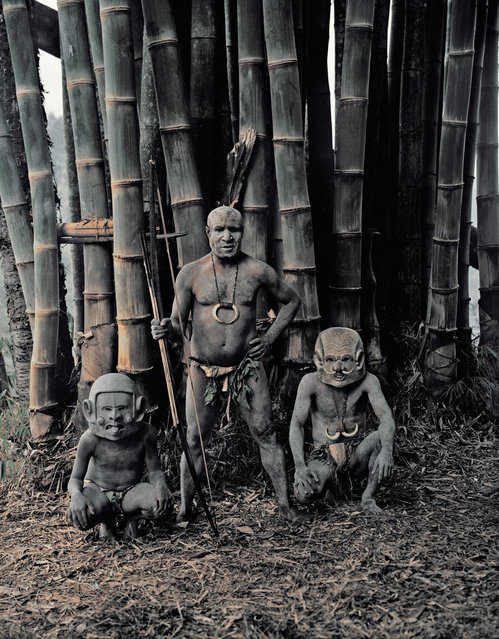
“Asaro from the Eastern Highlands”. The mudmen could not cover their faces with mud because the people of Papua New Guinea thought that the mud from the Asaro river was poisonous. So instead of covering their faces with this alleged poison, they made masks from pebbles that they heated and water from the waterfall, with unusual designs such as long or very short ears either going down to the chin or sticking up at the top, long joined eyebrows attached to the top of the ears, horns and sideways mouths. (Photo and caption by Jimmy Nelson)