Loading...
Done
Journalists (L) walk along the new Caminito del Rey (The King's Little Pathway) in El Chorro-Alora, near Malaga, southern Spain March 15, 2015. (Photo by Jon Nazca/Reuters)

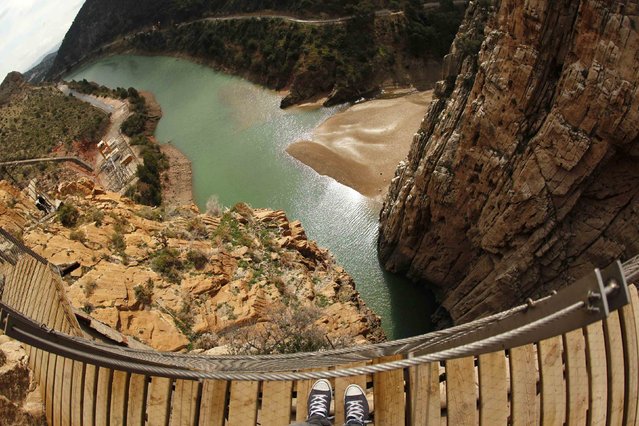
Journalists (L) walk along the new Caminito del Rey (The King's Little Pathway) in El Chorro-Alora, near Malaga, southern Spain March 15, 2015. Dubbed by many media outlets as the world's scariest pathway, the three-kilometre long pathway, which was built at about 100 metres (330 ft) above the gorge of Los Gaitanes between the years of 1901 and 1905, was closed in 2001 after five people died. A new walkway has then been built over the old walkway and will open to the public on March 28, 2015. (Photo by Jon Nazca/Reuters)
Details
16 Mar 2015 09:56:00
Chris Hondros RetrospectivePart2

Chris Hondros, a Getty Images photographer, was fatally wounded on April 20, 2011, in a mortar attack by government forces while covering the civil war in Libya. Hondros' work is woven in our history as he covered everything from politics to marathons. A new film will focus on his life as told through his images. Here's a look at some of his finest and final work. Some of these images are graphic in nature
Details
23 Aug 2013 17:38:00
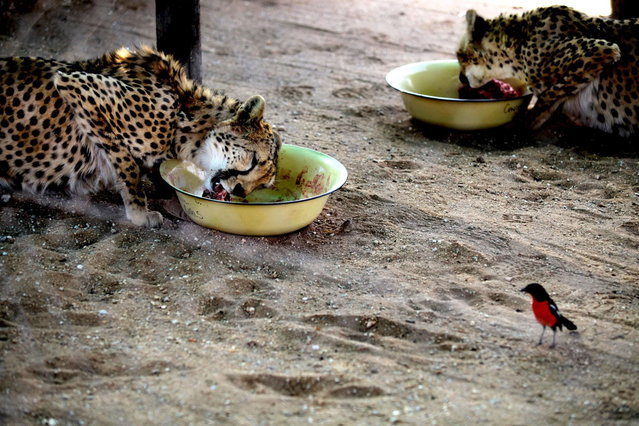
Young cheetahs eat meat at The Cheetah Conservation Fund (CCF) center in Otjiwarongo, Namibia, on August 13, 2013. The CCF started breeding Anatolian livestock dogs to promote cheetah-friendly farming after some 10,000 big cats – the current total worldwide population – were killed or moved off farms in the 1980s.  Up to 1,000 cheetahs were being killed a year, mostly by farmers who saw them as livestock killers. But the use of dogs has slashed losses for sheep and goat farmers and led to less retaliation against the vulnerable cheetah. (Photo by Jennifer Bruce/AFP Photo)

Young cheetahs eat meat at The Cheetah Conservation Fund (CCF) center in Otjiwarongo, Namibia, on August 13, 2013. The CCF started breeding Anatolian livestock dogs to promote cheetah-friendly farming after some 10,000 big cats – the current total worldwide population – were killed or moved off farms in the 1980s. Up to 1,000 cheetahs were being killed a year, mostly by farmers who saw them as livestock killers. But the use of dogs has slashed losses for sheep and goat farmers and led to less retaliation against the vulnerable cheetah. (Photo by Jennifer Bruce/AFP Photo)
Details
29 Aug 2013 10:56:00
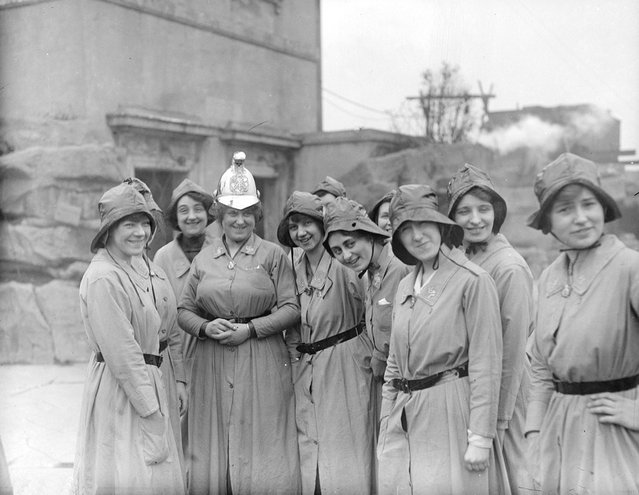
Members of the Women's Fire Brigade with their Chief Officer, March 1916. (Photo by Topical Press Agency)

Members of the Women's Fire Brigade with their Chief Officer, March 1916. (Photo by Topical Press Agency)
Details
22 Sep 2012 07:56:00
A masked protester talks to a soldier during clashes after the funeral of Brig. Gen. Wissam al-Hassan October 21, 2012. Lebanese soldiers fired guns and tear gas to push back hundreds of protesters who broke through a police cordon and tried to storm the government headquarters in Beirut. (Photo by Hussein Malla/Associated Press)

A masked protester talks to a soldier during clashes after the funeral of Brig. Gen. Wissam al-Hassan October 21, 2012. Lebanese soldiers fired guns and tear gas to push back hundreds of protesters who broke through a police cordon and tried to storm the government headquarters in Beirut. (Photo by Hussein Malla/Associated Press)
Details
27 Oct 2012 12:03:00
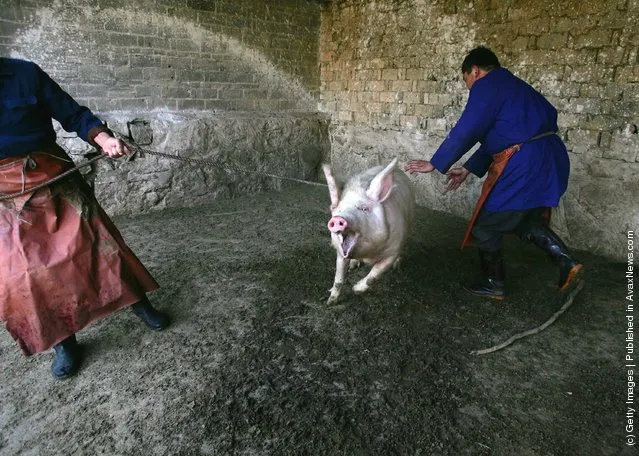
Pig

Chinese butchers catch a pig to slaughter on January 31, 2005 in Jinzhai County, Anhui Province, China. (Photo by Cancan Chu/GettyImages)
Details
20 Aug 2011 12:17:00
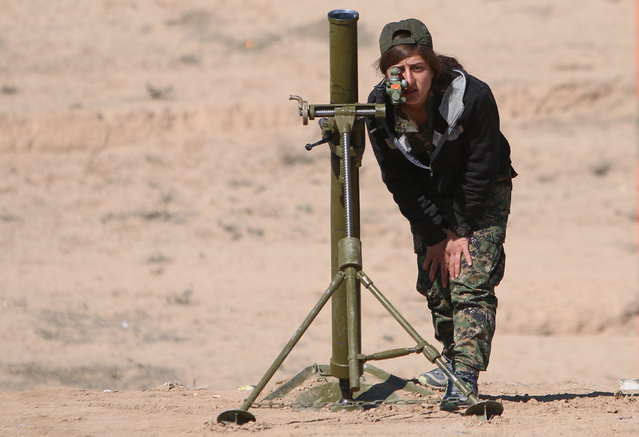
A Syrian Democratic Forces (SDF) female fighter adjusts a mortar in northern Deir al-Zor province ahead of an offensive against Islamic State militants, Syria February 21, 2017. (Photo by Rodi Said/Reuters)

A Syrian Democratic Forces (SDF) female fighter adjusts a mortar in northern Deir al-Zor province ahead of an offensive against Islamic State militants, Syria February 21, 2017. (Photo by Rodi Said/Reuters)
Details
23 Feb 2017 00:00:00
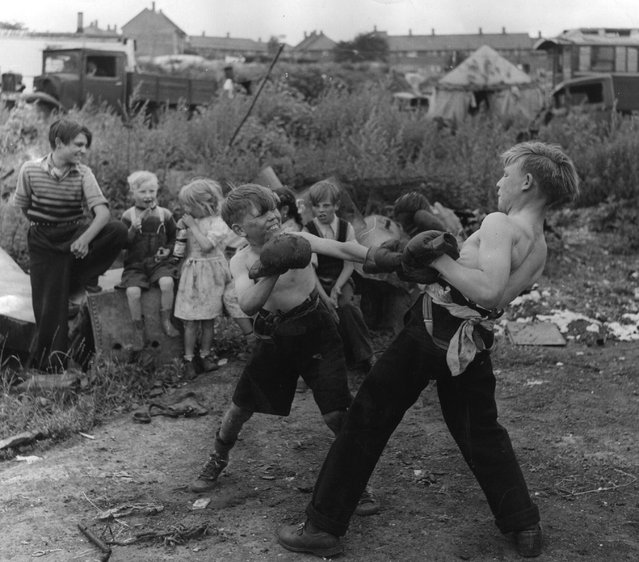
The unromantic gypsies. Children boxing in a gypsy camp in Kent, England on July 1, 1951. Like all boys these gypsy lads like to try their hand at boxing. Encouraged by their friends they fight it out on Corke's Meadow. Few Romanies now live a life of wandering romance. Most are like the three hundred squatters of Corke's Meadow, Kent, which is part of a “gypsy problem” that involves about 100,000 today. Of those about 25,000 can be rightly called gypsies, the rest are Mumpers and Posh-rats and Hobos. Corke's Meadow has both kinds. “Picture Post” cameraman Bert Hardy photographs the Corke's Meadow gypsies in their encampment. (Photo by Hulton-Deutsch Collection/Corbis via Getty Images)

The unromantic gypsies. Children boxing in a gypsy camp in Kent, England on July 1, 1951. Like all boys these gypsy lads like to try their hand at boxing. Encouraged by their friends they fight it out on Corke's Meadow. Few Romanies now live a life of wandering romance. Most are like the three hundred squatters of Corke's Meadow, Kent, which is part of a “gypsy problem” that involves about 100,000 today. Of those about 25,000 can be rightly called gypsies, the rest are Mumpers and Posh-rats and Hobos. Corke's Meadow has both kinds. “Picture Post” cameraman Bert Hardy photographs the Corke's Meadow gypsies in their encampment. (Photo by Hulton-Deutsch Collection/Corbis via Getty Images)
Details
12 Mar 2017 00:01:00