Loading...
Done
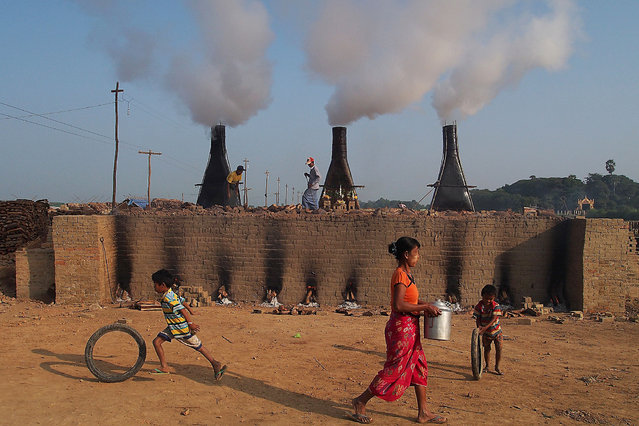
Children play in front of a brick factory on the outskirts of the northern Myanmar city of Mandalay on December 14, 2015. (Photo by Phyo Hein Kyaw/AFP Photo)

Children play in front of a brick factory on the outskirts of the northern Myanmar city of Mandalay on December 14, 2015. (Photo by Phyo Hein Kyaw/AFP Photo)
Details
06 May 2016 13:11:00
Thousands of travellers heading to their hometowns to celebrate Eid al-Fitr, the Muslim holiday to mark the end of Ramadan, wait in a traffic jam to board a ferry at the entrance to Gilimanuk port on Bali, Indonesia July 3, 2016 in this photo taken by Antara Foto. (Photo by Nyoman Budhiana/Reuters/Antara Foto)

Thousands of travellers heading to their hometowns to celebrate Eid al-Fitr, the Muslim holiday to mark the end of Ramadan, wait in a traffic jam to board a ferry at the entrance to Gilimanuk port on Bali, Indonesia July 3, 2016 in this photo taken by Antara Foto. (Photo by Nyoman Budhiana/Reuters/Antara Foto)
Details
12 Jul 2016 12:18:00
A couple photograph The Helmsley Building on Park Avenue, lit in honor of the victims of the Nice attacks, in Manhattan, New York, U.S., July 15, 2016. (Photo by Brendan McDermid/Reuters)

A couple photograph The Helmsley Building on Park Avenue, lit in honor of the victims of the Nice attacks, in Manhattan, New York, U.S., July 15, 2016. (Photo by Brendan McDermid/Reuters)
Details
17 Jul 2016 12:10:00
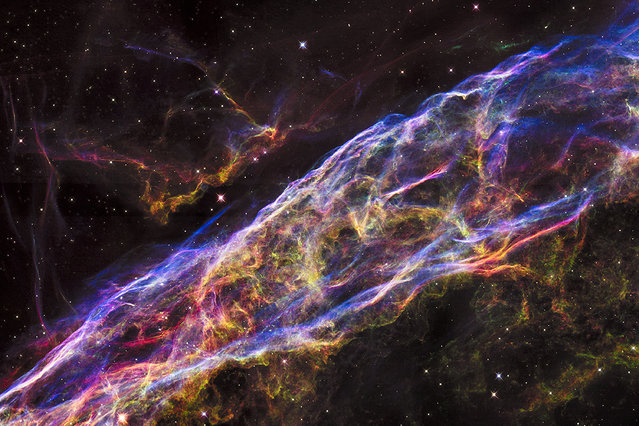
A small section of the expanding remains of the Veil Nebula, a massive star that exploded about 8,000 years ago. The entire nebula is 110 light-years across, covering six full moons on the sky as seen from Earth, and resides about 2,100 light-years away in the constellation Cygnus, the Swan. Image taken by NASA's Hubble Space Telescope. Released September 24, 2015. (Photo by Reuters/NASA/ESA/Hubble Heritage Team)

A small section of the expanding remains of the Veil Nebula, a massive star that exploded about 8,000 years ago. The entire nebula is 110 light-years across, covering six full moons on the sky as seen from Earth, and resides about 2,100 light-years away in the constellation Cygnus, the Swan. Image taken by NASA's Hubble Space Telescope. Released September 24, 2015. (Photo by Reuters/NASA/ESA/Hubble Heritage Team)
Details
10 Dec 2015 08:01:00
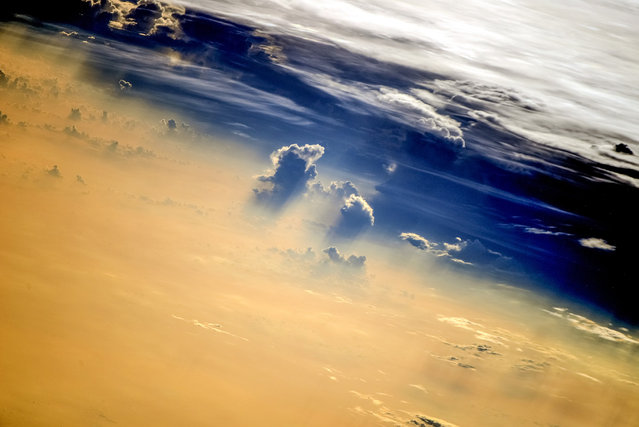
Image of the Clouds taken in August 2014 by astronauts on board the International Space Station (ISS).  A year from space photographs of hurricanes, typhoons and meteorite craters show an astronauts-eye view of our planet from hundreds of miles above the earth. The illuminating images were taken by astronauts onboard the International Space Station (ISS) over the course of 2014. (Photo by NASA/SPL/Barcroft Media)

Image of the Clouds taken in August 2014 by astronauts on board the International Space Station (ISS). A year from space photographs of hurricanes, typhoons and meteorite craters show an astronauts-eye view of our planet from hundreds of miles above the earth. The illuminating images were taken by astronauts onboard the International Space Station (ISS) over the course of 2014. (Photo by NASA/SPL/Barcroft Media)
Details
31 Dec 2014 14:47:00
A worker stack bricks on his head at a brick factory in Lalitpur January 12, 2015. (Photo by Navesh Chitrakar/Reuters)

A worker stack bricks on his head at a brick factory in Lalitpur January 12, 2015. (Photo by Navesh Chitrakar/Reuters)
Details
16 Jan 2015 12:40:00
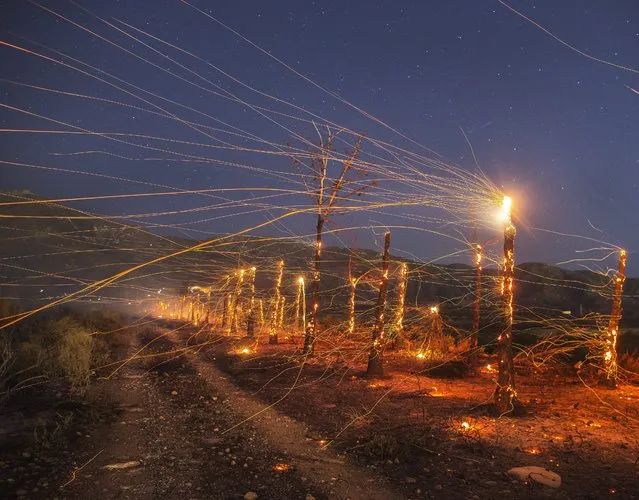
A long exposure image of embers flying off burnt out  trees following the wind driven wildfire ranging in the mountain area near Rancho Cucamonga late 30 April 2014.  Earlier in the day more than 1,500 homes were evacuated as the Etiwanda fire charred around 1,000 acres in San Barnardino National Forest. (Photo by Stuart Palley/EPA)

A long exposure image of embers flying off burnt out trees following the wind driven wildfire ranging in the mountain area near Rancho Cucamonga late 30 April 2014. Earlier in the day more than 1,500 homes were evacuated as the Etiwanda fire charred around 1,000 acres in San Barnardino National Forest. (Photo by Stuart Palley/EPA)
Details
22 Jun 2014 10:19:00
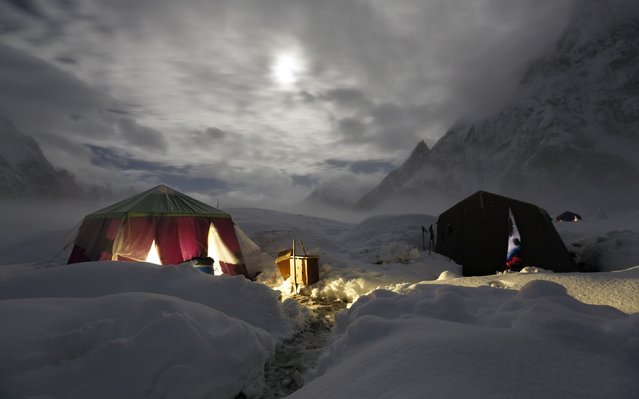
The moon illuminates the snow-covered Concordia, the confluence of the Baltoro and Godwin-Austen glaciers, near the world's second highest mountain the K2 (8,000 meters) in the Karakoram mountain range in Pakistan September 6, 2014. (Photo by Wolfgang Rattay/Reuters)

The moon illuminates the snow-covered Concordia, the confluence of the Baltoro and Godwin-Austen glaciers, near the world's second highest mountain the K2 (8,000 meters) in the Karakoram mountain range in Pakistan September 6, 2014. While other parts of Pakistan and northern India were flooded, Concordia in the Karakoram mountain range was covered with a seasonally unusual amount of snow. Geographically, Pakistan is a climbers paradise. It rivals Nepal for the number of peaks over 7,000 meters and is home to the world's second tallest mountain, K2, as well as four of the world's 14 summits higher than 8,000 meters. (Photo by Wolfgang Rattay/Reuters)
Details
24 Oct 2014 12:27:00