Loading...
Done
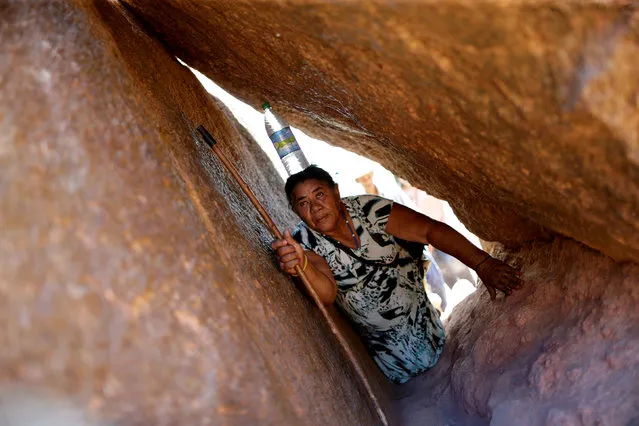
Catholic pilgrim Matilde Madalena de Jesus crawls on a rocky trail carrying a bottle of water on her head during the annual pilgrimage of the dead (Romaria dos Finados), in the city of Juazeiro do Norte, Ceara state, in Brazil October 31, 2016. (Photo by Ueslei Marcelino/Reuters)

Catholic pilgrim Matilde Madalena de Jesus crawls on a rocky trail carrying a bottle of water on her head during the annual pilgrimage of the dead (Romaria dos Finados), in the city of Juazeiro do Norte, Ceara state, in Brazil October 31, 2016. (Photo by Ueslei Marcelino/Reuters)
Details
01 Nov 2016 12:40:00
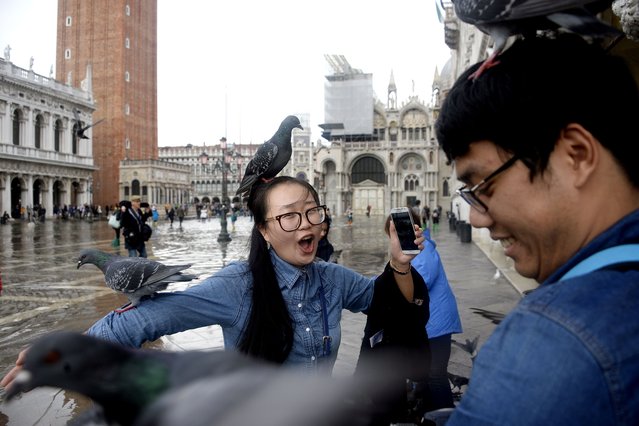
Tourists pose with pigeons in the flooded St. Mark's Square in Venice, on November 7, 2014. The high water, a combination of high tides and a strong Scirocco wind in the Adriatic Sea, stood at 110 centimeters early on November 7. The city has for years been wrestling with the problems posed by the threat of rising sea levels. (Photo by Olivier Morin/AFP Photo)

Tourists pose with pigeons in the flooded St. Mark's Square in Venice, on November 7, 2014. The high water, a combination of high tides and a strong Scirocco wind in the Adriatic Sea, stood at 110 centimeters early on November 7. The city has for years been wrestling with the problems posed by the threat of rising sea levels. (Photo by Olivier Morin/AFP Photo)
Details
08 Nov 2014 13:06:00
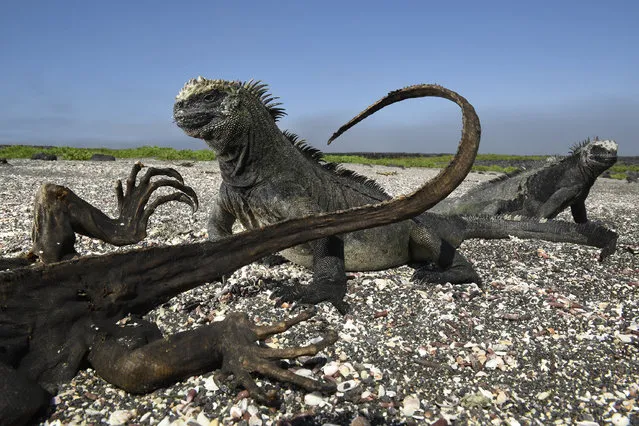
Galapagos – Rocking the Cradle: Four major ocean currents converge along the Galapagos archipelago, creating the conditions for an extraordinary diversity of animal life, April 25, 2016. The islands are home to at least 7,000 flora and fauna species, of which 97 percent of the reptiles, 80 percent of the land birds, 50 percent of the insects and 30 percent of the plants are endemic. The local ecosystem is highly sensitive to the changes in temperature, rainfall and ocean currents that characterize the climatic events known as El Niño and La Niña. These changes cause marked fluctuations in weather and food availability. Many scientists expect the frequency of El Niño and La Niña to increase as a result of climate change, making the Galapagos a possible early-warning location for its effects. (Photo by Thomas P. Peschak for National Geographic/World Press Photo)

Galapagos – Rocking the Cradle: Four major ocean currents converge along the Galapagos archipelago, creating the conditions for an extraordinary diversity of animal life, April 25, 2016. The islands are home to at least 7,000 flora and fauna species, of which 97 percent of the reptiles, 80 percent of the land birds, 50 percent of the insects and 30 percent of the plants are endemic. (Photo by Thomas P. Peschak for National Geographic/World Press Photo)
Details
16 Apr 2018 00:01:00