Loading...
Done
Admirers of Peruvian clown William Rojas, known professionally as “Chupetin”, carry his coffin during his funeral procession to the Eternal Hope cemetery in Huancayo, Peru, on July 2, 2020. Rojas, 45, died from COVID-19 after five days of being in intensive care. Peru surpassed 10,000 deaths from the coronavirus on Thursday, the health ministry said, a day after the government began easing a national lockdown in a bid to revive the economy. (Photo by Pedro Tinoco/AFP Photo)

Admirers of Peruvian clown William Rojas, known professionally as “Chupetin”, carry his coffin during his funeral procession to the Eternal Hope cemetery in Huancayo, Peru, on July 2, 2020. Rojas, 45, died from COVID-19 after five days of being in intensive care. Peru surpassed 10,000 deaths from the coronavirus on Thursday, the health ministry said, a day after the government began easing a national lockdown in a bid to revive the economy. (Photo by Pedro Tinoco/AFP Photo)
Details
05 Jul 2020 00:07:00
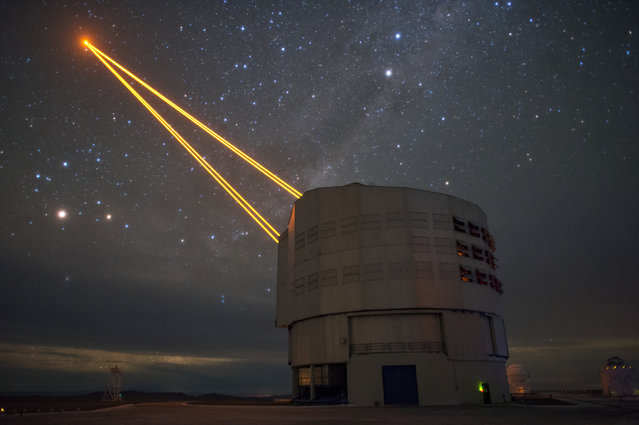
Four pillars of light from the 4 Laser Guide Star Facility on ESO's Very Large Telescope (VLT) are shown reaching into the Chilean night sky in this image from ESO Photo Ambassador Fred Kamphues, on September 2, 2016. The lasers are a key part of the adaptive optics system on the VLT. Adaptive optics allows astronomers to drastically reduce the atmospheric distortion present at even the best sites in the world for astronomy, including Paranal in Chile, the home of the VLT. (Photo by F. Kamphues/ESO)

Four pillars of light from the 4 Laser Guide Star Facility on ESO's Very Large Telescope (VLT) are shown reaching into the Chilean night sky in this image from ESO Photo Ambassador Fred Kamphues, on September 2, 2016. The lasers are a key part of the adaptive optics system on the VLT. Adaptive optics allows astronomers to drastically reduce the atmospheric distortion present at even the best sites in the world for astronomy, including Paranal in Chile, the home of the VLT. (Photo by F. Kamphues/ESO)
Details
23 Feb 2017 00:06:00
An amateur artist has created a series of hilarious images combining iconic film scenes with everyday locations all over the world. History teacher Francois Dourlen, from Cherbourg in France, has used stills of pop culture everything – from cult movies to old faithful TV favorites like The Simpsons and Baywatch, to new hits Minions – to bring this unique artwork to life. “(The first picture) was originally just a joke for my friends”, Dourlen said. “A lot of them liked it, so I did another…and a lot of people liked it! So I did another, and another”. (Photo by Francois Dourlen/Exclusivepix Media)

An amateur artist has created a series of hilarious images combining iconic film scenes with everyday locations all over the world. History teacher Francois Dourlen, from Cherbourg in France, has used stills of pop culture everything – from cult movies to old faithful TV favorites like The Simpsons and Baywatch, to new hits Minions – to bring this unique artwork to life. (Photo by Francois Dourlen/Exclusivepix Media)
Details
16 Mar 2017 00:04:00
A Chinese woman wears a mask to protect from particles blown in during a sandstorm as she walks in the street on May 4, 2017 in Beijing, China. Sandstorms are common in northern China during the spring season and are caused when heavy winds from Mongolia in the north brings sand and pollutants that can blanket Chinese cities and cause air quality to deteriorate. (Photo by Kevin Frayer/Getty Images)

A Chinese woman wears a mask to protect from particles blown in during a sandstorm as she walks in the street on May 4, 2017 in Beijing, China. Sandstorms are common in northern China during the spring season and are caused when heavy winds from Mongolia in the north brings sand and pollutants that can blanket Chinese cities and cause air quality to deteriorate. (Photo by Kevin Frayer/Getty Images)
Details
12 May 2017 07:06:00
An Indian nomadic Gujjar girl hangs on to a horse cart after collecting bricks from debris on the outskirts of Jammu, India, Tuesday, March 7, 2017. The Gujjar tribal communities are considered by some to be economically and socially backward and the lack of care by the state government has led to resentment amongst the community. The tribe moves to the plains from the hills to escape the cold winters. (Photo by Channi Anand/AP Photo)

An Indian nomadic Gujjar girl hangs on to a horse cart after collecting bricks from debris on the outskirts of Jammu, India, Tuesday, March 7, 2017. The Gujjar tribal communities are considered by some to be economically and socially backward and the lack of care by the state government has led to resentment amongst the community. The tribe moves to the plains from the hills to escape the cold winters. (Photo by Channi Anand/AP Photo)
Details
09 Jun 2017 06:36:00
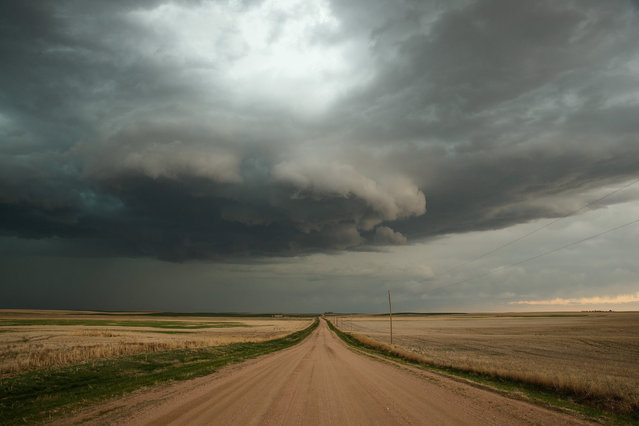
A supercell thunderstorm develops, May 8, 2017 in Elbert County outside of Limon, Colorado. With funding from the National Science Foundation and other government grants, scientists and meteorologists from the Center for Severe Weather Research try to get close to supercell storms and tornadoes trying to better understand tornado structure and strength, how low-level winds affect and damage buildings, and to learn more about tornado formation and prediction. (Photo by Drew Angerer/Getty Images)

A supercell thunderstorm develops, May 8, 2017 in Elbert County outside of Limon, Colorado. With funding from the National Science Foundation and other government grants, scientists and meteorologists from the Center for Severe Weather Research try to get close to supercell storms and tornadoes trying to better understand tornado structure and strength, how low-level winds affect and damage buildings, and to learn more about tornado formation and prediction. (Photo by Drew Angerer/Getty Images)
Details
16 Jun 2017 06:20:00
An Iraqi woman and foreigners use  pair of compact discs as a filter to watch the partial solar eclipse in war-torn Baghdad, 29 March 2006. Without access to proper equipment to protect their eyes from the sun's rays, eclipse watchers in Iraq used makeshift filters.  The moon blotted out the sun over northwest Africa early Wednesday, turning day into night in a total solar eclipse as it swept a shadowy path from the outer tip of Brazil to the steppes of Mongolia. (Photo by Hassan Ammar/AFP Photo)

An Iraqi woman and foreigners use pair of compact discs as a filter to watch the partial solar eclipse in war-torn Baghdad, 29 March 2006. Without access to proper equipment to protect their eyes from the sun's rays, eclipse watchers in Iraq used makeshift filters. The moon blotted out the sun over northwest Africa early Wednesday, turning day into night in a total solar eclipse as it swept a shadowy path from the outer tip of Brazil to the steppes of Mongolia. (Photo by Hassan Ammar/AFP Photo)
Details
25 Jul 2017 09:31:00
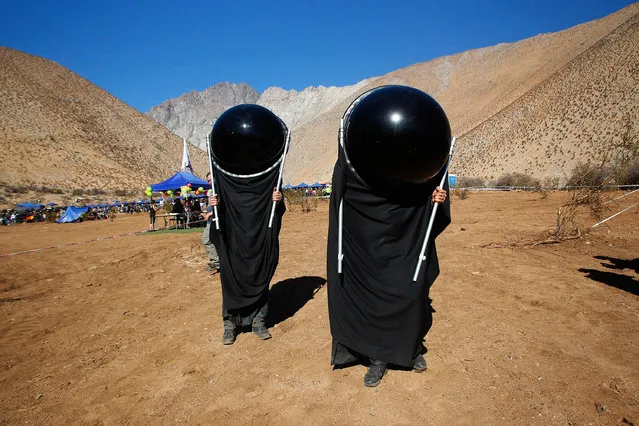
Chileans watch the sky with special suits prior to a total solar eclipse on July 2, 2019 in Paiguano, Chile. Around 25,0000 tourists arrived to Paiguano, a small town of around 1,000 inhabitants in the Elqui Valley, 650 km away Santiago. This is the only Earth's total solar eclipse of 2019 and the first one since 2017. From this point, the sun will fully disappear for around two minutes. It is best visible from a stripe in the South Pacific, Chile and Argentina. (Photo by Marcelo Hernandez/Getty Images)

Chileans watch the sky with special suits prior to a total solar eclipse on July 2, 2019 in Paiguano, Chile. Around 25,0000 tourists arrived to Paiguano, a small town of around 1,000 inhabitants in the Elqui Valley, 650 km away Santiago. This is the only Earth's total solar eclipse of 2019 and the first one since 2017. From this point, the sun will fully disappear for around two minutes. It is best visible from a stripe in the South Pacific, Chile and Argentina. (Photo by Marcelo Hernandez/Getty Images)
Details
04 Jul 2019 00:05:00