Loading...
Done
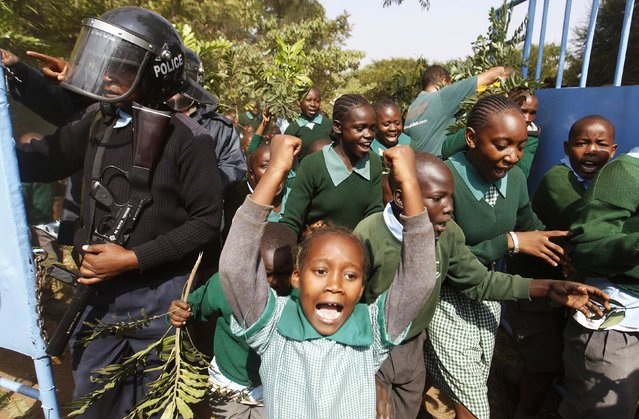
Students from Langata primary school run past riot police as they protest against a perimeter wall illegally erected by a private developer around their school playground in Kenya's capital Nairobi January 19, 2015. (Photo by Thomas Mukoya/Reuters)

Students from Langata primary school run past riot police as they protest against a perimeter wall illegally erected by a private developer around their school playground in Kenya's capital Nairobi January 19, 2015. Riot police used teargas to disperse students at a school in Nairobi as the children protested against the potential loss of their playground. The playground was fenced off in December, during the school holidays, by a prominent developer who also claims ownership of the land. The title to the contested site is said to be in the name of Airport View Housing Limited, according to local media, with plans to use the space to build a parking lot for a hotel. (Photo by Thomas Mukoya/Reuters)
Details
20 Jan 2015 13:04:00
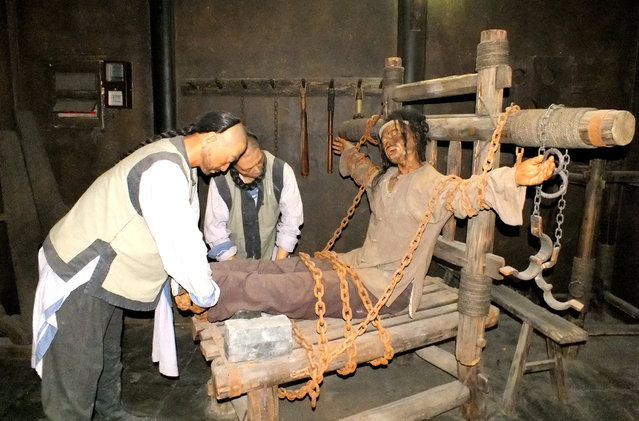
Wax figures with torture instrument named “torture-rack” are seen on October 25, 2014 in Huai'an, Jiangsu province of China. The exhibition, which opened last year at an educational center in the eastern city of Huai'an, includes reenactments of prisoners being hung over a fire, flayed and being tortured on what is known as a “Tiger Bench” – pictured above – a Qing dynasty (1644-1912) device that contorted victims' legs and arms in high pressure positions that could break bones or tear apart joints. (Photo by ChinaFotoPress)

Organizers of an exhibition of ancient instruments of torture in Huai'an, Jiangsu province, have suggested that children, heart disease patients and people with high blood pressure stay away because of the vivid depictions of shocking cruelty. The exhibition has more than 200 instruments of torture on display in the 50,000-square-meter exhibition halls of a restored ancient building. Wax figures, along with sound and light techniques, are incorporated for scary effect. The local government said the exhibition is for tourists and historians to research ancient torture practices. (Photo by ChinaFotoPress)
Details
29 Oct 2014 12:22:00
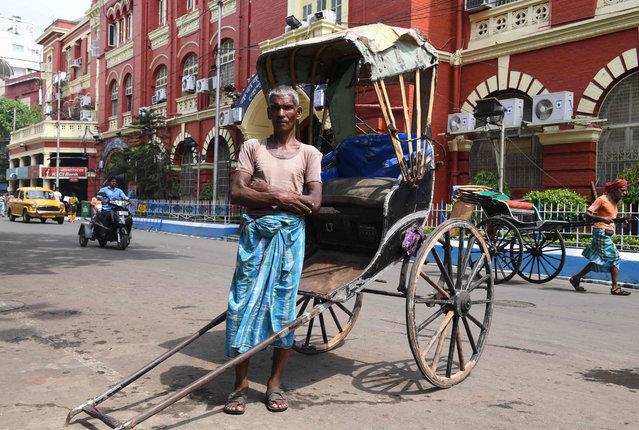
Mohammad Ashgar, 65, an Indian rickshaw puller, poses for a photograph next to his rickshaw in Kolkata on April 21, 2018. A mainstay of 19 th century transportation options, the hand- pulled rickshaw survives in India only in Kolkata after being outlawed elsewhere. The local puller's union puts the number of pullers in the city at 3,000. The union has resisted all previous attempts to ban their livelihood, previously organising mass protests of their members against moves to stamp out the practice. (Photo by Dibyangshu Sarkar/AFP Photo)

Ahead of May Day, AFP' s video and photo teams spoke to men and women around the globe whose jobs are becoming increasingly rare, particularly as technology transforms societies. Here: Mohammad Ashgar, 65, an Indian rickshaw puller, poses for a photograph next to his rickshaw in Kolkata on April 21, 2018. (Photo by Dibyangshu Sarkar/AFP Photo)
Details
02 May 2018 00:01:00
Kawakanih Yawalapiti, 9, Upper Xingu region of Mato Grosso, Brazil, 2018: Kawakanih lives with her tribe, the Yawalapiti, in Xingu national park, a preserve in the Amazon basin of Brazil. The Yawalapiti collect seeds to preserve species unique to their ecosystem, which lies between the rain forest and savannah. Kawakanih’s diet is simple, consisting mainly of fish, cassava, porridge, fruit and nuts. “It takes five minutes to catch dinner”, says Kawakanih. “When you’re hungry, you just go to the river with your net”. (Photo by Gregg Segal/The Guardian)

Photographer Gregg Segal travelled the world to document children and the food they eat in a week. Partly inspired by the increasing problems of childhood obesity, he tracked traditional regional diets as yet unaffected by globalisation, and ironically, found that the healthiest diets were often eaten by the least well off. (Photo by Gregg Segal/The Guardian)
Details
03 Jul 2019 00:03:00
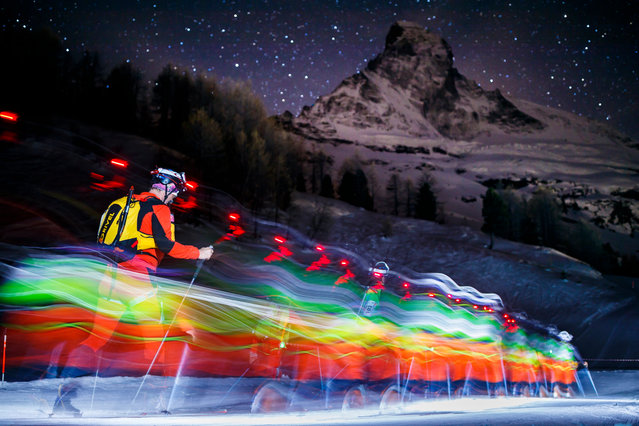
Competitors climb in front of the Matterhorn mountain at the start of the 21st Glacier Patrol race in Stafel outside the ski resort of Zermatt, Switzerland, 18 April 2018. The Glacier Patrol (Patrouille des Glaciers in French), organized by the Swiss Army, takes place from April 17 to 21. Highly-experienced hiker-skiers trek for over 53km (3994m ascent and 4090m descent) along the Haute Route along the Swiss-Italian border from Zermatt to Verbier. (Photo by Valentin Flauraud/EPA/EFE)

Competitors climb in front of the Matterhorn mountain at the start of the 21st Glacier Patrol race in Stafel outside the ski resort of Zermatt, Switzerland, 18 April 2018. The Glacier Patrol (Patrouille des Glaciers in French), organized by the Swiss Army, takes place from April 17 to 21. Highly-experienced hiker-skiers trek for over 53km (3994m ascent and 4090m descent) along the Haute Route along the Swiss-Italian border from Zermatt to Verbier. (Photo by Valentin Flauraud/EPA/EFE)
Details
19 Apr 2018 07:44:00
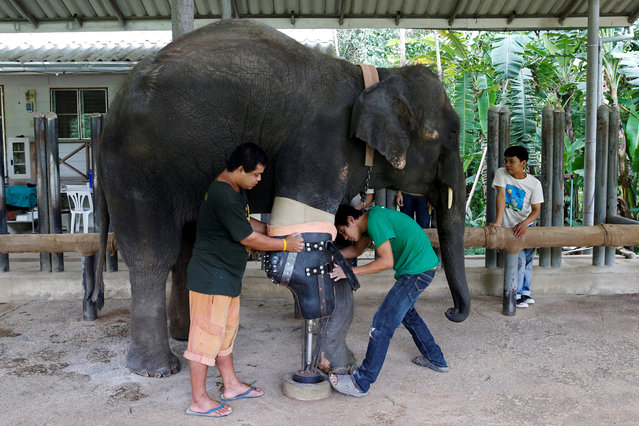
Mosha, the elephant that was injured by a landmine, has her prosthetic leg attached at the Friends of the Asian Elephant Foundation in Lampang, Thailand, June 29, 2016. Mosha was 7 months old when she stepped on a land mine near Thailand’s border with Myanmar and lost a front leg. That was a decade ago. Mosha is one of more than a dozen elephants who have been wounded by land mines in the border region, where rebels have been fighting the Myanmar government for decades. She was the first elephant to be fitted with a prosthetic limb at the hospital near Lampang. Mosha weighed about 1,300 pounds (590 kg) when she was wounded. (Photo by Athit Perawongmetha/Reuters)

Mosha, the elephant that was injured by a landmine, has her prosthetic leg attached at the Friends of the Asian Elephant Foundation in Lampang, Thailand, June 29, 2016. Mosha was 7 months old when she stepped on a land mine near Thailand’s border with Myanmar and lost a front leg. That was a decade ago... (Photo by Athit Perawongmetha/Reuters)
Details
24 Aug 2016 11:19:00
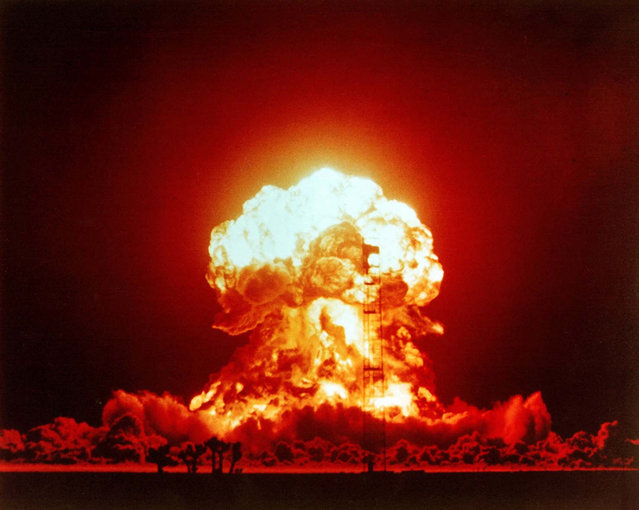
The BADGER shot was a 23 kiloton nuclear bomb. Over 2,000 US soldiers were within 3.7 kilometers of the explosion. (Photo by Alamy Stock Photo)

The BADGER shot was a 23 kiloton nuclear bomb. Over 2,000 US soldiers were within 3.7 kilometers of the explosion. (Photo by Alamy Stock Photo)
Details
12 Aug 2017 05:38:00
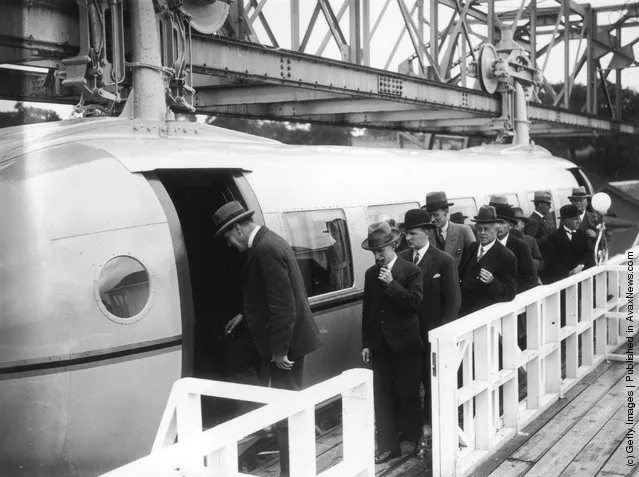
1930: The first load of passengers queuing for the Bennie Railplane in Glasgow; the inventor George Bennie is third in the queue. The streamlined cars are self propelled, driven by air screws in front and behind, and hang from a steel girder

The first load of passengers queuing for the Bennie Railplane in Glasgow; the inventor George Bennie is third in the queue. The streamlined cars are self propelled, driven by air screws in front and behind, and hang from a steel girder. (Photo by J. A. Hampton/Topical Press Agency/Getty Images). 4th July 1930
Details
28 Nov 2011 12:32:00