Loading...
Done
New autopilot features are demonstrated in a Tesla Model S during a Tesla event in Palo Alto, California, 2015. Federal officials say the driver of a Tesla S sports car using the vehicle’s “autopilot” automated driving system has been killed in a collision with a truck, the first U.S. self-driving car fatality. The National Highway Traffic Safety Administration said preliminary reports indicate the crash occurred when a tractor-trailer made a left turn in front of the Tesla at a highway intersection. (Photo by Beck Diefenbach/Reuters)

New autopilot features are demonstrated in a Tesla Model S during a Tesla event in Palo Alto, California, 2015. Federal officials say the driver of a Tesla S sports car using the vehicle’s “autopilot” automated driving system has been killed in a collision with a truck, the first U.S. self-driving car fatality. The National Highway Traffic Safety Administration said preliminary reports indicate the crash occurred when a tractor-trailer made a left turn in front of the Tesla at a highway intersection. Joshua D. Brown, of Canton, Ohio, died in the accident May 7 in Williston, Florida, when his car's cameras failed to distinguish the white side of a turning tractor-trailer from a brightly lit sky and didn't automatically activate its brakes, according to government records obtained Thursday. (Photo by Beck Diefenbach/Reuters)
Details
04 Jul 2016 08:30:00
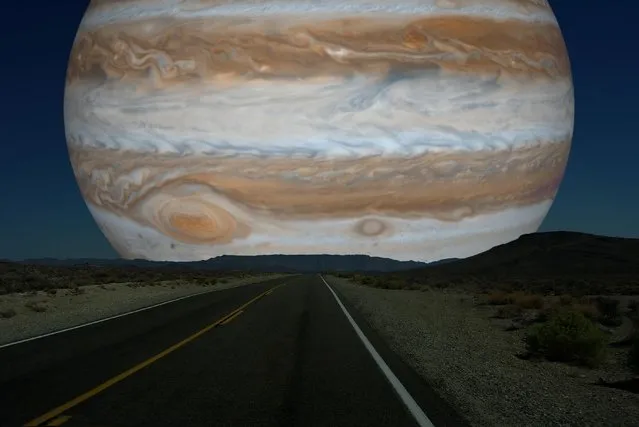
If The Moon Were Replaced With Some Of Our Planets

Our moon is a pretty big object. It's big enough to be a respectable planet in its own right, if it were orbiting the sun instead of the Earth. (Actually, it is orbiting the sun in a nearly perfectly circular orbit, that the Earth only slightly perturbs... but that's a topic for another day.) The Moon is a quarter the diameter of the Earth. Only Pluto has a satellite that is larger, in proportion to the size of the planet it orbits.

Details
29 Mar 2013 10:12:00
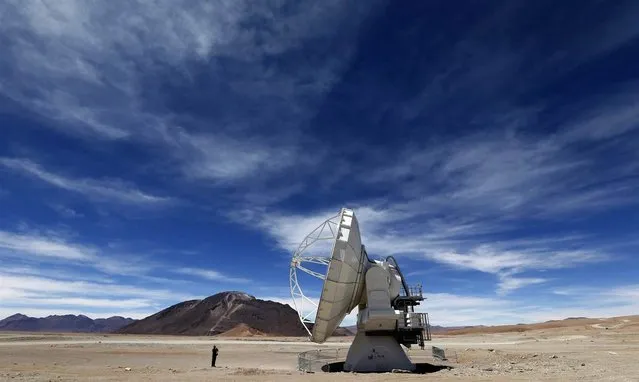
A man takes a photo of a radio antenna that's part of the Atacama Large Milimeter Array Observatory on March 12, 2013 at Llano de Chajnantor, about 43 miles (70 kilometers) from San Pedro de Atacama, Chile. The $1.5 billion ALMA facility, which had its official inauguration on March 13, is considered the world's most expensive ground-based observatory. (Photo by Felipe Trueba/EPA)

A man takes a photo of a radio antenna that's part of the Atacama Large Milimeter Array Observatory on March 12, 2013 at Llano de Chajnantor, about 43 miles (70 kilometers) from San Pedro de Atacama, Chile. The $1.5 billion ALMA facility, which had its official inauguration on March 13, is considered the world's most expensive ground-based observatory. (Photo by Felipe Trueba/EPA)
Details
03 Apr 2013 09:25:00
Mercury and Maia, fueled and overhauled, are waiting in the Tay at Dundee, for favorable weather to start the flight to the Cape, a distance of 6,370 miles. The composite machine moored in the Tay River, at Dundee, on September 23, 1938. (Photo by AP Photo)

Mercury and Maia, fueled and overhauled, are waiting in the Tay at Dundee, for favorable weather to start the flight to the Cape, a distance of 6,370 miles. The composite machine moored in the Tay River, at Dundee, on September 23, 1938. (Photo by AP Photo)
Details
04 Oct 2017 06:59:00
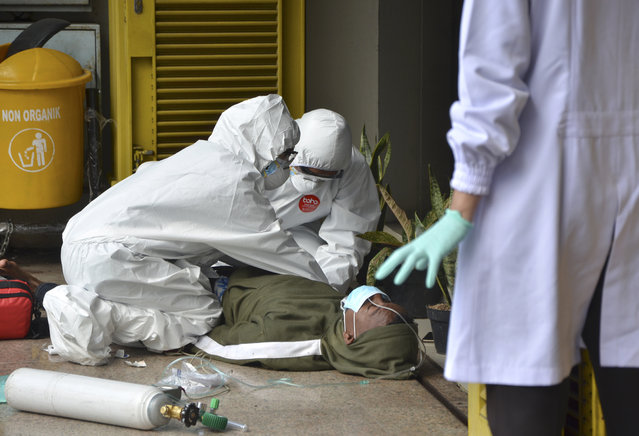
Paramedics wearing protective suits amid fears of coronavirus outbreak check on a man who collapsed outside a clinic in Jakarta, Indonesia, Thursday, March 26, 2020. It's not immediately clear what caused the man to collapse. The U.S. Embassy in Indonesia has ordered the departure of employees' family members under the age of 21 from its missions in the country where new COVID-19 patients have surged in the past week with high fatality. (Photo by Muchlis Akbar/AP Photo)

Paramedics wearing protective suits amid fears of coronavirus outbreak check on a man who collapsed outside a clinic in Jakarta, Indonesia, Thursday, March 26, 2020. It's not immediately clear what caused the man to collapse. The U.S. Embassy in Indonesia has ordered the departure of employees' family members under the age of 21 from its missions in the country where new COVID-19 patients have surged in the past week with high fatality. (Photo by Muchlis Akbar/AP Photo)
Details
29 Mar 2020 00:10:00
Men give bananas to monkeys gathered on the side of the road as India remains under an unprecedented lockdown over the highly contagious coronavirus (COVID-19) on April 08, 2020 in New Delhi, India. Wild animals, including monkeys, are roaming human settlements in India as people are staying indoors due to the 21-day lockdown. With India's 1.3 billion population and tens of millions of cars off the roads, wildlife is moving towards areas inhabited by humans. Wild animals in many countries have been seen roaming streets. A study says some 60 percent of the new diseases found around the globe every year are zoonotic, meaning they originate in animals and are passed on to humans. COVID-19 is a zoonotic disease that is suspected to have come from the wet markets of Wuhan, China. (Photo by Yawar Nazir/Getty Images)

Men give bananas to monkeys gathered on the side of the road as India remains under an unprecedented lockdown over the highly contagious coronavirus (COVID-19) on April 08, 2020 in New Delhi, India. Wild animals, including monkeys, are roaming human settlements in India as people are staying indoors due to the 21-day lockdown. (Photo by Yawar Nazir/Getty Images)
Details
12 Apr 2020 00:05:00

Some bats in the forested area of Guapiles, Costa Rica, 21 April 2020. (Photo by Jeffrey Arguedas/EPA/EFE)

Some bats in the forested area of Guapiles, Costa Rica, 21 April 2020. (Photo by Jeffrey Arguedas/EPA/EFE)
Details
03 May 2020 00:05:00
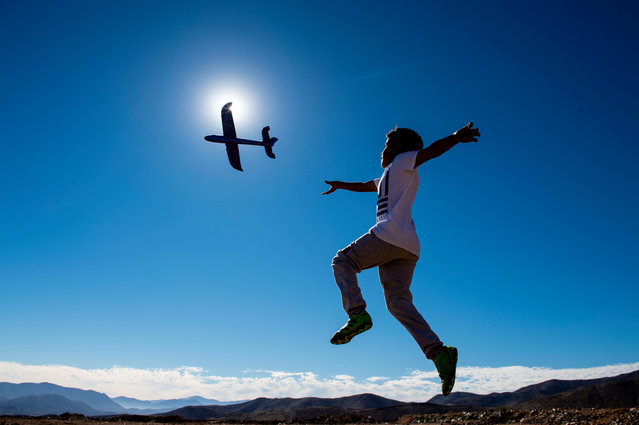
A boy plays with a toy plane on the eve of a solar eclipse, in La Higuera, Coquimbo Region, in the Atacama desert about 580 km north of Santiago, on July 1, 2019. A total solar eclipse will be visible from small parts of Chile and Argentina on July 2. (Photo by Martin Bernetti/AFP Photo)

A boy plays with a toy plane on the eve of a solar eclipse, in La Higuera, Coquimbo Region, in the Atacama desert about 580 km north of Santiago, on July 1, 2019. A total solar eclipse will be visible from small parts of Chile and Argentina on July 2. (Photo by Martin Bernetti/AFP Photo)
Details
14 May 2020 00:03:00