Loading...
Done
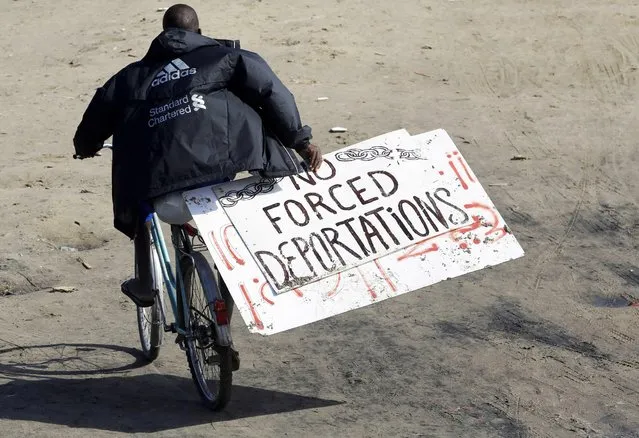
A migrant holds a placard which reads “No Forced Deportations” as he rides his bicycle at the makeshift camp called “The New Jungle” in Calais, France, September 18, 2015. (Photo by Regis Duvignau/Reuters)

A migrant holds a placard which reads “No Forced Deportations” as he rides his bicycle at the makeshift camp called “The New Jungle” in Calais, France, September 18, 2015. Around 3,500 migrants and refugees are camped in Calais, fleeing war and poverty in the Middle East, Africa and Asia and now living in the jungle. Most of them are hoping to make the crossing to England. (Photo by Regis Duvignau/Reuters)
Details
25 Sep 2015 08:00:00
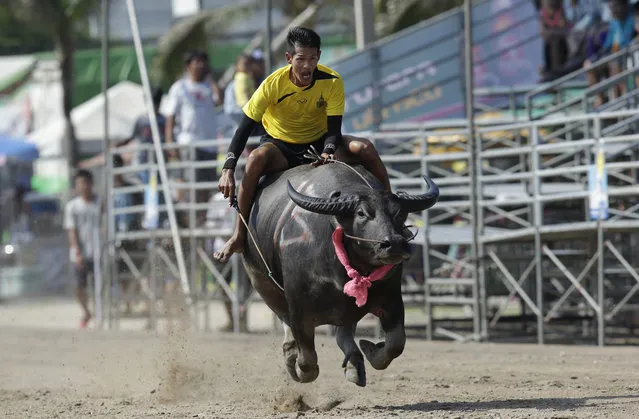
A Thai jockey competes during an annual water buffalo race in Chonburi Province, south of Bangkok, Thailand, Monday, Oct. 26, 2015. The annual race is a celebration among rice farmers before harvest. (AP Photo/Sakchai Lalit)

A Thai jockey competes during an annual water buffalo race in Chonburi Province, south of Bangkok, Thailand, Monday, October 26, 2015. The annual race is a celebration among rice farmers before harvest. (Photo by Sakchai Lalit/AP Photo)
Details
29 Oct 2015 08:06:00
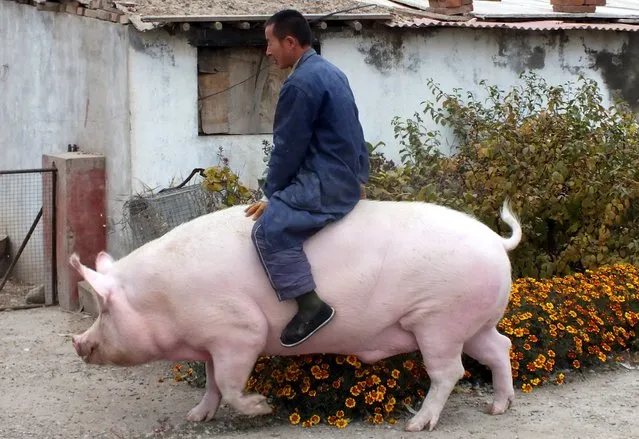
Farmer Zhang Xianping rides his pig "Big Precious" during an interview with the media, in Zhangjiakou, Hebei province, China, November 2, 2015. Zhang, a pig breeder, instead of killing it, decided to keep the two-year-old "Big Precious" as pet when its weight reached 600 kg, according to local media. (Photo by Reuters/China Daily)

Farmer Zhang Xianping rides his pig "Big Precious" during an interview with the media, in Zhangjiakou, Hebei province, China, November 2, 2015. Zhang, a pig breeder, instead of killing it, decided to keep the two-year-old "Big Precious" as pet when its weight reached 600 kg, according to local media. (Photo by Reuters/China Daily)
Details
06 Nov 2015 08:02:00
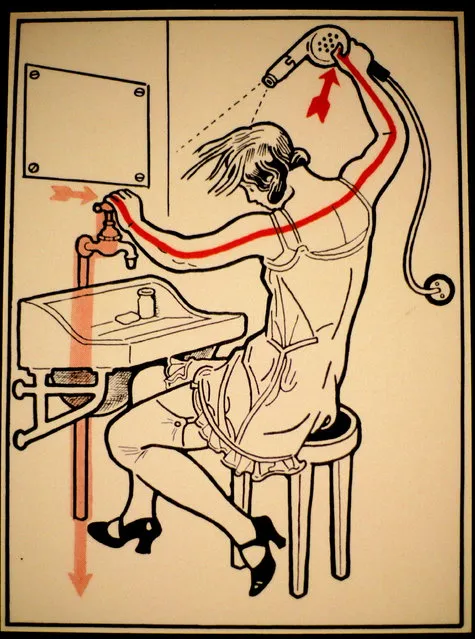
The book “Elektroschutz in 132 Bildern” (Electrical Protection in 132 Pictures) was published in Vienna in the early 1900s by a Viennese physician named Stefan Jellinek (1878-1968, a founder of the Electro-Pathological Museum). The pictures are nice and direct and unambiguous; they teach, graphically, that the surest way to kill yourself with electricity is to form a complete path from source (usually the bright red arrow) to ground (the screened back, pink arrow). Arrowheads provide the path for current flow. (Photo by The Vienna Technical Museum)

The book “Elektroschutz in 132 Bildern” (Electrical Protection in 132 Pictures) was published in Vienna in the early 1900s by a Viennese physician named Stefan Jellinek (1878-1968, a founder of the Electro-Pathological Museum). The pictures are nice and direct and unambiguous; they teach, graphically, that the surest way to kill yourself with electricity is to form a complete path from source (usually the bright red arrow) to ground (the screened back, pink arrow). Arrowheads provide the path for current flow. (Photo by The Vienna Technical Museum)
Details
11 Aug 2014 11:10:00
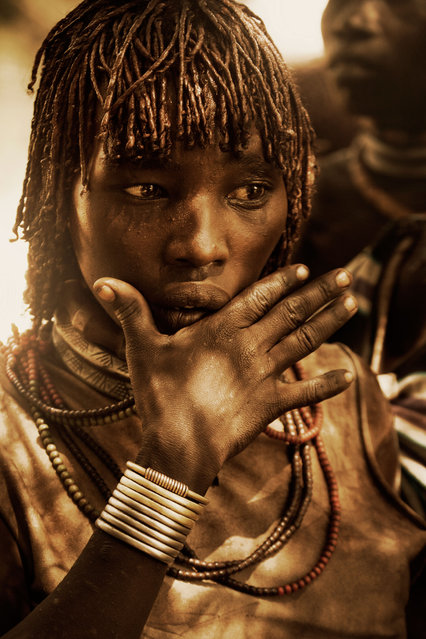
The Hamar people traditionally use red ocher clay to braid the hair of their women. (Photo by Diego Arroyo)

During his time in Ethiopia, New York-based art director and photographer Diego Arroyo spent time with the Hamar, Mursi, Dassanech, and Arbore Tribes. They, along with several others tribes, make up the 200,000 people situated in Africa’s Great Rift Valley. The people of the Omo Valley are still primarily herders and farmers, living an isolated and simple life. While they have yet to be truly touched by globalization, they could soon disappear. Their way of life is being threatened by a massive hydroelectric dam. (Photo by Diego Arroyo)
Details
13 Aug 2014 10:00:00
A pro-democracy protester wearing a Guy Fawkes mask holds a yellow umbrella and a banner in the part of Hong Kong's financial central district protesters are occupying November 2, 2014. The former British colony of Hong Kong, which returned to Chinese rule in 1997, has witnessed a month of protests calling on the Beijing-backed government to keep its promise of introducing universal suffrage. (Photo by Damir Sagolj/Reuters)

A pro-democracy protester wearing a Guy Fawkes mask holds a yellow umbrella and a banner in the part of Hong Kong's financial central district protesters are occupying November 2, 2014. The former British colony of Hong Kong, which returned to Chinese rule in 1997, has witnessed a month of protests calling on the Beijing-backed government to keep its promise of introducing universal suffrage. The protests have for the most part been peaceful, with occasional clashes between the student-led protesters and Beijing supporters seeking to move them from the streets. (Photo by Damir Sagolj/Reuters)
Details
03 Nov 2014 12:12:00
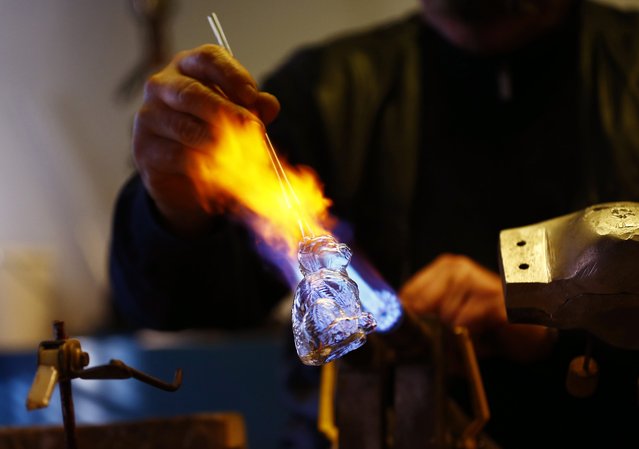
A worker heats a glass cat-shape ornament at the Silverado manufacture of hand-blown Christmas ornaments in town of Jozefow outside Warsaw December 2, 2014. (Photo by Kacper Pempel/Reuters)

A worker heats a glass cat-shape ornament at the Silverado manufacture of hand-blown Christmas ornaments in town of Jozefow outside Warsaw December 2, 2014. (Photo by Kacper Pempel/Reuters)
Details
04 Dec 2014 11:55:00
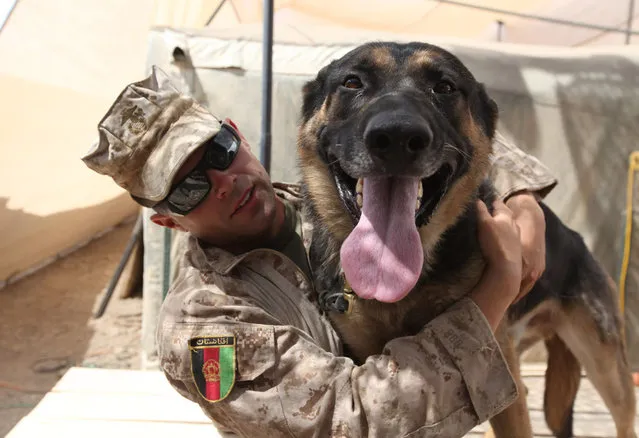
Afghanistan: Dogs of War Part 1

Throughout the course of the long war in Afghanistan, Coalition troops have relied on thousands of military working dogs to help keep them safe, and make their jobs easier. The dogs are trained to detect explosives, to find illegal drugs, to search for missing comrades, or target enemy combatants. Not only are they active on the front lines, but behind the lines they serve as therapy dogs, service dogs, and loyal companions. They also share the same risks as the ground troops, suffering injuries and sometimes death on the battlefields. Gathered here are images of these dogs and their handlers in Afghanistan and back home, from over the past several years, part of the ongoing series here on Afghanistan.
Details
03 Jun 2014 21:02:00