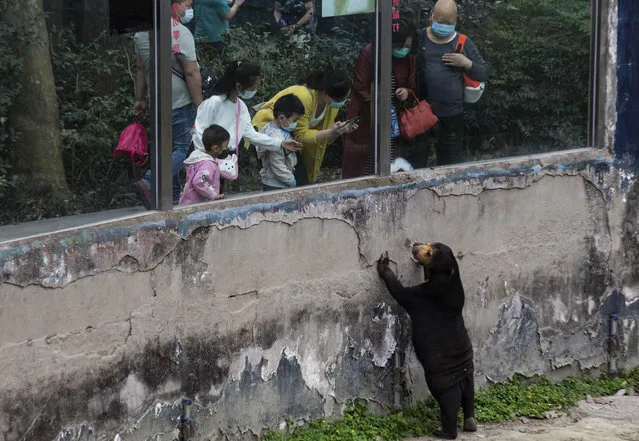
People look at a black bear at the Chengdu zoo amid the coronavirus outbreak on March 26, 2020 in Chengdu, Sichuan Province of China. (Photo by Wang Lei/China News Service via Getty Images)
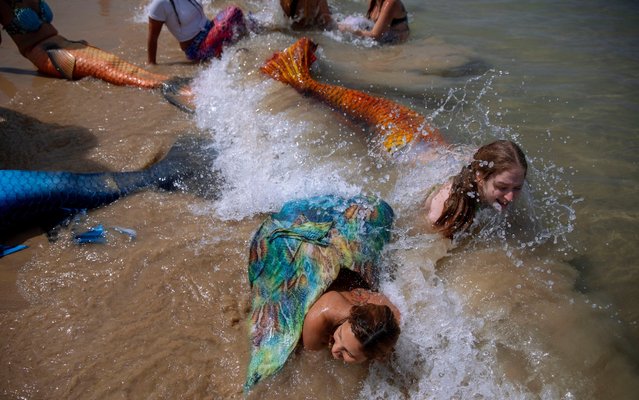
Members of the Israeli Mermaids Community bathe in the sea with a mermaid tails at the beachfront in Bat Yam, near Tel Aviv, Israel, Saturday, May 23, 2020. Members of the Israeli mermaid community gathered at the beachfront to mark the beginning of the bathing season. (Photo by Oded Balilty/AP Photo)
In this Monday, June 29, 2020 a man wearing a face mask to protect against coronavirus, walks past a hair product billboard on the street in Soweto, Johannesburg, South Africa. Africa now has more than a half-million confirmed coronavirus cases as the continent-wide total is now over 508,000 after South Africa recorded another day of more than 10,000 confirmed cases as a new global hot spot. (Photo by Themba Hadebe/AP Photo/File)
An OV-10 Bronco aircraft, decorated with World War One commemoration motifs, flies over Flanders international airport, ahead of the world's first Short Take Off & Landing competition on sand, in Wevelgem, Belgium May 8, 2018. (Photo by Francois Lenoir/Reuters)
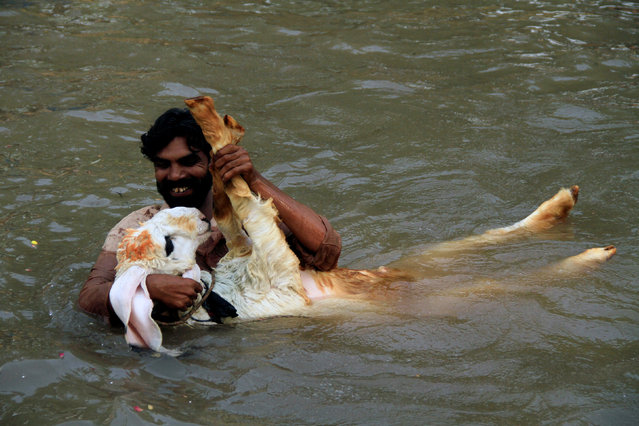
A man plays with his pet goat while taking a bath to cool off in a canal during hot and humid weather in Lahore, Pakistan May 30, 2018. (Photo by Mohsin Raza/Reuters)
American model and television personality Kendall Jenner attends the Longchamp 70th Anniversary Celebration at Opera Garnier on September 11, 2018 in Paris, France. (Photo by Dominique Maitre/WWD/Rex Features/Shutterstock)
Animal rights activists protest against the use of animal leather in fashion businness, a few days before the fashion week opening in Milan, Italy, 16 September 2018. (Photo by Matteo Bazzi/EPA/EFE)
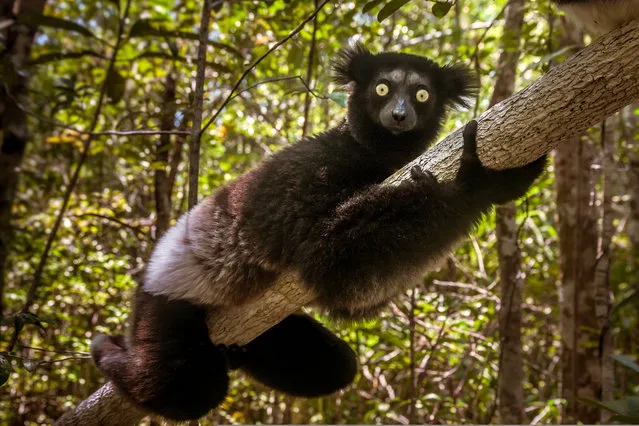
The secretive indri (Indri indri) of Madagascar, the largest living lemur. It is also critically endangered and highly evolutionarily distinct with no close relatives, which makes its branch one of most precarious on the mammal evolutionary tree. In the likely event that the indri goes extinct, we will lose 19m years of unique evolutionary history from the mammal tree of life. (Photo by Pierre-Yves Babelon/Aarhus University)