Loading...
Done
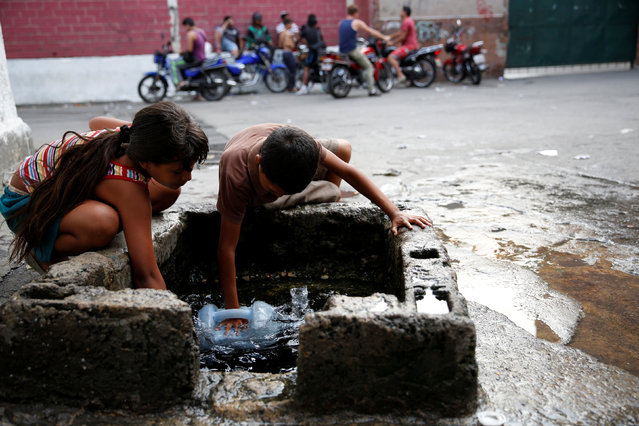
Children fill plastic containers with water from a well on a street, close to a neighbourhood called “The Tank” in the slum of Petare in Caracas, Venezuela, March 17, 2016. (Photo by Carlos Garcia Rawlins/Reuters)

Children fill plastic containers with water from a well on a street, close to a neighbourhood called “The Tank” in the slum of Petare in Caracas, Venezuela, March 17, 2016. Although their nation has one of the world's biggest hydroelectric dams and vast rivers like the fabled Orinoco, Venezuelans are still suffering water and power cuts most days. The problems with stuttering services have escalated in the last few weeks: yet another headache for the OPEC nation's 30 million people already reeling from recession, the world's highest inflation rate, and scarcities of basic goods. President Nicolas Maduro blames a drought, while the opposition blames government incompetence. (Photo by Carlos Garcia Rawlins/Reuters)
Details
08 May 2016 11:15:00
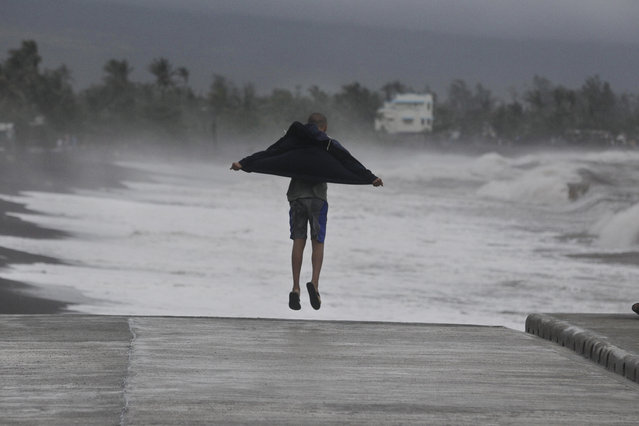
A resident jumps as he watches strong waves crash into shore as an effect of Typhoon Hagupit in Legazpi, Albay province, eastern Philippines on Sunday, December 7, 2014. Typhoon Hagupit knocked out power in entire coastal provinces, mowed down trees and sent more than 650,000 people into shelters before it weakened Sunday, sparing the central Philippines a repetition of unprecedented devastation by last year's storm. (Photo by Aaron Favila/AP Photo)

A resident jumps as he watches strong waves crash into shore as an effect of Typhoon Hagupit in Legazpi, Albay province, eastern Philippines on Sunday, December 7, 2014. Typhoon Hagupit knocked out power in entire coastal provinces, mowed down trees and sent more than 650,000 people into shelters before it weakened Sunday, sparing the central Philippines a repetition of unprecedented devastation by last year's storm. (Photo by Aaron Favila/AP Photo)
Details
08 Dec 2014 12:13:00
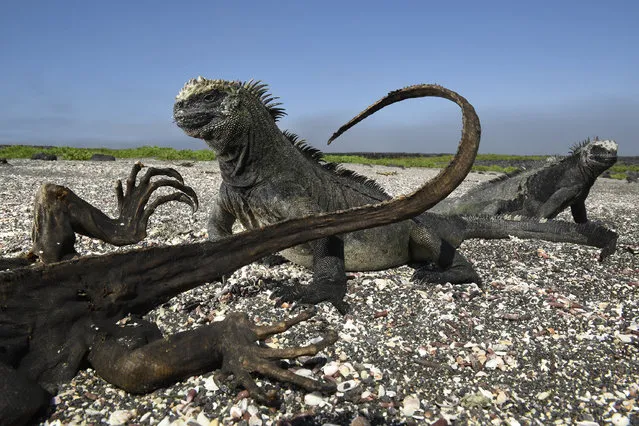
Galapagos – Rocking the Cradle: Four major ocean currents converge along the Galapagos archipelago, creating the conditions for an extraordinary diversity of animal life, April 25, 2016. The islands are home to at least 7,000 flora and fauna species, of which 97 percent of the reptiles, 80 percent of the land birds, 50 percent of the insects and 30 percent of the plants are endemic. The local ecosystem is highly sensitive to the changes in temperature, rainfall and ocean currents that characterize the climatic events known as El Niño and La Niña. These changes cause marked fluctuations in weather and food availability. Many scientists expect the frequency of El Niño and La Niña to increase as a result of climate change, making the Galapagos a possible early-warning location for its effects. (Photo by Thomas P. Peschak for National Geographic/World Press Photo)

Galapagos – Rocking the Cradle: Four major ocean currents converge along the Galapagos archipelago, creating the conditions for an extraordinary diversity of animal life, April 25, 2016. The islands are home to at least 7,000 flora and fauna species, of which 97 percent of the reptiles, 80 percent of the land birds, 50 percent of the insects and 30 percent of the plants are endemic. (Photo by Thomas P. Peschak for National Geographic/World Press Photo)
Details
16 Apr 2018 00:01:00
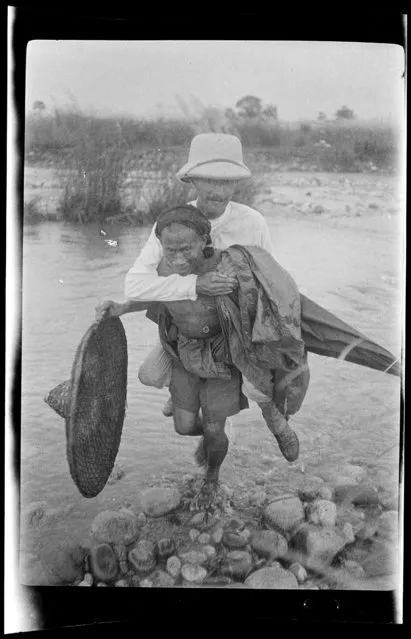
Hillcoat Riding Fu Tu. China, An Xian, 1917-1919. (Photo by Sidney David Gamble)

“Sidney D. Gamble (July 12, 1890 – 1968) was born in Cincinnati, Ohio, to David Berry and Mary Huggins Gamble; grandson of James Gamble, who, with William Procter, founded Procter & Gamble in 1837. in 1912 he graduated magna cum laude from Princeton University with a Bachelor of Literature degree and was elected to Phi Beta Kappa. He visited China for four extended periods, 1908, 1917–1919, 1924–27, and 1931–1932, doing Christian social work for the Y.M.C.A and conducting social surveys. He is now best known for his remarkable and extensive photographs of Peking and North China.” – Wikipedia. (Photo by Sidney David Gamble via Duke University Libraries)

Photo: Hillcoat Riding Fu Tu. China, An Xian, 1917-1919. P.S. All photos are available in high resolution.
Details
16 Aug 2012 11:24:00
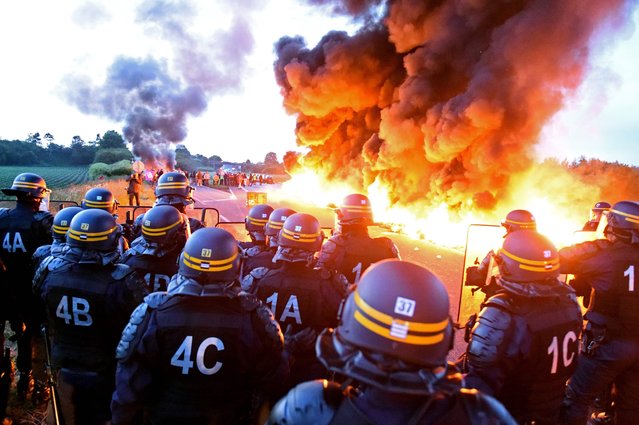
Riot police stand guard behind a fire as refinery workers hold a blockade of the oil depot of Douchy-Les-Mines to protest against the government's proposed labour reforms, on May 25, 2016. Refinery workers stepped up strikes that threaten to paralyse France weeks ahead of the Euro 2016 tournament as the government moved to break their blockades, escalating a three-month tug-of-war over labour reforms. (Photo by François L.O./AFP Photo)

Riot police stand guard behind a fire as refinery workers hold a blockade of the oil depot of Douchy-Les-Mines to protest against the government's proposed labour reforms, on May 25, 2016. Refinery workers stepped up strikes that threaten to paralyse France weeks ahead of the Euro 2016 tournament as the government moved to break their blockades, escalating a three-month tug-of-war over labour reforms. (Photo by François L.O./AFP Photo)
Details
26 May 2016 13:02:00
 A couple embrace during the start of the San Fermin festival in Pamplona, Spain July 6, 2016. (Photo by Vincent West/Reuters)

A couple embrace during the start of the San Fermin festival in Pamplona, Spain July 6, 2016. Revelers from around the world kick off the festival with a messy party in the Pamplona town square, one day before the first of eight days of the running of the bulls. (Photo by Vincent West/Reuters)
Details
07 Jul 2016 11:59:00
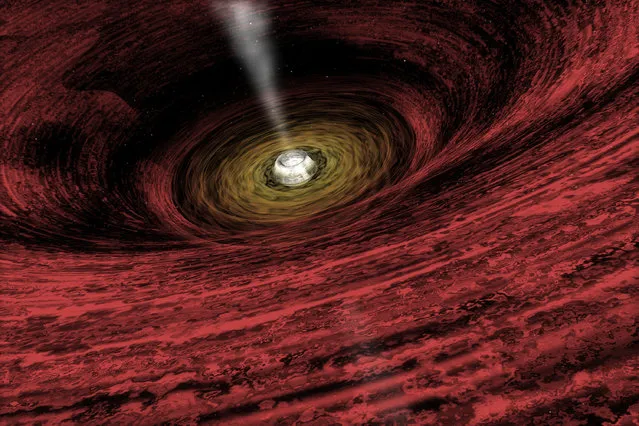
An artist's impression of a growing supermassive black hole located in the early Universe is seen in this NASA handout illustration released on June 15, 2011. Using the deepest X-ray image ever taken, astronomers found the first direct evidence that massive black holes were common in the early universe. This discovery from NASA's Chandra X-Ray Observatory shows that very young black holes grew more aggressively than previously thought, in tandem with the growth of their host galaxies. (Photo by Reuters/NASA/Chandra X-Ray Observatory/A.Hobart)

An artist's impression of a growing supermassive black hole located in the early Universe is seen in this NASA handout illustration released on June 15, 2011. Using the deepest X-ray image ever taken, astronomers found the first direct evidence that massive black holes were common in the early universe. This discovery from NASA's Chandra X-Ray Observatory shows that very young black holes grew more aggressively than previously thought, in tandem with the growth of their host galaxies. (Photo by Reuters/NASA/Chandra X-Ray Observatory/A.Hobart)
Details
11 Feb 2016 12:57:00
A female Chinese People's Liberation Army soldier looks at members of an honor guard preparing for a welcome ceremony for visiting German President Joachim Gauck, outside the Great Hall of the People in Beijing, Monday, March 21, 2016. (Photo by Andy Wong/AP Photo)

A female Chinese People's Liberation Army soldier looks at members of an honor guard preparing for a welcome ceremony for visiting German President Joachim Gauck, outside the Great Hall of the People in Beijing, Monday, March 21, 2016. (Photo by Andy Wong/AP Photo)
Details
22 Mar 2016 11:36:00