Loading...
Done
Cuddle Party

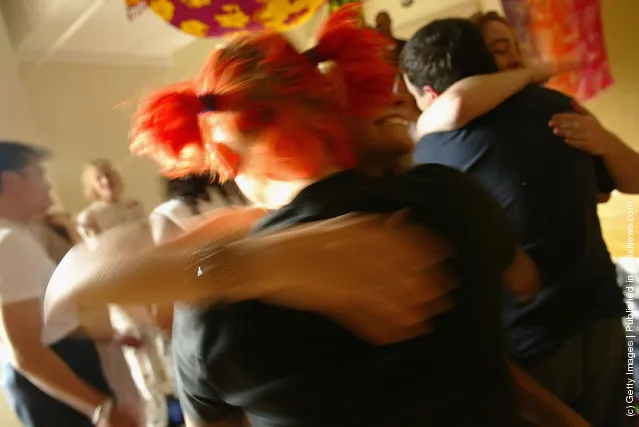
“A cuddle party or cuddle puddle is an event designed with the intention of allowing people to experience non-sexual group physical intimacy through cuddling. Cuddle parties are described by organizers as “workshop/social-events” that gives adults an opportunity to “give and receive welcomed affectionate touch in a no-expectation, friendly setting, according to your needs, desires, interests, and boundaries”. Cuddle parties are described as non-sexual events but kissing may occur at some parties”. – Wikipedia

Photo: People cuddle during an a “Cuddle Party” October 16, 2004 in New York City. Started by Reid Mihalko and Marcia Baczynski, cuddle parties are events for adults to get together and explore affectionate touch and communication without it becoming sexualized. At the parties, strangers spend time introducing themselves and setting boundaries before lying down to cuddle. (Photo by Spencer Platt/Getty Images)
Details
12 Sep 2011 10:07:00
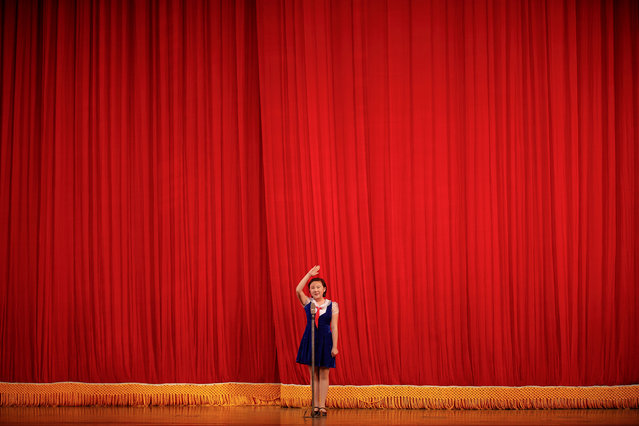
A girl salutes to visitors before a show at the Mangyongdae Children's Palace in central Pyongyang, North Korea May 5, 2016. Foreign journalists invited to cover North Korea's first ruling party congress in 36 years were treated on Thursday to song and dance performances by schoolchildren professing their love for leader Kim Jong Un. Kim is expected to use the congress starting on Friday to declare North Korea a nuclear weapons state and formally adopt his “Byongjin” policy to pursue economic development and nuclear capability at the same time. (Photo by Damir Sagolj/Reuters)

A girl salutes to visitors before a show at the Mangyongdae Children's Palace in central Pyongyang, North Korea May 5, 2016. Pyongyang held a gala of song and dance performances by local school children on May 5 for visiting delegations of foreign journalists and tourists at the Mangyongdae Children's Palace. The event included orchestral, choir, and acrobatic performances, many of them with political undertones. The Seventh Worker's Party Congress commences on May 6, 2016. (Photo by Damir Sagolj/Reuters)
Details
06 May 2016 13:37:00
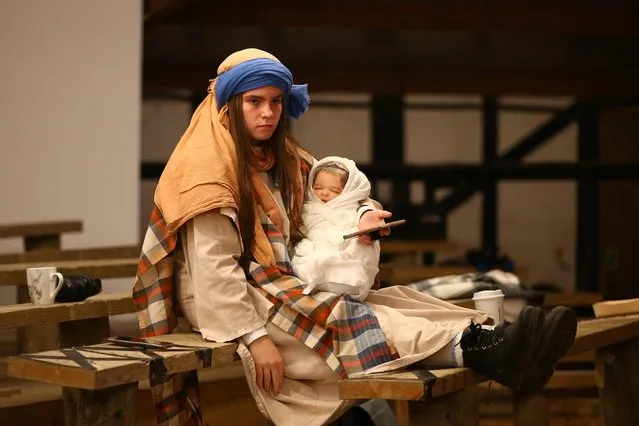
An actor holds a fake baby while waiting for the Wintershall Nativity play dress rehearsal to begin at Wintersall Estate on December 12, 2021 in Guildford, England. The Nativity play, which tells the story of the birth of Jesus Christ, has been performed annually since 1990 over the Christmas period by the Wintershall players. (Photo by Hollie Adams/Getty Images)

An actor holds a fake baby while waiting for the Wintershall Nativity play dress rehearsal to begin at Wintersall Estate on December 12, 2021 in Guildford, England. The Nativity play, which tells the story of the birth of Jesus Christ, has been performed annually since 1990 over the Christmas period by the Wintershall players. (Photo by Hollie Adams/Getty Images)
Details
14 Dec 2021 06:29:00
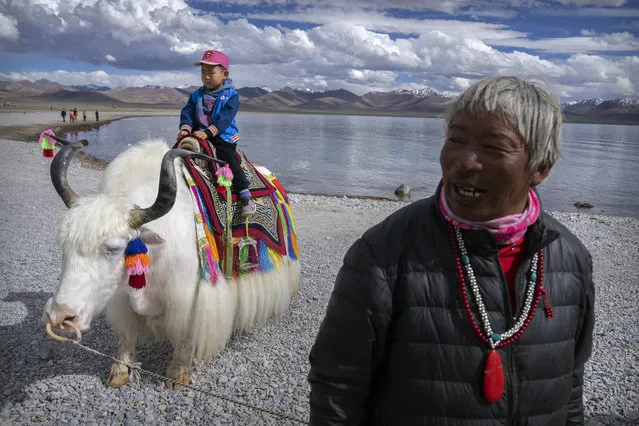
A Tibetan man stands nearby as a young tourist poses for photos on a white yak at the shore of the lake in Namtso in western China’s Tibet Autonomous Region, as seen during a government organized visit for foreign journalists, Wednesday, June 2, 2021. (Photo by Mark Schiefelbein/AP Photo)

A Tibetan man stands nearby as a young tourist poses for photos on a white yak at the shore of the lake in Namtso in western China’s Tibet Autonomous Region, as seen during a government organized visit for foreign journalists, Wednesday, June 2, 2021. (Photo by Mark Schiefelbein/AP Photo)
Details
16 Jun 2021 10:25:00
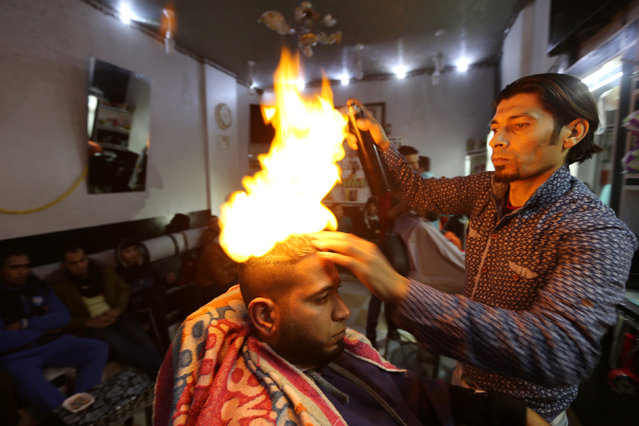
Palestinian barber Ramadan Odwan styles and straightens the hair of a customer with fire at his salon in Rafah, in the southern Gaza Strip February 2, 2017. In Ramadan Odwan's barbershop in Gaza, hair isn't just blow-dried, it's blowtorch-dried. “People have gone crazy about it, many people are curious to go through the experience and they are not afraid”, he told Reuters. “People here love adventures”. Odwan, 37, is not the first stylist in the world to use flame to straighten hair, but his craft is unique in the Gaza Strip. In his salon in the southern Gaza town of Rafah, Odwan applied what he described as a protective liquid coating to a customer's hair – he declined to disclose its contents – before aiming for the head and pressing the button on a small blowtorch. “I control how long I apply fire, I keep it on and off for 10 seconds or 15 seconds. It is completely safe and I have not encountered any accident since I started it two months ago”, Odwan added. Odwan charges 20 shekels ($5.20) for a haircut and fire-straightening. A barber for the past 18 years, he said part of the reason he uses the technique is to show that Palestinian barbers are as “professional as those out there around the world”. (Photo by Ibraheem Abu Mustafa/Reuters)

Palestinian barber Ramadan Odwan styles and straightens the hair of a customer with fire at his salon in Rafah, in the southern Gaza Strip February 2, 2017. In Ramadan Odwan's barbershop in Gaza, hair isn't just blow-dried, it's blowtorch-dried. “People have gone crazy about it, many people are curious to go through the experience and they are not afraid”, he told Reuters. “People here love adventures”. (Photo by Ibraheem Abu Mustafa/Reuters)
Details
11 Feb 2017 00:05:00
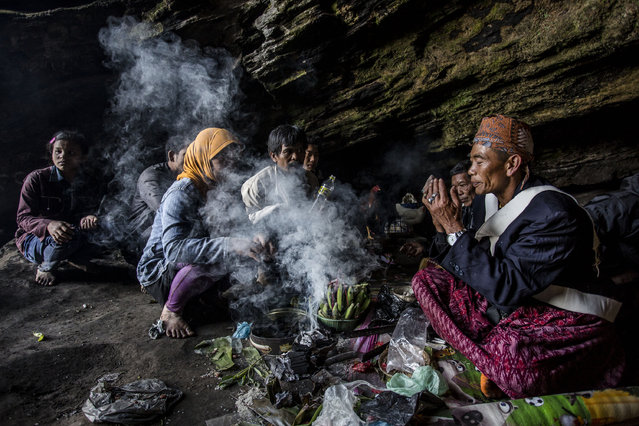
A Tenggerese shaman praying for worshippers at Widodaren cave during the Tenggerese Hindu Yadnya Kasada festival on July 31, 2015 in Probolinggo, East Java, Indonesia. The festival is the main festival of the Tenggerese people and lasts about a month. On the fourteenth day, the Tenggerese make the journey to Mount Bromo to make offerings of rice, fruits, vegetables, flowers and livestock to the mountain gods by throwing them into the volcano's caldera. (Photo by Ulet Ifansasti/Getty Images)

A Tenggerese shaman praying for worshippers at Widodaren cave during the Tenggerese Hindu Yadnya Kasada festival on July 31, 2015 in Probolinggo, East Java, Indonesia. The festival is the main festival of the Tenggerese people and lasts about a month. On the fourteenth day, the Tenggerese make the journey to Mount Bromo to make offerings of rice, fruits, vegetables, flowers and livestock to the mountain gods by throwing them into the volcano's caldera. The origin of the festival lies in the 15th century when a princess named Roro Anteng started the principality of Tengger with her husband Joko Seger, and the childless couple asked the mountain Gods for help in bearing children. The legend says the Gods granted them 24 children but on the provision that the 25th must be tossed into the volcano in sacrifice. The 25th child, Kesuma, was finally sacrificed in this way after initial refusal, and the tradition of throwing sacrifices into the caldera to appease the mountain Gods continues today. (Photo by Ulet Ifansasti/Getty Images)
Details
01 Aug 2015 12:07:00
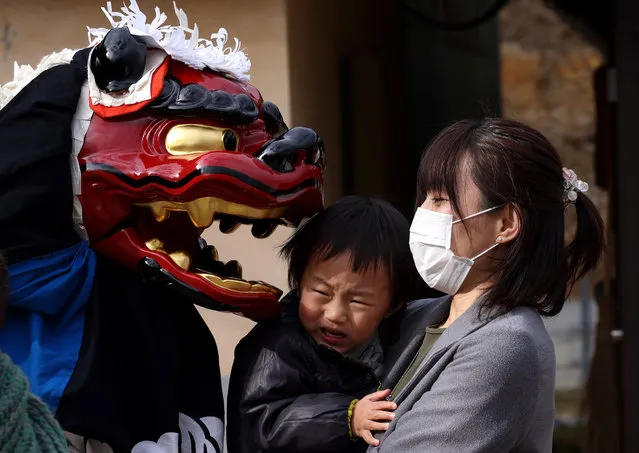
A performer wearing a lion mask performs the Ise Daikagura lion dance at the remote village of Yamanawa on February 08, 2021 in Ryuo, Japan. Ise Daikagura is a group of traditional Lion Dance performers who pray in front of farmers houses and businesses for good grain harvests and disease-free lives. Performers play sacred music using drums and flutes with two lion mask dancers. A lion mask is considered a symbol of God, who enters the house and performs in front of the Shinto God, a statue placed inside the house, mostly in the kitchen. These prayers are called “Kamodo Barai”. After the prayers, they are gifted with money, rice, sake and Japanese sweets from the householders. A group can travel for more than one hundred days to thousands of households and businesses throughout rural-villages in western Japan, and pray to those who are unable to visit the country’s most sacred shrine, the Grand Ise Shrine in Mie Prefecture. The group started its performance in the Edo era between 1603 to 1868 according to Japanese history. The Japanese government designated it as an important folk cultural national property in 1981. (Photo by Buddhika Weerasinghe/Getty Images)

A performer wearing a lion mask performs the Ise Daikagura lion dance at the remote village of Yamanawa on February 08, 2021 in Ryuo, Japan. Ise Daikagura is a group of traditional Lion Dance performers who pray in front of farmers houses and businesses for good grain harvests and disease-free lives. (Photo by Buddhika Weerasinghe/Getty Images)
Details
18 Feb 2021 09:27:00
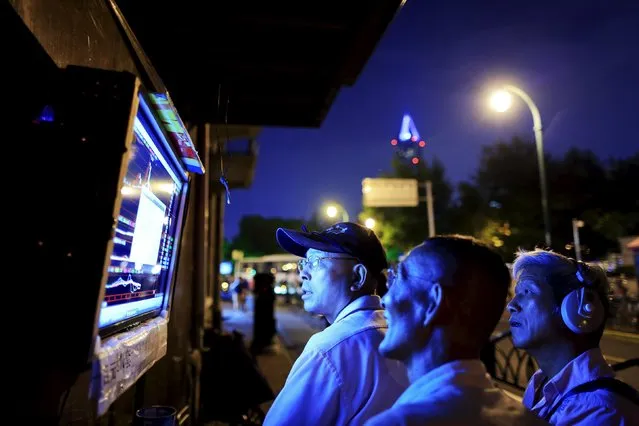
Shen Yuxi (L), introduces analysis software to investors at a “street stock salon” in central Shanghai, China, September 5, 2015. Shen carries a TV screen on his electronic bike to the "salon" every weekends where he sets it up on the wall outside a brokerage house. Shen's been selling analysis software at "the salon" for more than 10 years. (Photo by Aly Song/Reuters)

Some are in it just for the money, others to help buy a meal. Then there are those who trade for fun or to spend time among friends. Millions of investors – pensioners, security guards, high-school students – dominate China's stock markets, conducting about 80 percent of all trades. Retirees gather in brokerage houses dotted around China also to enjoy some company and savour the air conditioning on hot days. Some start as young as 13, trading from home with an eye on future careers in finance. Winning isn't guaranteed. This year, among the most turbulent in China's financial history, its stock markets more than doubled in the six months to May, only to crash amid concerns that growth in the country, which makes everything from cars to steel, is slowing faster than previously thought. (Photo by Aly Song/Reuters)
Details
13 Oct 2015 08:00:00