Loading...
Done
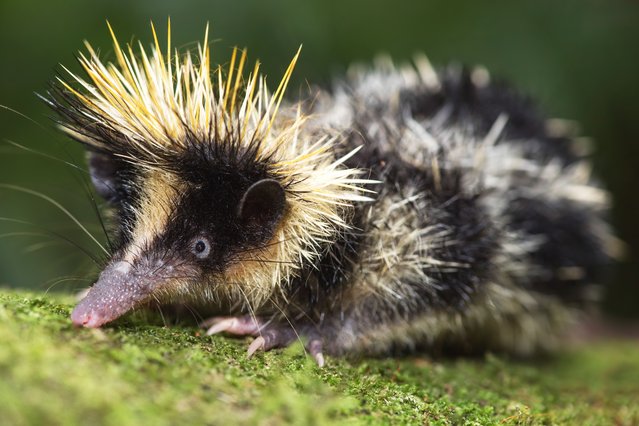
This spiky tenrec was spotted in Madagascar’s Mantadia National Park in the last decade of September 2025. Mostly nocturnal and rarely seen, it puffs out its spines when threatened. Spiky tenrecs are excellent swimmers — unlike most spiny mammals, some species of tenrec can forage in streams and rivers, using their spines for protection while hunting aquatic insects and small prey. (Photo by Dale Morris/Solent News & Photo Agency)

This spiky tenrec was spotted in Madagascar’s Mantadia National Park in the last decade of September 2025. Mostly nocturnal and rarely seen, it puffs out its spines when threatened. Spiky tenrecs are excellent swimmers — unlike most spiny mammals, some species of tenrec can forage in streams and rivers, using their spines for protection while hunting aquatic insects and small prey. (Photo by Dale Morris/Solent News & Photo Agency)
Details
05 Oct 2025 04:02:00
A French soldier stands near a military combat command vehicle on display at The Defence and Security Exhibition

A French soldier stands near a military combat command vehicle on display at The Defence and Security Exhibition on September 13, 2011 in London, England. ExCeL London is hosting the exhibition with hundreds of manufacturers from all over the world displaying their hardware. (Photo by Peter Macdiarmid/Getty Images)
Details
15 Sep 2011 11:24:00
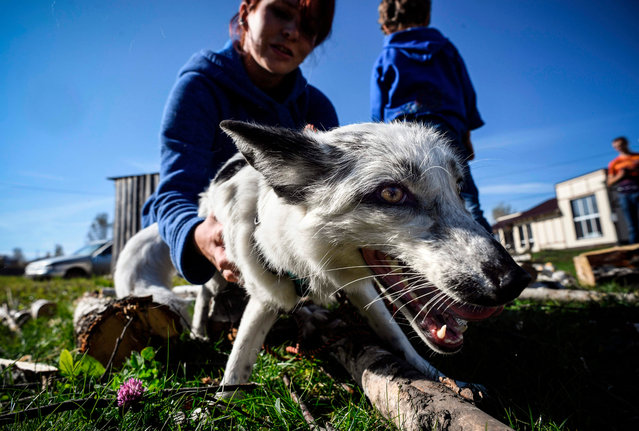
Tatyana Abramova, 33, plays with her home fox Plombir at her countryside house outside Siberian city of Novosibirsk on September 12, 2020. The official start of the Soviet experiment to better understand the domestication of animals by humans began in 1959, and was initiated by geneticists Dmitri Beliaiev and Lioudmila Trout on a farm in Akademgorodok, the scientific center of excellence in Siberia. Their primary objective was to domesticate foxes, to understand how the ancestor of wolves, another canine, evolved into a loyal and loving dog. And understand what this domestication tells us about the genetic evolution of species. (Photo by Alexander Nemenov/AFP Photo)

Tatyana Abramova, 33, plays with her home fox Plombir at her countryside house outside Siberian city of Novosibirsk on September 12, 2020. The official start of the Soviet experiment to better understand the domestication of animals by humans began in 1959, and was initiated by geneticists Dmitri Beliaiev and Lioudmila Trout on a farm in Akademgorodok, the scientific center of excellence in Siberia. Their primary objective was to domesticate foxes, to understand how the ancestor of wolves, another canine, evolved into a loyal and loving dog. And understand what this domestication tells us about the genetic evolution of species. (Photo by Alexander Nemenov/AFP Photo)
Details
25 Oct 2020 00:05:00


“Doctor fish is the name given to two species of fish: Garra rufa and Cyprinion macrostomus. Other nicknames include nibble fish, kangal fish, physio fish and doctorfishen; in non-medical contexts, Garra rufa is called the reddish log sucker. They live and breed in the outdoor pools of some Turkish spas, where they feed on the skin of patients with psoriasis. The fish are like combfishes in that they only consume the affected and dead areas of the skin, leaving the healthy skin to grow, with the outdoor location of the treatment bringing beneficial effects. The spas are not meant as a curative treatment option, only as a temporary alleviation of symptoms, and patients usually revisit the spas every few months”. – Wikipedia

Photo: Visitors to the Aqua Sheko fish therapy spa have their feet exfoliated on June 24, 2010 in London, England. Customers sit with their feet in a tank filled with 100-150 Garra Rufa fish which remove any dead skin by nibbling and sucking. A half hour session is then followed by a foot massage. (Photo by Peter Macdiarmid/Getty Images)
Details
22 Jun 2011 10:44:00
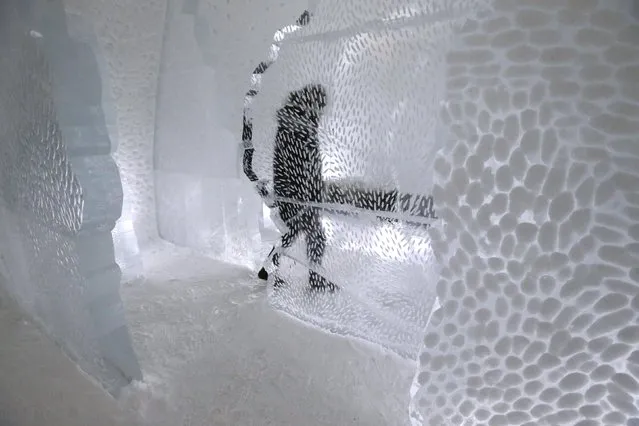
A man walks into a room in the Ice hotel in Jukkasjarvi, Sweden, December 16, 2015. (Photo by Ints Kalnins/Reuters)

In Jukkasjärvi, a village a few miles east of Kiruna, the proprietors of one hotel begin planning for a winter ice festival in March. That’s when they begin collecting some 5,000 tons of ice from the River Torne in order to prepare the Icehotel, the world’s coolest place to stay. Options for overnight stay include snow rooms, ice rooms, art suites, and the Northern Lights room, all of which range from about $300 to $900 per night. But the deluxe suite’s the only way to go. These rooms come with a critical amenity: heated ensuite bathrooms and saunas. Here: A man walks into a room in the Ice hotel in Jukkasjarvi, Sweden, December 16, 2015. (Photo by Ints Kalnins/Reuters)
Details
18 Dec 2015 08:02:00
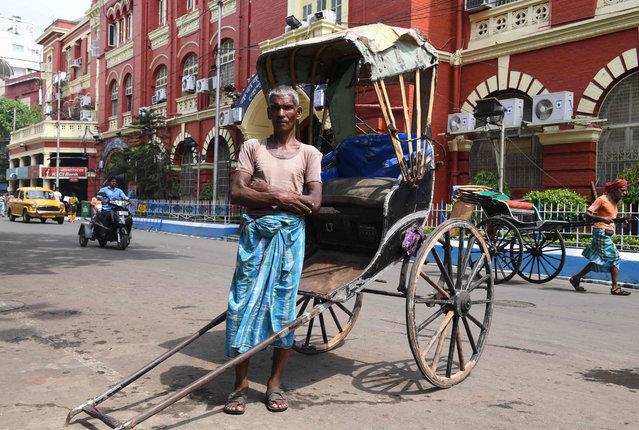
Mohammad Ashgar, 65, an Indian rickshaw puller, poses for a photograph next to his rickshaw in Kolkata on April 21, 2018. A mainstay of 19 th century transportation options, the hand- pulled rickshaw survives in India only in Kolkata after being outlawed elsewhere. The local puller's union puts the number of pullers in the city at 3,000. The union has resisted all previous attempts to ban their livelihood, previously organising mass protests of their members against moves to stamp out the practice. (Photo by Dibyangshu Sarkar/AFP Photo)

Ahead of May Day, AFP' s video and photo teams spoke to men and women around the globe whose jobs are becoming increasingly rare, particularly as technology transforms societies. Here: Mohammad Ashgar, 65, an Indian rickshaw puller, poses for a photograph next to his rickshaw in Kolkata on April 21, 2018. (Photo by Dibyangshu Sarkar/AFP Photo)
Details
02 May 2018 00:01:00
A man walks along an empty street near the central financial district in Hong Kong September 30, 2014. Tens of thousands of pro-democracy protesters extended a blockade of Hong Kong streets on Tuesday, stockpiling supplies and erecting makeshift barricades ahead of what some fear may be a push by police to clear the roads before Chinese National Day. (Photo by Carlos Barria/Reuters)

Reuters photographer Bobby Yip took a series of portraits of people taking part in the “Occupy Central” protests in Hong Kong, and asked them why they had joined the demonstrations. China rules Hong Kong under a “one country, two systems” formula that accords the territory limited democracy. Tens of thousands of mostly student protesters are demanding Beijing give them full democracy, with the freedom to nominate election candidates. The unrest is the worst in Hong Kong since China resumed its rule over the former British colony in 1997. (Photo by Carlos Barria/Reuters)
Details
30 Sep 2014 09:10:00
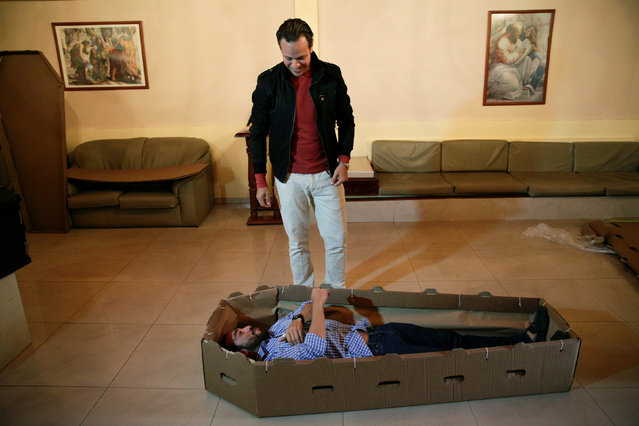
Elio Angulo (bottom C) lies inside a cardboard coffin next to Alejandro Blanchard as they introduce their product to potential customers at a mortuary in Valencia, in the state of Carabobo, Venezuela August 25, 2016. (Photo by Marco Bello/Reuters)

Elio Angulo (bottom C) lies inside a cardboard coffin next to Alejandro Blanchard as they introduce their product to potential customers at a mortuary in Valencia, in the state of Carabobo, Venezuela August 25, 2016. When Venezuelan entrepreneurs Alejandro Blanchard and Elio Angulo decided to create cardboard coffins, they were looking for an ecological selling point to compete against classic wood and brass caskets. Three years on, with the oil-rich country mired in deep economic crisis, their “bio-coffins” are becoming a viable option because of high prices for wooden coffins and shortages of brass ones. (Photo by Marco Bello/Reuters)
Details
27 Aug 2016 11:18:00