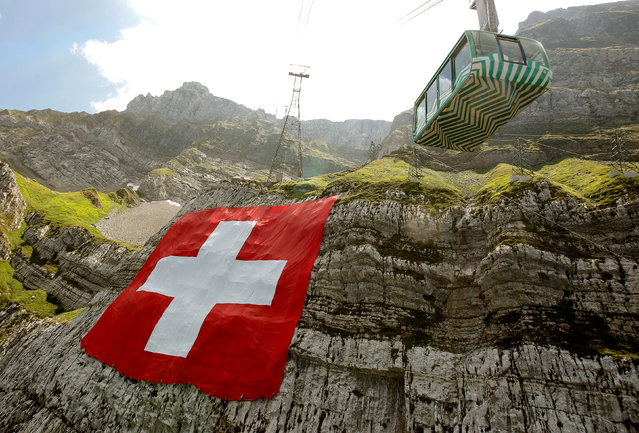
Climbers place a huge 80x80 metres (262x262 feet) Swiss national flag on the western face of the north-eastern Swiss landmark Mount Saentis, Switzerland on July 31, 2018. (Photo by Arnd Wiegmann/Reuters)
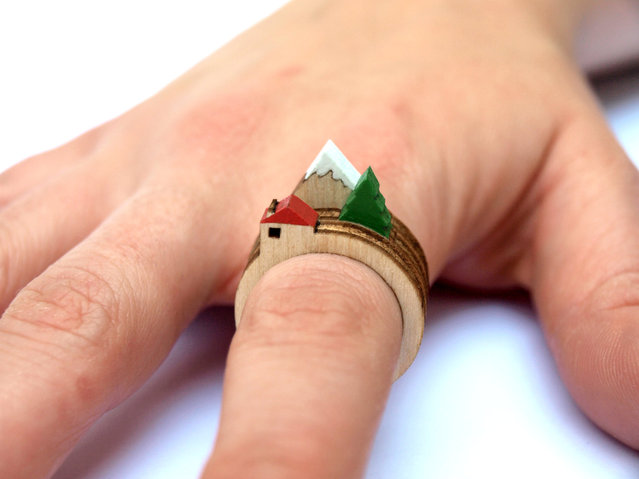
If you ever wanted to wear houses on your finger, now’s your chance (though it’s hard to imagine that any sane person would have such a desire)! Clive Roddy offers you an opportunity to fulfill your dream of having a ring that features houses, waves, mountains, or trees. In order to create these rings, first the metal is cut using a laser, and then the whole thing is hand painted using colored enamel. Though these rings are very pretty, it is hard to imagine someone wearing such a ring on everyday basis. These types of rings should probably be reserved for special occasions or festivals, rather than for everyday use. (Photo by Clive Roddy)
In this Tuesday, August 27, 2019, file photo, a climber stops to take pictures of clouds while climbing towards the summit of Mount Fuji to watch the sunrise, in Japan. (Photo by Jae C. Hong/AP Photo/File)
A climber walks on the ridge beneath the eastern peak of the Gamsberg (2385 meters above sea level) near Grabs, Switzerland, Friday, October 3, 2014. (Photo by Gian Ehrenzeller/AP Photo/Keystone)
The Langdale Pikes in the Lake District in North West England are illuminated on September 14, 2020 by a team of 30 climbers to celebrate the 50th anniversary of the local mountain rescue service. (Photo by Tom Mcnally/Triangle News)
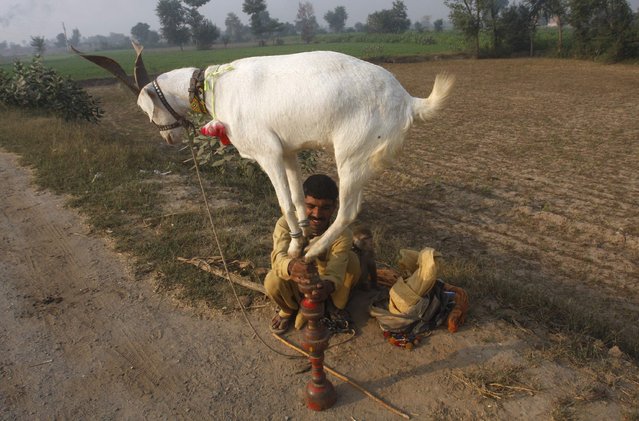
The goats are known to be good climbers, but this one is taking the climbing thing to a whole new level. It clambered on the tip of its owner’s stick, as a part of the roadside performance for a quick coin, on the outskirts of Faisalabad, Pakistan, November 5, 2012. (Photo by Fayyaz Hussain/Reuters)
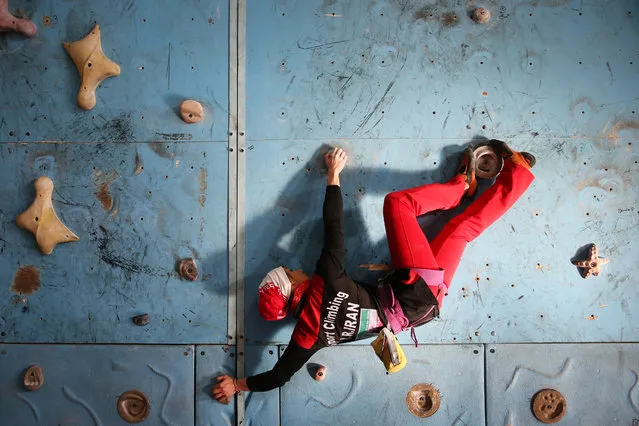
In this Monday, January 18, 2016 photo, Iranian rock climber, Farnaz Esmaeilzadeh, scales a climbing gym in the city of Zanjan, some 330 kilometers (207 miles) west of the capital Tehran, Iran. Esmaeilzadeh, 27, who has been climbing since she was 13, has distinguished herself in international competitions despite the barriers she faces as a female athlete in conservative Iran. (Photo by Ebrahim Noroozi/AP Photo)
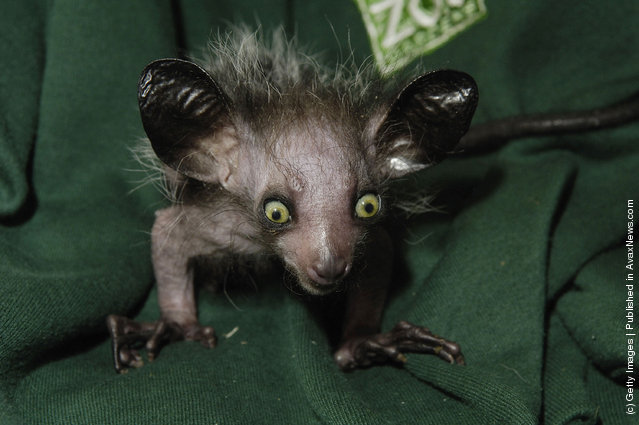
“The aye-aye (Daubentonia madagascariensis) is a lemur, a strepsirrhine primate native to Madagascar that combines rodent-like teeth and a special thin middle finger to fill the same ecological niche as a woodpecker. It is the world's largest nocturnal primate, and is characterized by its unusual method of finding food; it taps on trees to find grubs, then gnaws holes in the wood and inserts its narrow middle finger to pull the grubs out. The only other animal species known to find food in this way is the striped possum. From an ecological point of view the aye-aye fills the niche of a woodpecker as it is capable of penetrating wood to extract the invertebrates within”. – Wikipedia
Photo: In this handout image from Bristol Zoo is seen the first captive bred aye-aye in the UK named “Kintana” (meaning star in Malagasy) April 15, 2005 at Bristol Zoo Gardens, England. The zoo announced today only the second baby aye-aye to be hand-reared in the world (the first was in Jersey Zoo) and has now made his first public appearance since his birth on 11 February 2005. (Photo by Rob Cousins/Bristol Zoo via Getty Images)