Loading...
Done
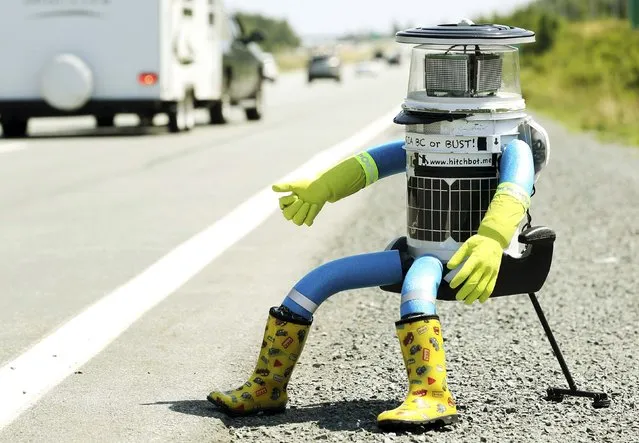
The anthropomorphic robot named hitchBOT sits on the shoulder of Highway 102 to begin its 6000 kilometer cross country journey outside of Halifax, Nova Scotia, July 27, 2014. The hitch hiking robot is part of a social experiment to see if drivers will pick up and drop off the robot in one piece to an art gallery in Victoria, British Columbia. (Photo by Paul Darrow/Reuters)

The anthropomorphic robot named hitchBOT sits on the shoulder of Highway 102 to begin its 6000 kilometer cross country journey outside of Halifax, Nova Scotia, July 27, 2014. The hitch hiking robot is part of a social experiment to see if drivers will pick up and drop off the robot in one piece to an art gallery in Victoria, British Columbia. (Photo by Paul Darrow/Reuters)
Details
02 Aug 2014 13:12:00
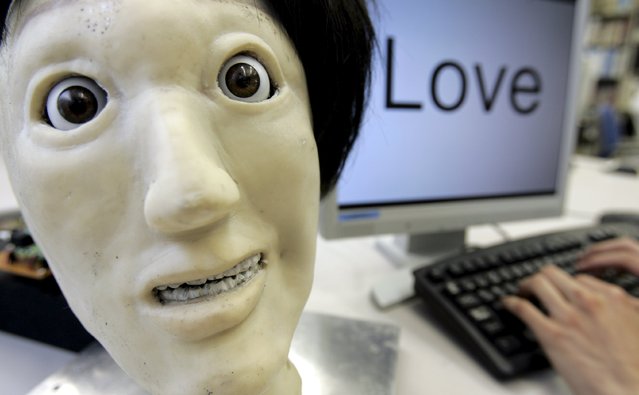
A humanoid robot named Kansei, meaning “sensibility” in Japanese, makes a facial expression depicting “happiness”, next to the word “Love” during a demonstration at a laboratory of Meiji University's Robot and Science Institute in Kawasaki, south of Tokyo in this June 4, 2007 file photo. (Photo by Yuriko Nakao/Reuters)

A humanoid robot named Kansei, meaning “sensibility” in Japanese, makes a facial expression depicting “happiness”, next to the word “Love” during a demonstration at a laboratory of Meiji University's Robot and Science Institute in Kawasaki, south of Tokyo in this June 4, 2007 file photo. Three-fourths of robot installations over the next decade are expected to be concentrated in four areas: transportation equipment, including the automotive sector; computer and electronic products; electrical equipment and machinery. Labor costs have climbed in countries such as China that have been popular for outsourcing production, while technological advances for robots allow them to be more flexible and perform more tasks. (Photo by Yuriko Nakao/Reuters)
Details
17 Apr 2015 09:39:00
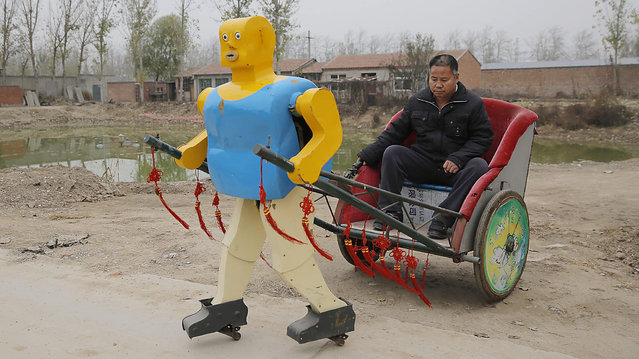
Robot inventor Wu Yulu sits on a rickshaw driven by a robot which he invented in his village in rural Beijing's Tongzhou district, China, 17 November 2016. The 54-year-old Chinese farmer living in rural Beijing's Tongzhou district invented 63 robots in the past 30 years. Wu, who only received primary school education, plans to give up the agricultural work for his robot products. He regularly participates in exhibitions, transfers patent rights and teaches at the university to earn money. (Photo by Wu Hong/EPA)

Robot inventor Wu Yulu sits on a rickshaw driven by a robot which he invented in his village in rural Beijing's Tongzhou district, China, 17 November 2016. The 54-year-old Chinese farmer living in rural Beijing's Tongzhou district invented 63 robots in the past 30 years. Wu, who only received primary school education, plans to give up the agricultural work for his robot products. He regularly participates in exhibitions, transfers patent rights and teaches at the university to earn money. (Photo by Wu Hong/EPA)
Details
21 Nov 2016 10:41:00
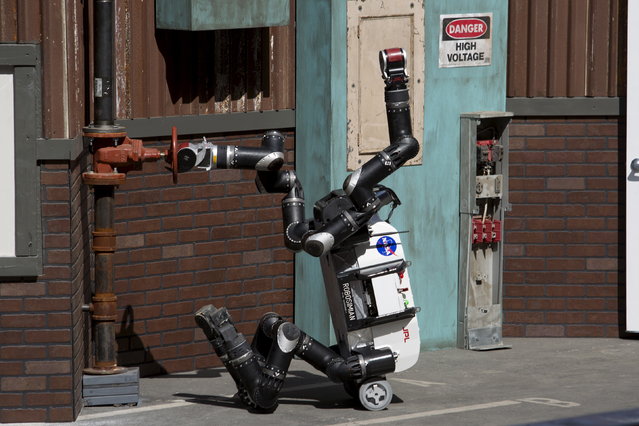
The Jet Propulsion Lab team's RoboSimian robot turns on a valve at a simulated disaster-response course during day one of the Defense Advanced Research Projects Agency (DARPA) Robotics Challenge finals in Pomona, California, June 5, 2015. (Photo by David McNew/Reuters)

The Jet Propulsion Lab team's RoboSimian robot turns on a valve at a simulated disaster-response course during day one of the Defense Advanced Research Projects Agency (DARPA) Robotics Challenge finals in Pomona, California, June 5, 2015. (Photo by David McNew/Reuters)
Details
13 Dec 2015 08:29:00
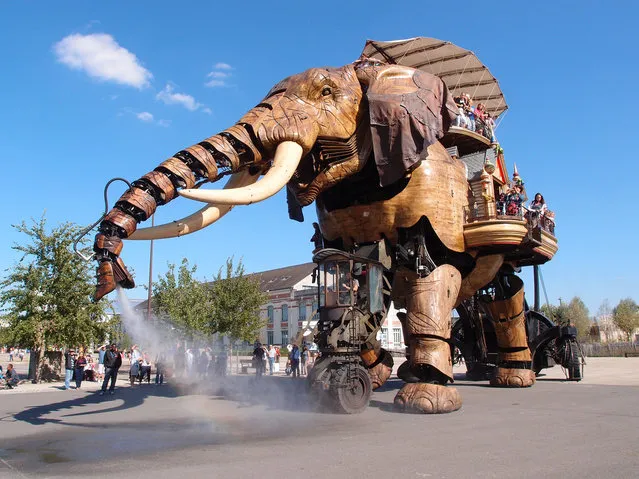
The Machines Of The Isle Of Nantes

Due to the influence of Sci-Fi movies, many of us have an obsession with giant robots. How cool would it be to ride a gigantic robotic dinosaur or elephant? It would be even cooler to control one! Regretfully, the modern technologies are not yet sophisticated enough to fulfill this dream. Pierre Orefice and François Delarozière, however, came very close. These two artists have made it their goal to turn Nantes, France, into a hot tourist destination spot for people who love robots. In their project of Machines de l'île in Nantes, they have created a whole park of robotic monstrosities, ranging from a giant 3 story high elephant to a 2 meter long centipede crawling on a rail track.
Details
05 Jan 2015 13:21:00
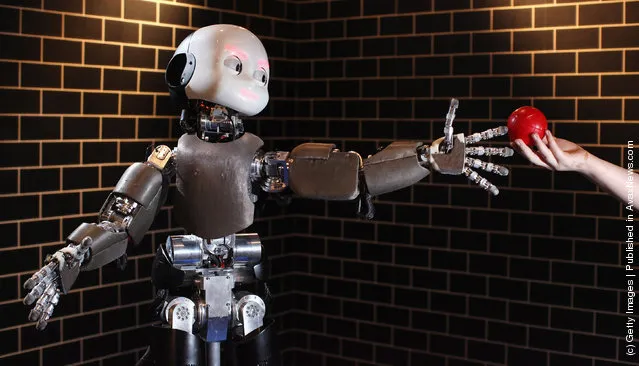
An iCub robot built by the Italian Institute of Technology tracks a ball in the Robotville exhibition at the Science Museum on November 29, 2011 in London, England

An iCub robot built by the Italian Institute of Technology tracks a ball in the Robotville exhibition at the Science Museum on November 29, 2011 in London, England. The Science Museum's Robotville exhibition showcases 20 unique and cutting-edge robots from European research laboratories, it is free to enter and runs from December 1–4, 2011. (Photo by Oli Scarff/Getty Images)
Details
30 Nov 2011 13:04:00
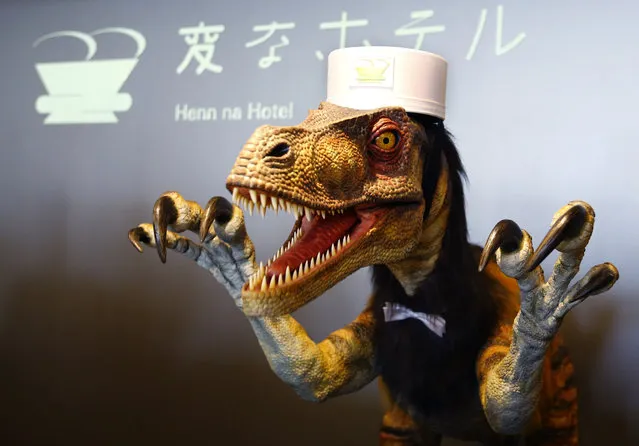
A receptionist dinosaur robot performs at the new robot hotel, aptly called Henn na Hotel or Weird Hotel, in Sasebo, southwestern Japan, Wednesday, July 15, 2015. From the receptionist that does the check-in and check-out to the porter that’s a stand-on-wheels taking luggage up to the room, the hotel, that is run as part of Huis Ten Bosch amusement park, is “manned” almost totally by robots to save labor costs. (Photo by Shizuo Kambayashi/AP Photo)

A receptionist dinosaur robot performs at the new robot hotel, aptly called Henn na Hotel or Weird Hotel, in Sasebo, southwestern Japan, Wednesday, July 15, 2015. From the receptionist that does the check-in and check-out to the porter that’s a stand-on-wheels taking luggage up to the room, the hotel, that is run as part of Huis Ten Bosch amusement park, is “manned” almost totally by robots to save labor costs. (Photo by Shizuo Kambayashi/AP Photo)
Details
16 Jul 2015 11:18:00
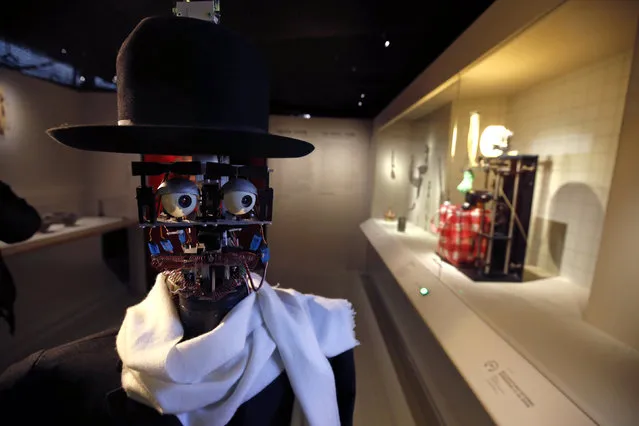
The Berenson robot strolls among visitors during the exhibition “Persona : Oddly Human” at the Quai Branly museum in Paris, France, February 23, 2016. The Berenson robot, developed in France in 2011, is the brainchild of anthropologist Denis Vidal and robotics engineer Philippe Gaussier. Its programming allows it to record reactions of museum visitors to certain pieces of art and then use the data to develop its own unique taste, which allows “Berenson” to judge whether or not it likes a certain work of art within an exhibition. (Photo by Philippe Wojazer/Reuters)

The Berenson robot strolls among visitors during the exhibition “Persona : Oddly Human” at the Quai Branly museum in Paris, France, February 23, 2016. The Berenson robot, developed in France in 2011, is the brainchild of anthropologist Denis Vidal and robotics engineer Philippe Gaussier. Its programming allows it to record reactions of museum visitors to certain pieces of art and then use the data to develop its own unique taste, which allows “Berenson” to judge whether or not it likes a certain work of art within an exhibition. (Photo by Philippe Wojazer/Reuters)
Details
25 Feb 2016 12:26:00