Loading...
Done
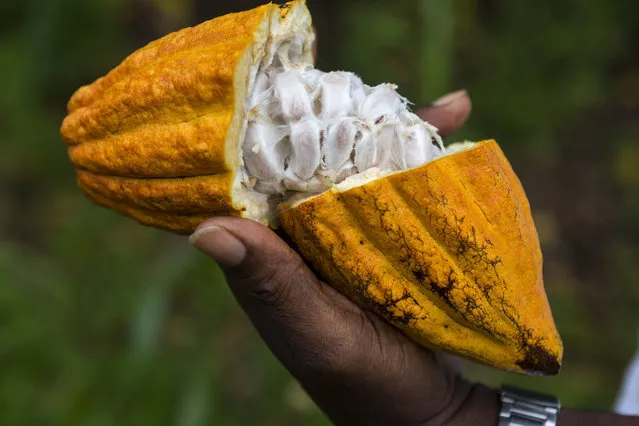
Farmer holding a freshly cut cocoa bean pod, revealing the pulp and seed inside on a rainforest farm. (Photo by Doug McKinlay/Getty Images)

Chocolate is the greatest gift the Earth has given us. The dessert table would be a sad sight without it. It’s so beloved, so appreciated, that the Swedish scientist who named the cocoa plant that gives us chocolate called it Theobroma cacao, which means “food of the gods”. Here: Farmer holding a freshly cut cocoa bean pod, revealing the pulp and seed inside on a rainforest farm. (Photo by Doug McKinlay/Getty Images)
Details
10 Aug 2016 10:20:00
Chasing Ice in Greenland

The Greenland ice sheet is a vast body of ice covering 660,235 sq miles, roughly 80% of the surface of Greenland. It is the second largest ice body in the world, after the Antarctic Ice Sheet. Some scientists predict that climate change may be near a "tipping point" where the entire ice sheet will melt in about 2000 years. If the entire 2,850,000 cubic kilometres (683,751 cu mi) of ice were to melt, it would lead to a global sea level rise of 7.2 m (23.6 ft).
Details
30 Apr 2014 13:15:00
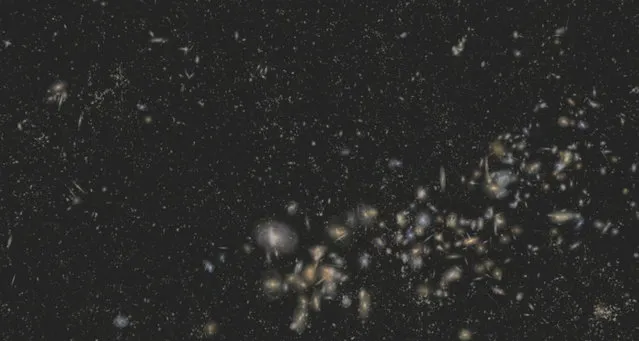
New 3-D Map of Massive Galaxies and Distant Black Holes Offers Clues to Dark Matter and Dark Energy

“The Sloan Digital Sky Survey III (SDSS-III) has released the largest-ever three-dimensional map of massive galaxies and distant black holes, which will help astronomers explain the mysterious “dark matter” and “dark energy” that scientists know makes up 96 percent of the Universe”. – SDSS-III
Details
10 Aug 2012 09:01:00
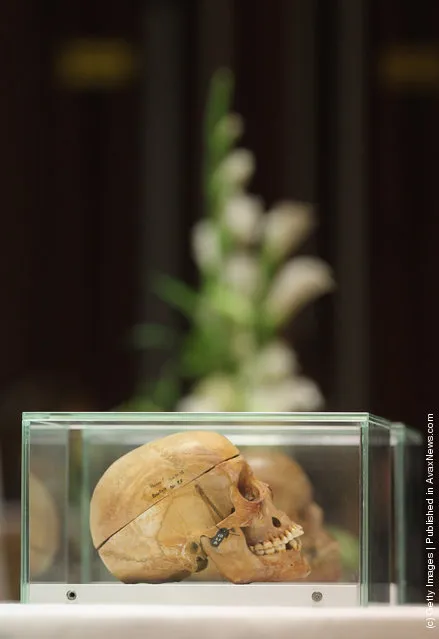
Charite Hospital Returns Herero Skulls To Namibia

Two of 20 skulls to be taken possession of by a delegation from Namibia stand on display at a ceremony at Charite hospital on September 30, 2011 in Berlin, Germany. The skulls are from Herero and Nama tribespeople taken by German colonial forces between 1904 and 1908, when the Germans violently suppressed an uprising in what was then German Southwest Africa, which is today's Namibia, and in the process killed tens of thousand of Herero and Nama. German scientists at the time took the skulls back to Berlin to demonstrate the racial superiority of Europeans over black Africans. Many Namibians demand a formal apology from the German government. (Photo by Sean Gallup/Getty Images)
Details
02 Oct 2011 11:42:00
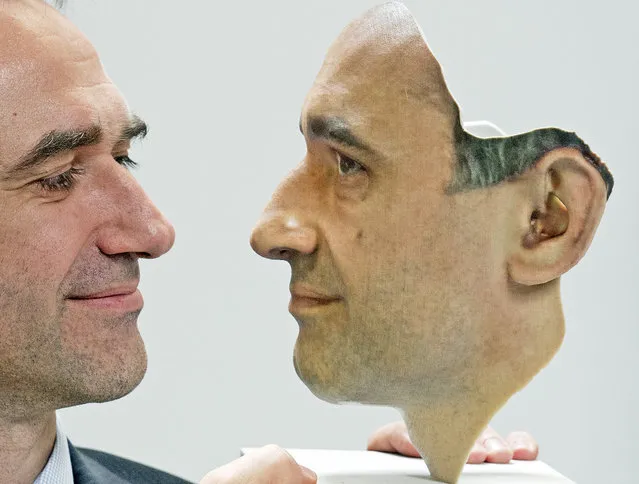
Mario Huettenhofer, chief of the German company 3D Fab, presents his own face as 3d print during the international fairs FabCon 3.D and Rapid.Tech in Erfurt, Germany, Thursday, May 15, 2014. 130 exhibitors from all over the world present the entire world of 3D printing. (Photo by Jens Meyer/AP Photo)

Mario Huettenhofer, chief of the German company 3D Fab, presents his own face as 3d print during the international fairs FabCon 3.D and Rapid.Tech in Erfurt, Germany, Thursday, May 15, 2014. 130 exhibitors from all over the world present the entire world of 3D printing. The trade fairs are accompanied by specialist programs featuring 80 scientists, practitioners and trend analysts from ten countries, who will explain the latest findings, trends and applications for additive processes in industry and for 3D printing in the private sector to newcomers, experts and consumers alike. (Photo by Jens Meyer/AP Photo)
Details
17 May 2014 13:06:00
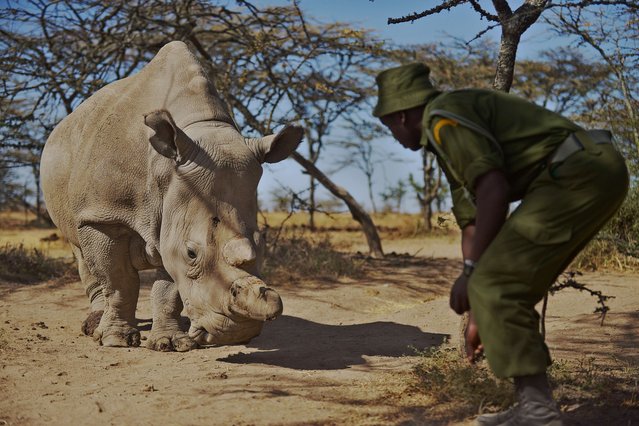
A park ranger stands next to a nothern white female rhinoceros named Najin at Ol Pejeta Conservancy, some 290 kms north of the Kenyan capital, Nairobi, on January 27, 2015. Najin is one of only five members of the sub-species left on the planet, three of which reside at Ol Pejeta Conservancy. (Photo by Tony Karumba/AFP Photo)

A park ranger stands next to a nothern white female rhinoceros named Najin at Ol Pejeta Conservancy, some 290 kms north of the Kenyan capital, Nairobi, on January 27, 2015. Najin is one of only five members of the sub-species left on the planet, three of which reside at Ol Pejeta Conservancy. Conservationists and scientists met in Kenya this week to come up with a last ditch plan to save the northern white rhinoceros from extinction. (Photo by Tony Karumba/AFP Photo)
Details
31 Jan 2015 14:07:00


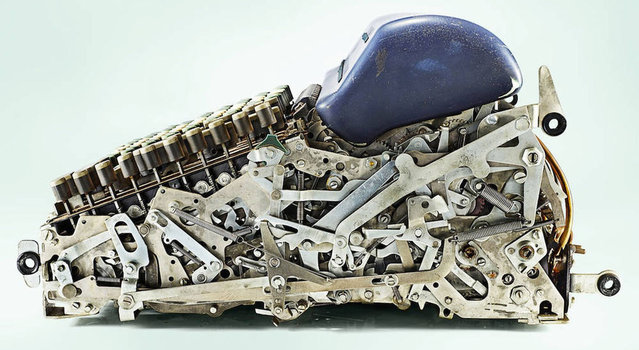
In his newest series of photos called Low Tech, Kevin Twomey artfully captures the complexity of old-style typewriters and similar machines. Despite being completely outdated, you cannot help being amazed at how complicated those “simple” devises really are. Hundreds of little parts were meticulously put together to form a machine that would perform such “basic” functions by today’s standards. Similarly, very few modern people actually think about how complicated the current technology really is. We take for granted streaming videos, GPS, and countless devises that we use every day, while in reality, these things would seem like magic to even the most prominent scientists from only half a century ago. (Photo by Kevin Twomey)
Details
21 Nov 2014 12:42:00
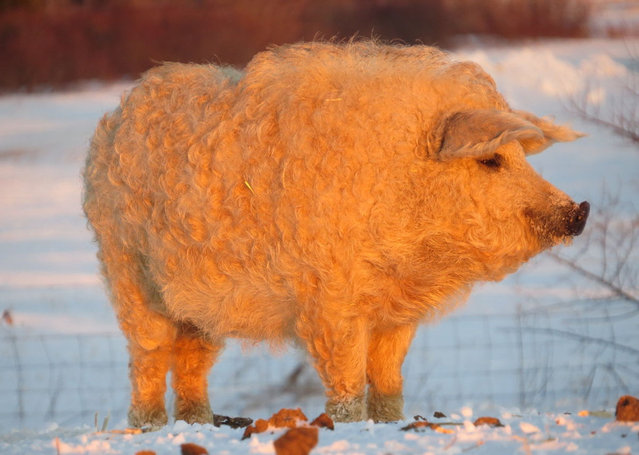
Mangalitsa The Hairy Pig

When you look at the picture of a furry pig that resembles a sheep from a distance, you may think that this may be the result of the work of some crazy scientist that tinkered with the pig’s genome. However, in this case, this is not true. Mangalica is a natural breed of pigs, which were bred in Europe for their lard. This breed of pigs is very unique, since the only other breed of pigs which had a long coat was Loncolnshire Curly Coat, which is now extinct. In the past, these pigs were quite popular, since they were able to produce a lot of lard. However, when the demand for pig lard dwindled, the population of these pigs rapidly decreased, making it a “rare breed”.
Details
01 Dec 2014 13:42:00