Loading...
Done


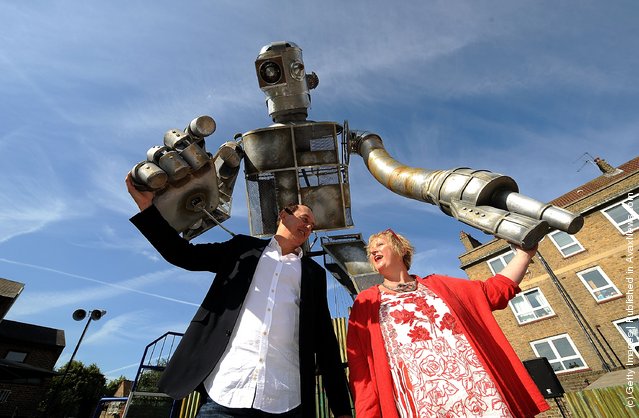
Bradley Hemmings and Jenny Sealey MBE pose for the camera with a Giant Iron Man on the set of Iron Man at the Greenwich and Docklands Festival in St Alfege Park on June 24, 2011 in London, England after they are announced by LOCOG as the Artistic Directors for the Paralympic Games Opening Ceremony. (Photo by Christopher Lee/Getty Images)
Details
25 Jun 2011 09:12:00


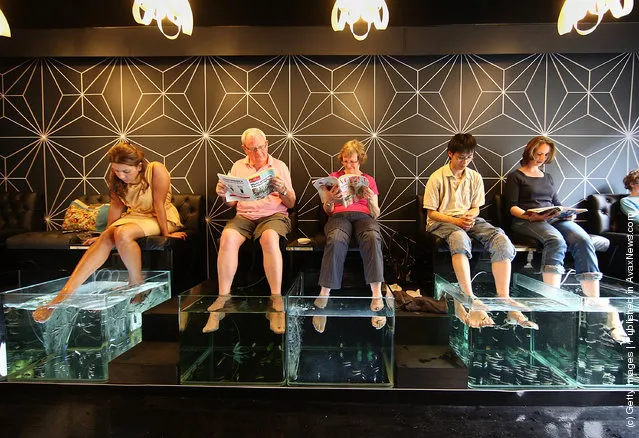
“Doctor fish is the name given to two species of fish: Garra rufa and Cyprinion macrostomus. Other nicknames include nibble fish, kangal fish, physio fish and doctorfishen; in non-medical contexts, Garra rufa is called the reddish log sucker. They live and breed in the outdoor pools of some Turkish spas, where they feed on the skin of patients with psoriasis. The fish are like combfishes in that they only consume the affected and dead areas of the skin, leaving the healthy skin to grow, with the outdoor location of the treatment bringing beneficial effects. The spas are not meant as a curative treatment option, only as a temporary alleviation of symptoms, and patients usually revisit the spas every few months”. – Wikipedia

Photo: Visitors to the Aqua Sheko fish therapy spa have their feet exfoliated on June 24, 2010 in London, England. Customers sit with their feet in a tank filled with 100-150 Garra Rufa fish which remove any dead skin by nibbling and sucking. A half hour session is then followed by a foot massage. (Photo by Peter Macdiarmid/Getty Images)
Details
22 Jun 2011 10:44:00
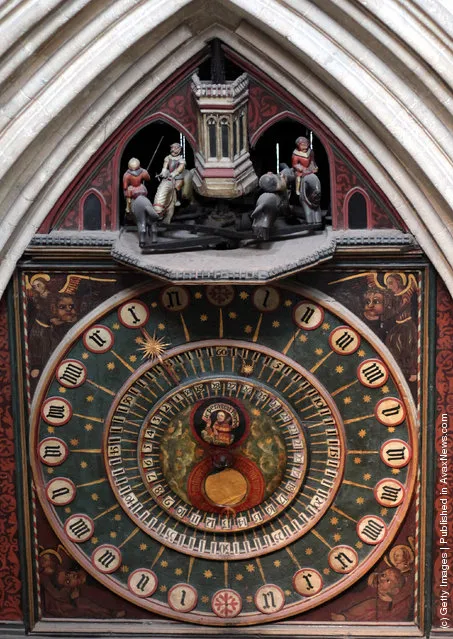
Wells Clock – World's Oldest Mechanical Clock

“Wells Cathedral is a Church of England cathedral in Wells, Somerset, England. Built between 1175 and 1490, Wells Cathedral has been described as “the most poetic of the English Cathedrals”. The Wells clock, an astronomical clock, is located in the north transept. The surviving mechanism, dated to between 1386 and 1392, was replaced in the 19th century, and was eventually moved to the Science Museum in London, where it continues to operate. It is the second-oldest surviving clock in England”. – Wikipedia

Photo: The clock face of world's oldest continually-working mechanical clock is seen as it is hand wound for the very last time on August 21, 2010 in Wells, England. (Photo by Matt Cardy/Getty Images)
Details
10 Aug 2011 11:23:00
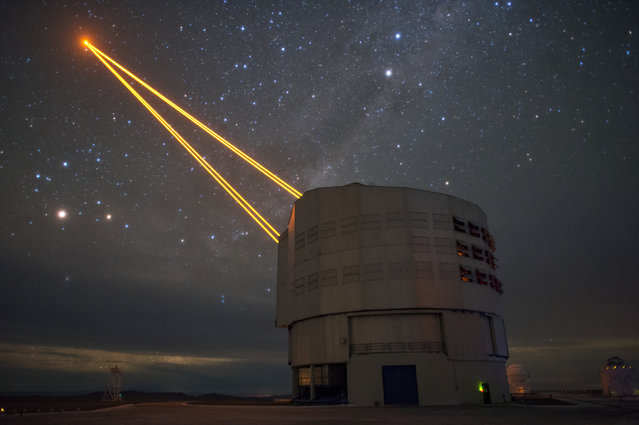
Four pillars of light from the 4 Laser Guide Star Facility on ESO's Very Large Telescope (VLT) are shown reaching into the Chilean night sky in this image from ESO Photo Ambassador Fred Kamphues, on September 2, 2016. The lasers are a key part of the adaptive optics system on the VLT. Adaptive optics allows astronomers to drastically reduce the atmospheric distortion present at even the best sites in the world for astronomy, including Paranal in Chile, the home of the VLT. (Photo by F. Kamphues/ESO)

Four pillars of light from the 4 Laser Guide Star Facility on ESO's Very Large Telescope (VLT) are shown reaching into the Chilean night sky in this image from ESO Photo Ambassador Fred Kamphues, on September 2, 2016. The lasers are a key part of the adaptive optics system on the VLT. Adaptive optics allows astronomers to drastically reduce the atmospheric distortion present at even the best sites in the world for astronomy, including Paranal in Chile, the home of the VLT. (Photo by F. Kamphues/ESO)
Details
23 Feb 2017 00:06:00
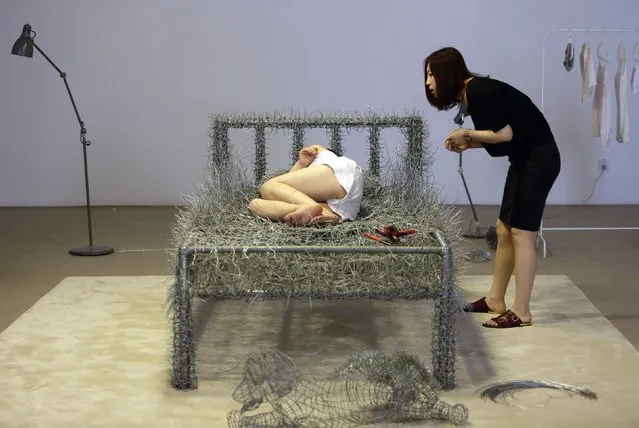
Chinese artist Zhou Jie takes a nap on an unfinished iron wire bed, one of her sculpture works, after lunch as a friend of hers looks on at Beijing Now Art Gallery, in Beijing August 11, 2014. (Photo by Jason Lee/Reuters)

Chinese artist Zhou Jie takes a nap on an unfinished iron wire bed, one of her sculpture works, after lunch as a friend of hers looks on at Beijing Now Art Gallery, in Beijing August 11, 2014. Zhou started her art project titled “36 Days” on August 9, in which she would live inside an exhibition hall with an unfinished iron wire bed, some iron wire sculptures in the shape of stuffed animal dolls, a certain amount of food and her mobile phone, for 36 days. The entire process is open to visitors and she may also interact with them, according to Zhou. (Photo by Jason Lee/Reuters)
Details
16 Aug 2014 10:37:00
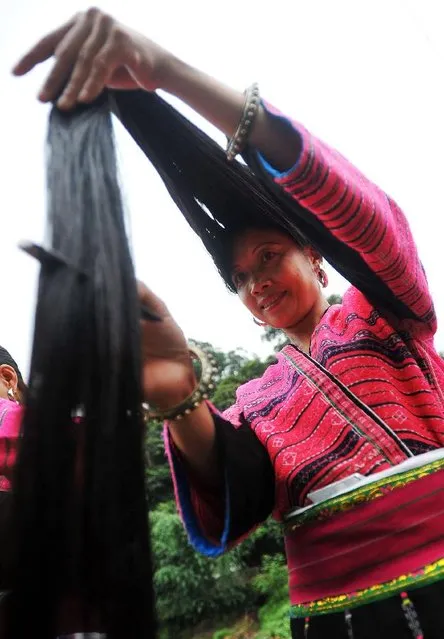
A woman combs her hair at the Huangluo Village of the Yao ethnic group in Guilin, south China's Guangxi Zhuang Autonomous Region, July 15, 2012. (Photo by Lu Boan/Xinhua)

“The Yao nationality is a government classification for various minorities in China. They form one of the 55 ethnic minority groups officially recognized by the People's Republic of China, where they reside in the mountainous terrain of the southwest and south”. – Wikipedia

Photo: A woman combs her hair at the Huangluo Village of the Yao ethnic group in Guilin, south China's Guangxi Zhuang Autonomous Region, July 15, 2012. The Huangluo Village of the Yao ethnic group locates at the Longji Terraces in Heping Town of Longsheng County in Guilin. Women here have the tradition of keeping long hair. They believe that long hair brings good luck and fortune. The average length of hair of 180 women in the village is 1.7 meters. (Photo by Lu Boan/Xinhua)
Details
07 Mar 2015 08:33:00
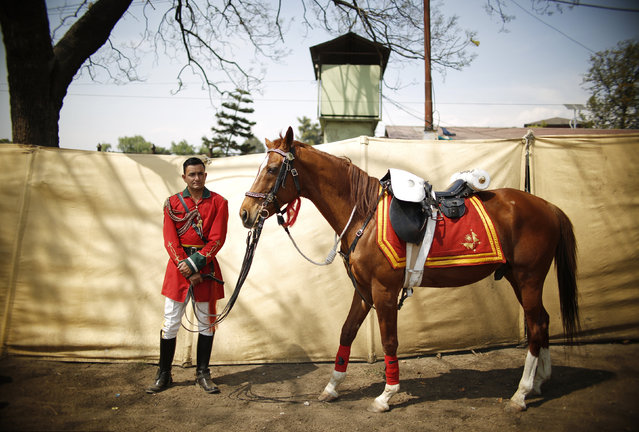
A Nepalese army solder stand next to a horse during the “Ghodejatra” Horse Race festival, which is organised by the Nepal Army, in Kathmandu, Nepal, April 7, 2016. Ghode Jatra, the horse racing festival of Nepal, celebrated on the New Moon day of mid March or early April is among the important celebrations of the Kathmandu Valley. exists a tree in the South-East part of the Tundikhel where Gurumapa supposed to be resides. (Photo by Navesh Chitrakar/Reuters)

A Nepalese army solder stand next to a horse during the “Ghodejatra” Horse Race festival, which is organised by the Nepal Army, in Kathmandu, Nepal, April 7, 2016. Ghode Jatra, the horse racing festival of Nepal, celebrated on the New Moon day of mid March or early April is among the important celebrations of the Kathmandu Valley. Grand horse parade including various acrobatic style of shows are performed by Nepal military at Tundikhel-a fenced parade ground located in the heart of Kathmandu city. (Photo by Navesh Chitrakar/Reuters)
Details
08 Apr 2016 14:33:00
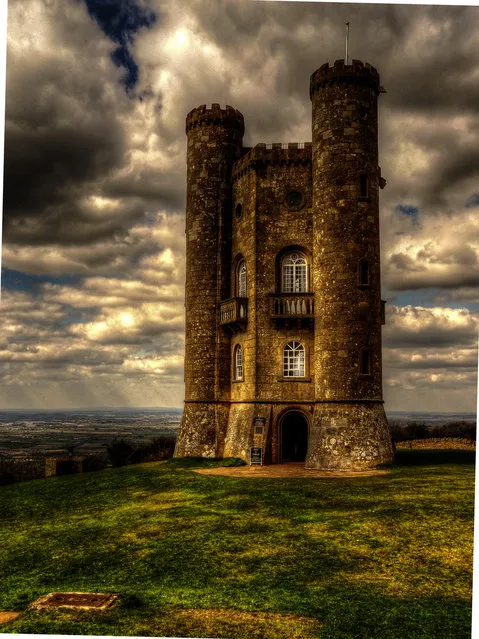
Broadway Tower In English

Broadway Tower is a folly located on Broadway Hill, near the village of Broadway, in the English county of Worcestershire, at the second highest point of the Cotswolds after Cleeve Hill. Broadway Tower's base is 1,024 feet (312 metres) above sea level. The tower itself stands 55 feet (17 metres) high. The “Saxon” tower was designed by James Wyatt in 1794 in the form of a castle, and built for Lady Coventry in 1799. The tower was built on a “beacon” hill, where beacons were lit on special occasions. Lady Coventry wondered if a beacon on this hill could be seen from her house in Worcester – approximately 22 miles (35 km) away – and sponsored the construction of the folly to find out. The beacon could be seen clearly.
Details
19 Dec 2013 10:06:00