Loading...
Done
Shemika Charles limbos under her car at Niagara Falls State Park on May 28, 2015 in Buffalo, New York. A world record holding limbo queen thinks she has become the first person to shimmy under a car. Shemika Charles amazed herself and onlookers when she bent over backwards to get underneath the SUV earlier this week. The supple 22-year-old entered the record books in 2010 when she limboed down to an incredible eight and a half inches – the height of a beer bottle. (Photo by Ruaridh Connellan/Barcroft USA)

Shemika Charles limbos under her car at Niagara Falls State Park on May 28, 2015 in Buffalo, New York. A world record holding limbo queen thinks she has become the first person to shimmy under a car. Shemika Charles amazed herself and onlookers when she bent over backwards to get underneath the SUV earlier this week. The supple 22-year-old entered the record books in 2010 when she limboed down to an incredible eight and a half inches – the height of a beer bottle. She trains for up to four hours a day to keep her body in peak condition and now travels around America performing with her family. However, regular performances put an incredible strain on her body and she sees a chiropractor once a week to have her hips realigned. Her mother was also a successful limbo dancer in her home country of Trinidad and Tobago but had to give up due to injury. (Photo by Ruaridh Connellan/Barcroft USA)
Details
19 Dec 2015 08:07:00
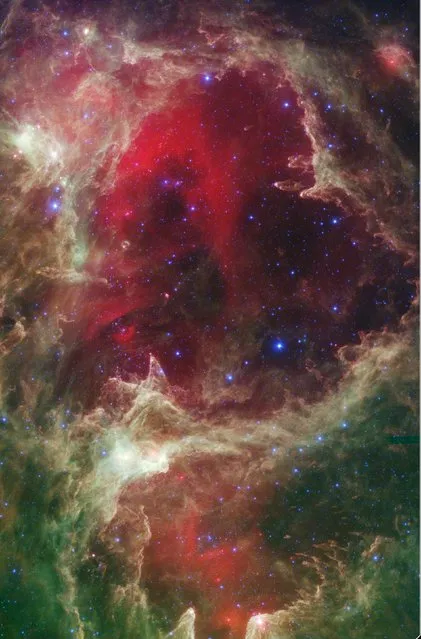
An infrared portrait from NASA's Spitzer Space Telescope which shows generations of stars is seen in this undated NASA handout image released February 14, 2013. In this wispy star-forming region, called W5, the oldest stars can be seen as blue dots in the centers of the two hollow cavities (other blue dots are background and foreground stars not associated with the region). Red shows heated dust that pervades the region's cavities, while green highlights dense clouds. (Photo by NASA/Reuters/JPL-Caltech/Harvard-Smithsonian/Handout)

An infrared portrait from NASA's Spitzer Space Telescope which shows generations of stars is seen in this undated NASA handout image released February 14, 2013. In this wispy star-forming region, called W5, the oldest stars can be seen as blue dots in the centers of the two hollow cavities (other blue dots are background and foreground stars not associated with the region). Red shows heated dust that pervades the region's cavities, while green highlights dense clouds. (Photo by NASA/Reuters/JPL-Caltech/Harvard-Smithsonian/Handout)
Details
03 Mar 2013 08:44:00
Sir Argus, centre, with Brian Hayes up, jumps the first during the Guinness Beginners Steeplechase, alongside eventual winner Mars Harper, right, with Sam Ewing up, during day four of the Galway Races Summer Festival at Ballybrit Racecourse in Galway, Ireland on August 3, 2023. (Photo by Seb Daly/Sportsfile)

Sir Argus, centre, with Brian Hayes up, jumps the first during the Guinness Beginners Steeplechase, alongside eventual winner Mars Harper, right, with Sam Ewing up, during day four of the Galway Races Summer Festival at Ballybrit Racecourse in Galway, Ireland on August 3, 2023. (Photo by Seb Daly/Sportsfile)
Details
15 Aug 2023 03:08:00
A participant in the Crazy Races extreme sports game competes in the cross-country obstacle race in Ufa, Russia on September 21, 2015. (Photo by TASS/Barcroft Media)

A participant in the Crazy Races extreme sports game competes in the cross-country obstacle race in Ufa, Russia on September 21, 2015. (Photo by TASS/Barcroft Media)
Details
23 Sep 2015 11:47:00
A member of the Grupa Magnifica acrobatics club poses for a photo on the Baltic Sea beach during sunset in the town of Leba, Pomeranian region, on August 6, 2024. (Photo by Sergei Gapon/AFP Photo)

A member of the Grupa Magnifica acrobatics club poses for a photo on the Baltic Sea beach during sunset in the town of Leba, Pomeranian region, on August 6, 2024. (Photo by Sergei Gapon/AFP Photo)
Details
02 Sep 2024 03:12:00
Racegoers try to shelter from the rain during day one of the Cazoo Derby Festival at Epsom Racecourse on Friday, June 4, 2021. (Photo by John Walton/PA Images via Getty Images)

Racegoers try to shelter from the rain during day one of the Cazoo Derby Festival at Epsom Racecourse in Surrey, United Kingdom on Friday, June 4, 2021. (Photo by John Walton/PA Images via Getty Images)
Details
05 Jun 2021 09:15:00
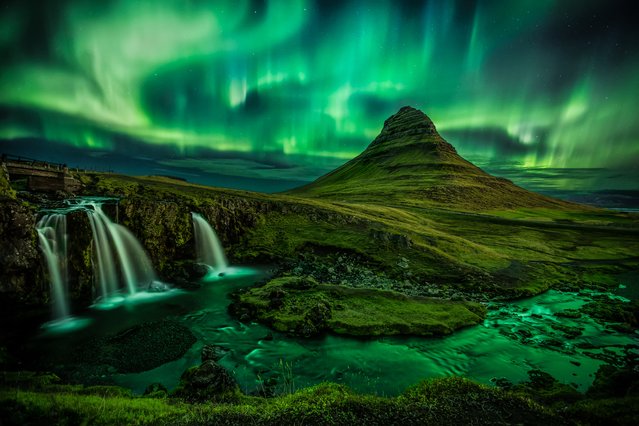
“A burst of the aurora borealis over Kirkjufell, taken in September 2016. This shot has been a holy grail for me and was finally captured after many trips”. MICK RYAN, JUDGE: Iceland is a hotspot for aurora photography and this composition of the symmetric, free-standing Kirkjufell and the trident waterfall is much-sought after. If you can time your visit when the aurora “kp” index is high and know the settings for nighttime aurora images, you may end up with a beautiful photograph like this. (Photo by DB/The Guardian)"

October winner. “A burst of the aurora borealis over Kirkjufell, taken in September 2016. This shot has been a holy grail for me and was finally captured after many trips”. MICK RYAN, JUDGE: Iceland is a hotspot for aurora photography and this composition of the symmetric, free-standing Kirkjufell and the trident waterfall is much-sought after. If you can time your visit when the aurora “kp” index is high and know the settings for nighttime aurora images, you may end up with a beautiful photograph like this. (Photo by DВ/The Guardian)
Details
26 Dec 2016 07:33:00
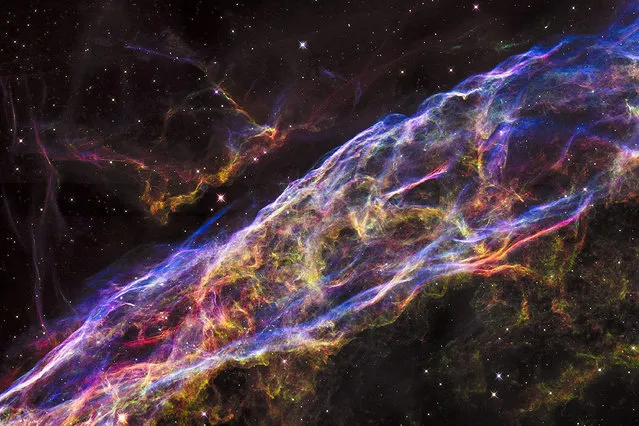
A small section of the expanding remains of the Veil Nebula, a massive star that exploded about 8,000 years ago. The entire nebula is 110 light-years across, covering six full moons on the sky as seen from Earth, and resides about 2,100 light-years away in the constellation Cygnus, the Swan. (Photo by Reuters/NASA/ESA/Hubble)

A small section of the expanding remains of the Veil Nebula, a massive star that exploded about 8,000 years ago. The entire nebula is 110 light-years across, covering six full moons on the sky as seen from Earth, and resides about 2,100 light-years away in the constellation Cygnus, the Swan. (Photo by Reuters/NASA/ESA/Hubble)
Details
29 Feb 2016 11:30:00