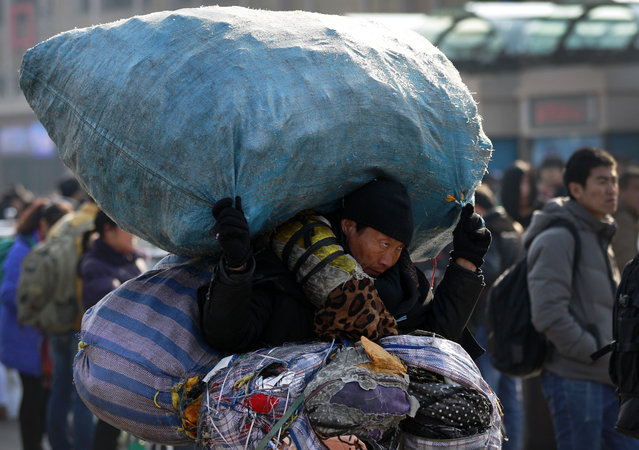
A migrant carries his belongings as he arrives at the Beijing railway station to catch a train in Beijing, Friday, February 13, 2015. (Photo by Andy Wong/AP Photo)
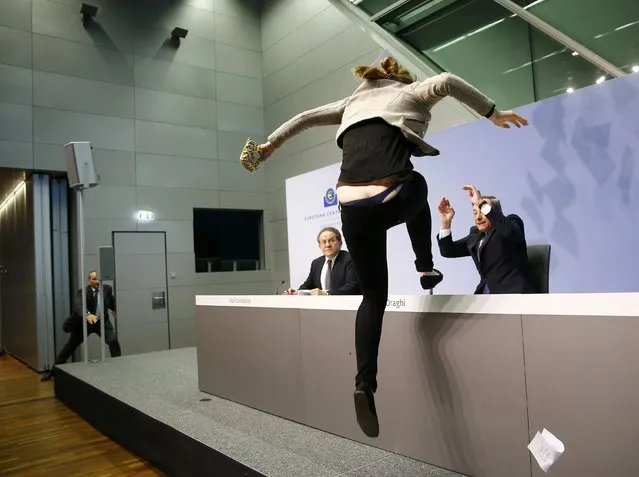
A protester jumps on the table in front of the European Central Bank President Mario Draghi during a news conference in Frankfurt, April 15, 2015. The news conference was disrupted on Wednesday when a woman in a black T-shirt jumped on the podium. (Photo by Kai Pfaffenbach/Reuters)
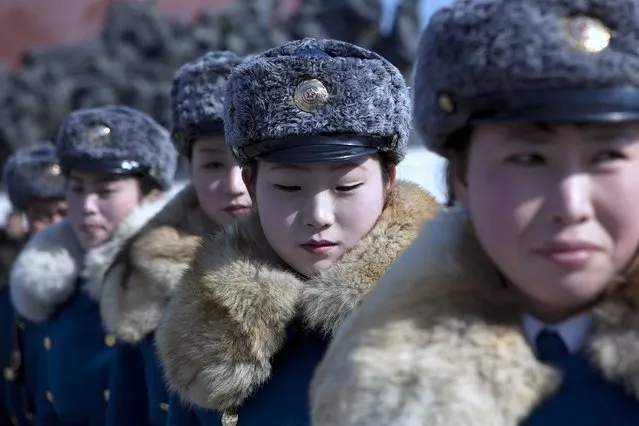
Female North Korean traffic police officers gather in front of bronze statues of the late leaders Kim Il Sung and Kim Jong Il to pay their respects in Pyongyang, North Korea on Saturday, February 16, 2013. North Koreans turned out to commemorate what would have been the 71th birthday of Kim Jong Il who died on December 17, 2011. (Photo by David Guttenfelder/AP Photo)
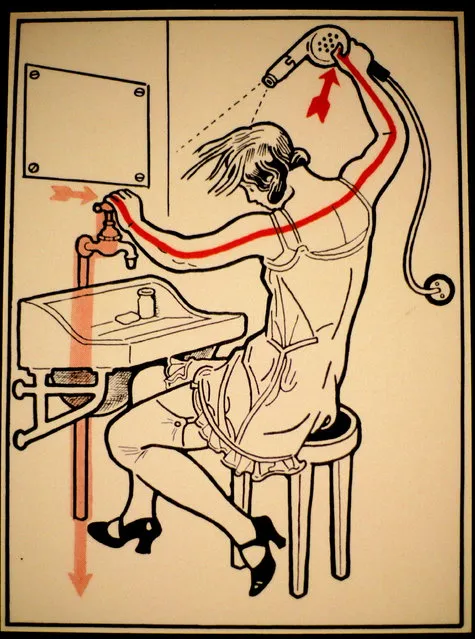
The book “Elektroschutz in 132 Bildern” (Electrical Protection in 132 Pictures) was published in Vienna in the early 1900s by a Viennese physician named Stefan Jellinek (1878-1968, a founder of the Electro-Pathological Museum). The pictures are nice and direct and unambiguous; they teach, graphically, that the surest way to kill yourself with electricity is to form a complete path from source (usually the bright red arrow) to ground (the screened back, pink arrow). Arrowheads provide the path for current flow. (Photo by The Vienna Technical Museum)
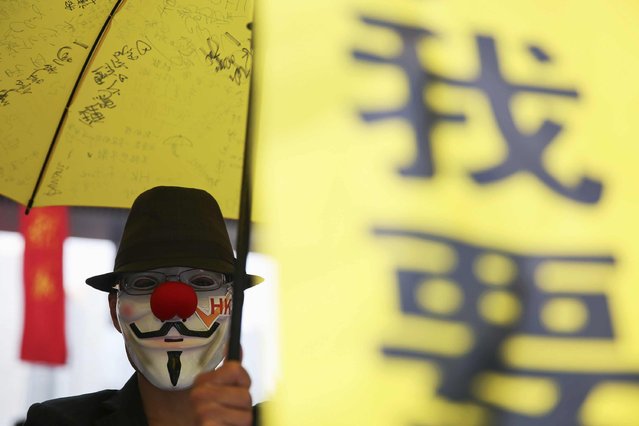
A pro-democracy protester wearing a Guy Fawkes mask holds a yellow umbrella and a banner in the part of Hong Kong's financial central district protesters are occupying November 2, 2014. The former British colony of Hong Kong, which returned to Chinese rule in 1997, has witnessed a month of protests calling on the Beijing-backed government to keep its promise of introducing universal suffrage. The protests have for the most part been peaceful, with occasional clashes between the student-led protesters and Beijing supporters seeking to move them from the streets. (Photo by Damir Sagolj/Reuters)
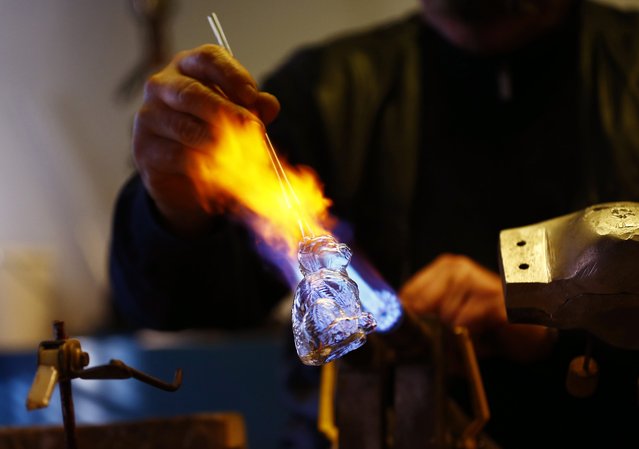
A worker heats a glass cat-shape ornament at the Silverado manufacture of hand-blown Christmas ornaments in town of Jozefow outside Warsaw December 2, 2014. (Photo by Kacper Pempel/Reuters)
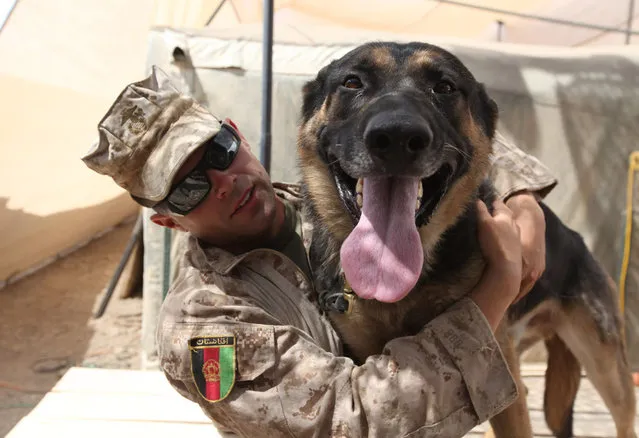
Throughout the course of the long war in Afghanistan, Coalition troops have relied on thousands of military working dogs to help keep them safe, and make their jobs easier. The dogs are trained to detect explosives, to find illegal drugs, to search for missing comrades, or target enemy combatants. Not only are they active on the front lines, but behind the lines they serve as therapy dogs, service dogs, and loyal companions. They also share the same risks as the ground troops, suffering injuries and sometimes death on the battlefields. Gathered here are images of these dogs and their handlers in Afghanistan and back home, from over the past several years, part of the ongoing series here on Afghanistan.
«Little Red Riding Hood». “The moment I pulled this sweater out of the drawer for Frankie I knew what I wanted for my picture today. I envisioned the look, the style, and the composition. When working with a 2 year old it is never easy to actually get the shot you want, especially when they decide to skip nap time. But I really like how this one turned out” – Rich. (Photo by Rich)