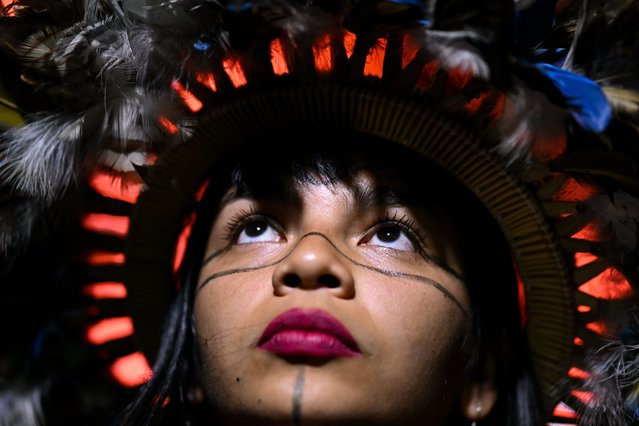
Txai Suruí, Amazonian Activist, during the opening night of Web Summit Rio 2023 at Riocentro in Rio de Janeiro, Brazil. (Photo By Stephen McCarthy/Sportsfile for Web Summit Rio via Getty Images)
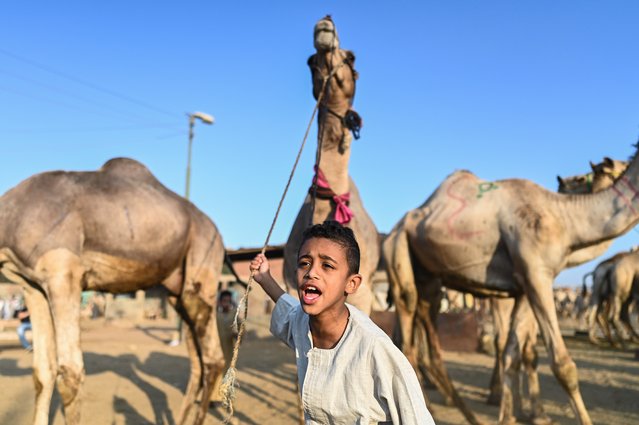
A child stands next to sacrificial camels at the camel market ahead of the Muslim festival of Eid al-Adha in the Birqash district, Giza, Egypt, 30 May 2025. Eid al-Adha is one of the holiest Muslim holidays, marking the annual Hajj pilgrimage to Mecca. (Photo by Mohamed Hossam/EPA/EFE)
A member of the Gumatj clan performs a ceremonial welcome during the Garma Festival at the Gulkula ceremonial in the Gove Peninsula of the Northern Territory, Australia 03 August 2024. The Garma Festival is Australia’s largest Indigenous gathering, a 4-day celebration of Yolngu life and culture held in remote northeast Arnhem Land. (Photo by Mick Tsikas/EPA)
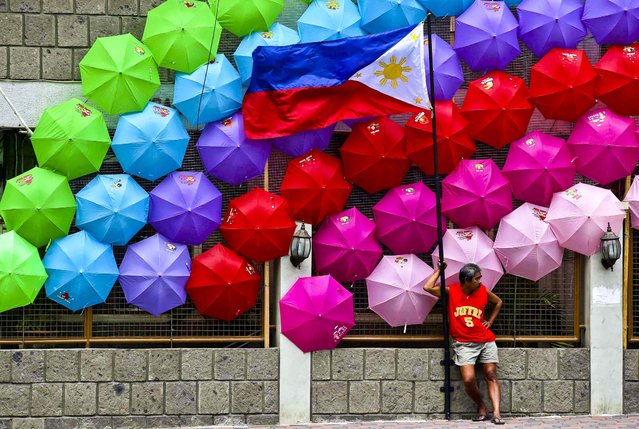
A man stands beside the Philippine flag as colorful umbrellas adorn a village hall in suburban San Juan, east of Manila, Philippines, on June 27, 2013. (Photo by Aaron Favila/Associated Press)
A giant new exhibition space created by famed graffiti artist Banksy opens to the public on May 3, 2008 in London, England. The disused tunnel beneath Waterloo station has been transformed by 30 artists from around the world. The three day event, tagged as the “Cans festival”, also invites the public to add their own stencil art. (Photo by Jim Dyson/Getty Images)
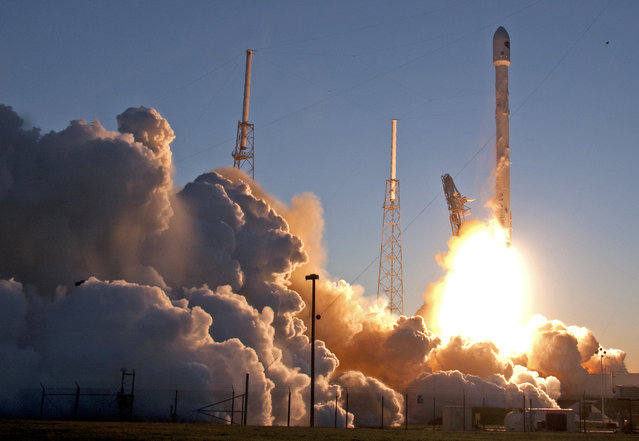
An unmanned Falcon 9 SpaceX rocket lifts off from launch complex 40 at the Cape Canaveral Air Force Station, Wednesday, February 11, 2015, in Cape Canaveral, Fla. On board is the Deep Space Climate Observatory, which will head toward a solar-storm lookout point a million miles away. (Photo by John Raoux/AP Photo)
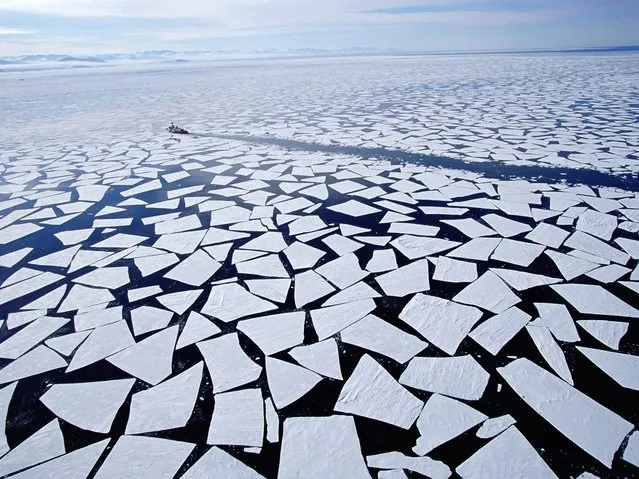
McMurdo Station is a U.S. Antarctic research centre located on the southern tip of Ross Island, which is in the New Zealand-claimed Ross Dependency on the shore of McMurdo Sound in Antarctica. It is operated by the United States through the United States Antarctic Program, a branch of the National Science Foundation. The station is the largest community in Antarctica, capable of supporting up to 1,258 residents, and serves as the United States Antarctic science facility. All personnel and cargo going to or coming from Amundsen–Scott South Pole Station first pass through McMurdo.