Loading...
Done


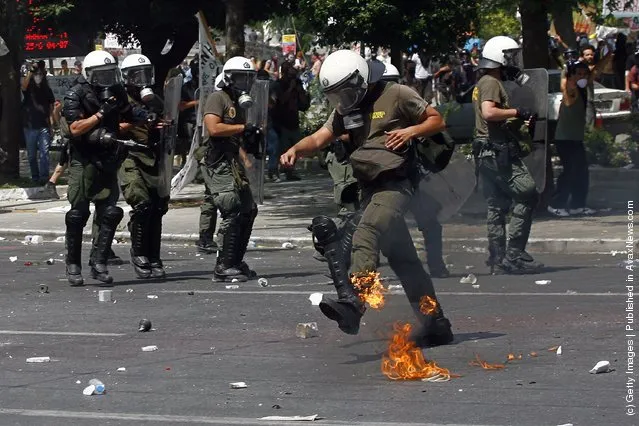
An officer is on fire as demonstrators clash with police during a protest against plans for new austerity measures on June 28, 2011 in Athens, Greece. Greece's largest labor unions have called for a 48-hour strike, while the Socialist government is beginning to push through legislation for cost cutting reforms. (Photo by Milos Bicanski/Getty Images)
Details
29 Jun 2011 10:57:00
Occupy Denver Protesters Bring Various Activists Groups Together For March

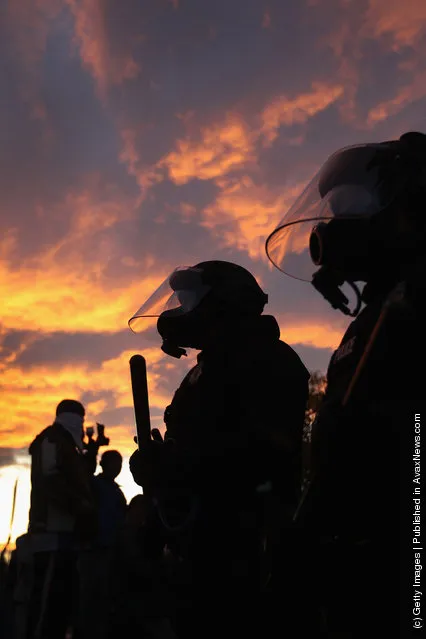
Riot police face off with demonstrators at the “Occupy Denver” camp on October 29, 2011 in Denver, Colorado. Following a march by protesters, police moved in on their encampment to tear down recently erected tents. They arrested numerous protesters, pepper-sprayed others and others reportedly fired rubber bullets at the crowd during the confrontation. (Photo by John Moore/Getty Images)
Details
30 Oct 2011 10:58:00


A competitor scrambles in the mud under barbed wire during the Tough Guy Challenge 2009 at South Perton Farm on February 1, 2009 in Wolverhampton, England. The biannual event to raise cash for charity challenges thousands of international competitors to run through a gruelling set of 21 obstacles including water, fire and tunnels after a lengthy run at the start. (Photo by Christopher Furlong/Getty Images)
Details
18 Nov 2011 14:02:00
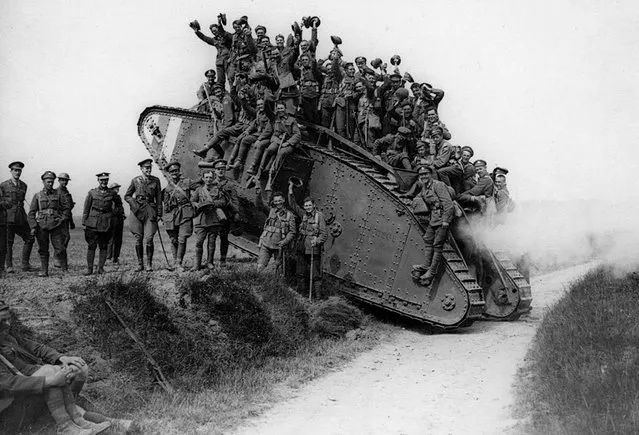
These black-and-white photos are taken from the new book “Armoured Warfare in the First World War 1916 – 1918” by Anthony Tucker-Jones and published by Pen & Sword Military. “Interestingly the British, French and Germans took completely different approaches with varying results”. The British military produced “Little Willie” in Autumn 1915 weighing 18 tonnes, which had a crew of two plus four gunners. “Inspired by a tracked artillery tractor “Little Willie” was referred to as a water tank – hence the name tank – to ensure secrecy”, said Anthony. “This led to the strange looking Mark I with its peculiar rhomboid shape, designed to cross trenches with guns in sponsons on either side. The Germans saw the tank as unchivalrous and were slow to grasp its utility. They favoured the Stormtrooper (specialist soldiers used to infiltrate enemy trenches) and artillery, not the tank”, said Anthony. “However, they didn’t hesitate to make use of captured British tanks. Although the tank helped secure victory and German soldiers dubbed it “Germany’s Downfall” the country was ultimately brought to its knees by the Allies blockade”. Here: British troops hitch a ride on a Mark IV after the massed tank fleet spearheading attack at Cambrai on November 20, 1917. (Photo by Anthony Tucker-Jones/Mediadrumworld.com)

These black-and-white photos are taken from the new book “Armoured Warfare in the First World War 1916 – 1918” by Anthony Tucker-Jones and published by Pen & Sword Military. Here: British troops hitch a ride on a Mark IV after the massed tank fleet spearheading attack at Cambrai on November 20, 1917. (Photo by Anthony Tucker-Jones/Mediadrumworld.com)
Details
23 Feb 2017 00:02:00
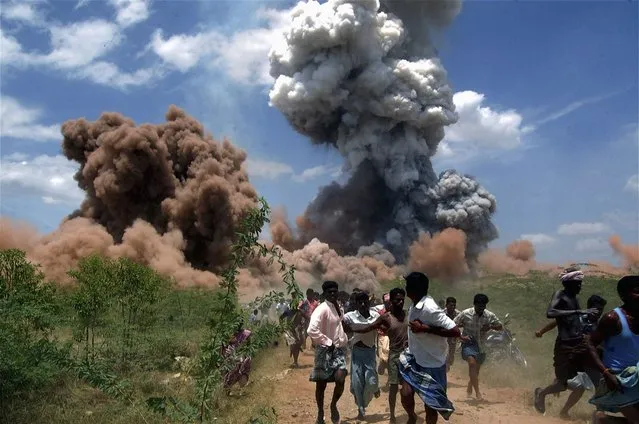
In this September 5, 2012 file photo, people run for cover as smoke rises from the site of a fire at a fireworks factory on the outskirts of Sivakasi, about 500 kilometers (310 miles) southwest of Chennai, India. Police in southern India arrested six employees of the fireworks factory for a massive blaze that killed 40 workers and injured 60 others. (Photo by AP Photo/File)

In this September 5, 2012 file photo, people run for cover as smoke rises from the site of a fire at a fireworks factory on the outskirts of Sivakasi, about 500 kilometers (310 miles) southwest of Chennai, India. Police in southern India arrested six employees of the fireworks factory for a massive blaze that killed 40 workers and injured 60 others. (Photo by AP Photo/File). P.S. I didn't publish the photos which you already saw here (Avax).
Details
04 Jan 2013 15:25:00
Israeli soldiers play the parts of wounded civilians during a drill simulating a toxic spill from an attack on a train in Beersheba, southern Israel, 13 January 2016, as Home Front medical teams, fire fighters and police carry out rescue operations. The large scale drill is the concluding exercise of the Fourth International Conference on Healthcare System Preparedness and Response to Emergencies and Disasters and includes some 200 of the world's experts on health system readiness from around the world. (Photo by Jim Hollander/EPA)

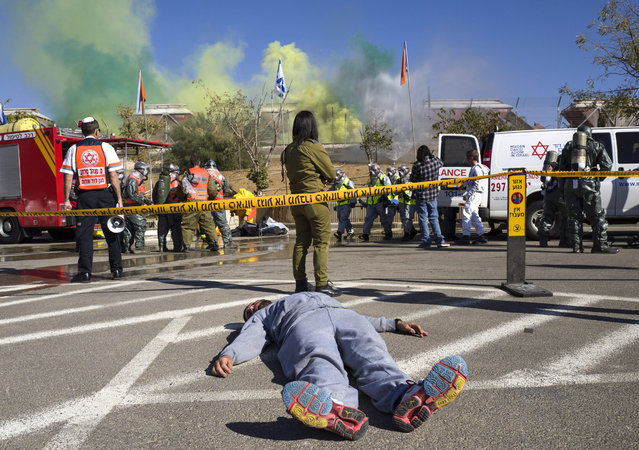
Israeli soldiers play the parts of wounded civilians during a drill simulating a toxic spill from an attack on a train in Beersheba, southern Israel, 13 January 2016, as Home Front medical teams, fire fighters and police carry out rescue operations. The large scale drill is the concluding exercise of the Fourth International Conference on Healthcare System Preparedness and Response to Emergencies and Disasters and includes some 200 of the world's experts on health system readiness from around the world. The conference is dealing with all types of medical emergencies from terrorist attacks to natural disasters. (Photo by Jim Hollander/EPA)
Details
15 Jan 2016 08:02:00
A poster for the IMAX presentation of “The Hunger Games: Catching Fire” (left), and a teaser poster for “The Hunger Games: Mockingjay, Part I”, both created by the Los Angeles-based design firm IGNITION. (Photo by Key Art Awards 2014)

A poster for the IMAX presentation of “The Hunger Games: Catching Fire” (left), and a teaser poster for “The Hunger Games: Mockingjay, Part I”, both created by the Los Angeles-based design firm IGNITION. Both are nominated for the 2014 Key Art Awards in the category of Theatrical Domestic One-Sheet. The Hollywood Reporter's annual competition for the best in film and TV advertising honors some of the most creative imagery used in movie posters. Here is a selection of some of this year's nominees. (Photo by Key Art Awards 2014)
Details
08 Oct 2014 12:25:00
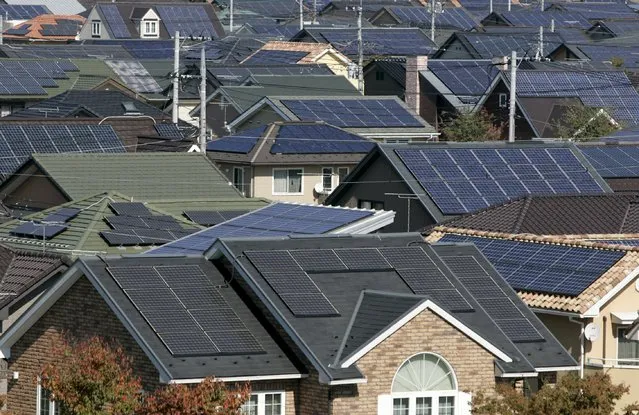
Rooftops of solar powered houses are pictured in Ota, 80 km northwest of Tokyo in this October 28, 2008 file photo. One by one, Japan is turning off the lights at the giant oil-fired power plants that propelled it to the ranks of the world's top industrialised nations. With nuclear power in the doldrums after the Fukushima disaster, it's solar energy that is becoming the alternative. (Photo by Yuriko Nakao/Reuters)

Rooftops of solar powered houses are pictured in Ota, 80 km northwest of Tokyo in this October 28, 2008 file photo. One by one, Japan is turning off the lights at the giant oil-fired power plants that propelled it to the ranks of the world's top industrialised nations. With nuclear power in the doldrums after the Fukushima disaster, it's solar energy that is becoming the alternative. Solar power is set to become profitable in Japan as early as this quarter, according to the Japan Renewable Energy Foundation (JREF), freeing it from the need for government subsidies and making it the last of the G7 economies where the technology has become economically viable. (Photo by Yuriko Nakao/Reuters)
Details
24 Nov 2015 08:04:00