A fisherman throws a net for catching fish with his wife in Yanhu fisherman village near Yangzhou, Jiangsu province, China, 18 October 2018. (Photo by Aleksandar Plavevski/EPA/EFE)
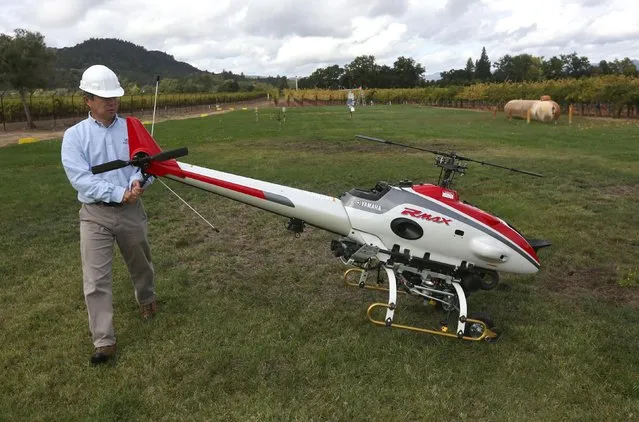
In this October 15, 2014 file photo, Katsu Nakamura, sky division manager for Yamaha USA, moves the RMax unmanned helicopter into position before a demonstration of its aerial application capabilities at the University of California, Davis' Oakville Station test vineyard in Oakville, Calif. Researchers at UC Davis have been studying the effectiveness of the drone's ability for spraying pest control and nutritional materials on the test vineyard in California's Napa Valley. (Photo by Rich Pedroncelli/AP Photo)
Rian Johnson, left, director of the upcoming film “Knives Out”, takes a picture of cast member Ana de Armas as they are introduced onstage during the Lionsgate presentation at CinemaCon 2019, the official convention of the National Association of Theatre Owners (NATO) at Caesars Palace, Thursday, April 4, 2019, in Las Vegas. (Photo by Chris Pizzello/Invision/AP Photo)
Brazilian navy soldiers watch a woman as they patrol the area at the Copacabana Beach before carnival festivities in Rio de Janeiro, Brazil February 14, 2017. (Photo by Sergio Moraes/Reuters)
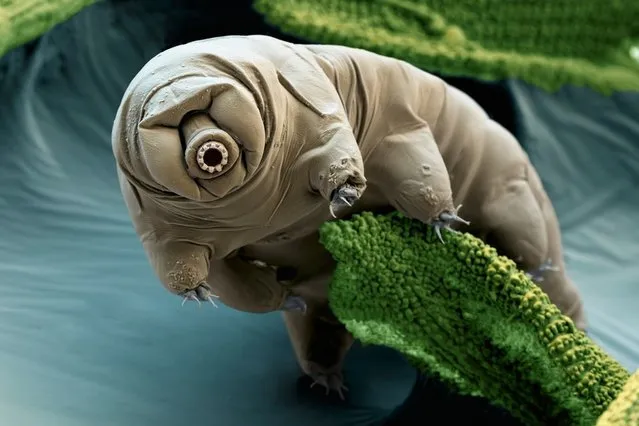
“Tardigrades (commonly known as waterbears or moss piglets) are small, water-dwelling, segmented animals with eight legs. Tardigrades were first discovered in 1773 by Johann August Ephraim Goeze, who called them kleiner Wasserbär, meaning “little water bear” in German. The name Tardigrada means “slow walker” and was given by Lazzaro Spallanzani in 1777. The name water bear comes from the way they walk, reminiscent of a bear's gait. The biggest adults may reach a body length of 1.5 millimetres (0.059 in), the smallest below 0.1 mm. Freshly hatched tardigrades may be smaller than 0.05 mm”. – Wikipedia. Photo: Tardigrades. (Photo by SPL/East News)