Loading...
Done


“Osama bin Laden has been killed in an American operation in Pakistan, President Obama announced from the White House on Sunday, calling his death “the most significant achievement to date in our nation's effort to defeat al-Qaida”. In a statement delivered from the East Room, Obama said a small team of U.S. personnel attacked a compound in Pakistan's Abbottabad Valley, where bin Laden had been hiding since late last summer. The U.S. team killed the 54-year-old al-Qaida leader after a firefight and “took custody of his body”, Obama said.” – Nwsource.com

Photo: Saudi dissident Osama bin Laden in an undated photo. October 10, 2001. Afghanistan's ruling Taliban lifted restrictions on Bin Laden, giving him permission to conduct “Jihad”, or holy war, against Afghanistan's enemies. (Photo by Getty Images)
Details
02 May 2011 07:36:00
Nuclear Football

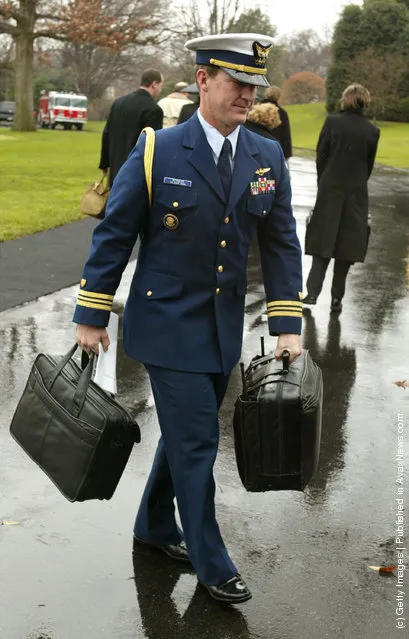
“The nuclear football (also known as the atomic football, the president's emergency satchel, the button, the black box, or just the football) is a briefcase, the contents of which are to be used by the President of the United States of America to authorize a nuclear attack while away from fixed command centers, such as the White House Situation Room. It functions as a mobile hub in the strategic defense system of the United States. It is a metallic Zero Halliburton briefcase carried in a black leather “jacket”. The package weighs around 45 pounds (20 kilograms). A small antenna protrudes from the bag near the handle”. – Wikipedia

Photo: A U.S. Military officer carries the “football”, which carries nuclear launch codes, on South Lawn after returning with U.S. President George W. Bush to the White House January 7, 2002 in Washington, DC. (Photo by Mark Wilson/Getty Images)
Details
06 Aug 2011 12:53:00
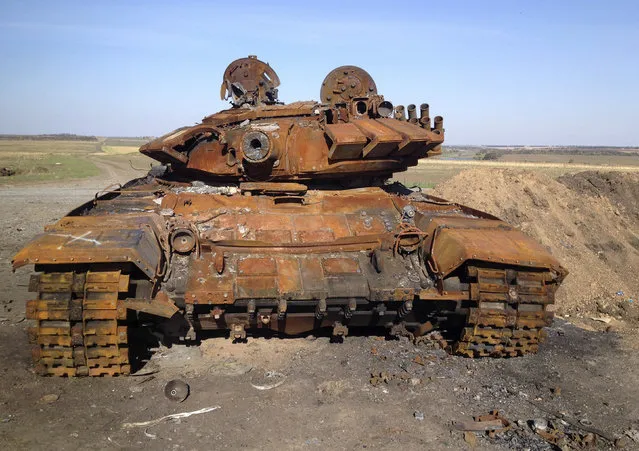
A destroyed T-72 tank, which presumably came from Russia, is seen on a battlefield near separatist-controlled Starobesheve, eastern Ukraine, October 2, 2014.(Photo by Maria Tsvetkova/Reuters)

A destroyed T-72 tank, which presumably came from Russia, is seen on a battlefield near separatist-controlled Starobesheve, eastern Ukraine, October 2, 2014. The burnt-out remains of dozens of tanks and armoured vehicles in fields near the small village of Horbatenko bear witness to the ferocity of a battle that turned the tide of the conflict in eastern Ukraine. Among the debris, Reuters found the blackened carcasses of what military experts have since identified as two Russian army tanks, supporting statements by Kiev and the West that the rebels were backed by troops and equipment sent by Moscow. (Photo by Maria Tsvetkova/Reuters)
Details
24 Oct 2014 12:14:00
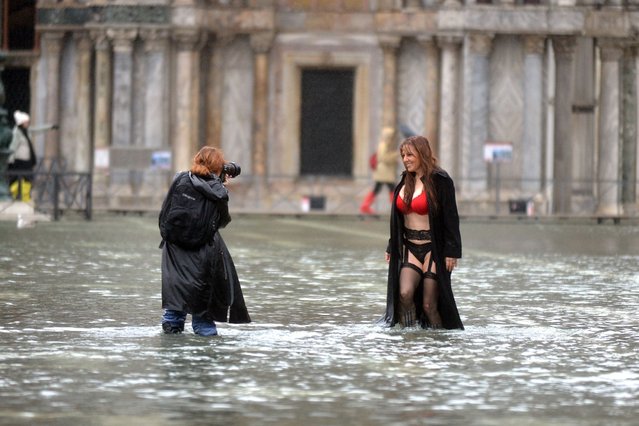
A woman poses on the flooded St. Mark's square during an acqua-alta (high-water) alert in Venice, on November 19, 2013. (Photo by Andrea Pattaro/AFP Photo)

A woman poses on the flooded St. Mark's square during an acqua-alta (high-water) alert in Venice, on November 19, 2013. (Photo by Andrea Pattaro/AFP Photo)

P.S. All pictures, as usual, are presented in high resolution. To see Hi-Res images – just TWICE click on any picture. In other words, click small picture – opens the BIG picture. Click BIG picture – opens VERY BIG picture (if available; this principle works anywhere on the site AvaxNews).
Details
23 Nov 2013 11:21:00
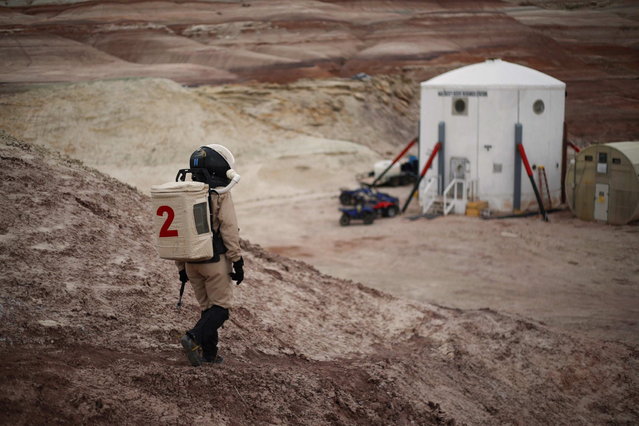
Csilla Orgel, a geologist of Crew 125 EuroMoonMars B mission, makes her way back to the Mars Desert Research Station (MDRS) in the Utah desert March 3, 2013. (Photo by Jim Urquhart/Reuters)

NASA says it could be another 20 years before humans touch down on Mars, but in a sense, the Mars Society has been exploring the red planet for more than a decade – in Utah. Photo: Csilla Orgel, a geologist of Crew 125 EuroMoonMars B mission, makes her way back to the Mars Desert Research Station (MDRS) in the Utah desert March 3, 2013. The MDRS aims to investigate the feasibility of a human exploration of Mars and uses the Utah desert's Mars-like terrain to simulate working conditions on the red planet. Scientists, students and enthusiasts work together developing field tactics and studying the terrain. All outdoor exploration is done wearing simulated spacesuits and carrying air supply packs and crews live together in a small communication base with limited amounts of electricity, food, oxygen and water. Everything needed to survive must be produced, fixed and replaced on site. (Photo by Jim Urquhart/Reuters)
Details
14 Mar 2013 12:11:00
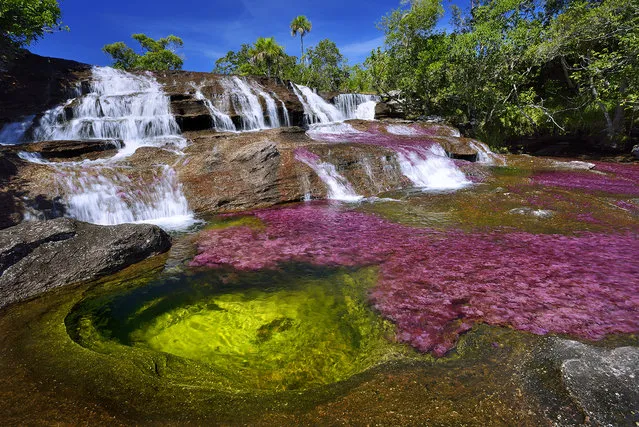
A waterfall is seen at the end of the rainy season, in August, when the water level finally decreases, in the Cano Cristales RIver in the Sierra de la Macarena in Colombia. It has become covered with a bright pink endemic aquatic plant, Macarenia Clavigera. (Photo by Olivier Grunewald)

“El rio mas bonito del Mundo”, the most beautiful river of the world, the “River of five colors”, the “Rainbow River”, or even the “Escaped from Paradise”, are the shimmering appellations that Colombians give to Cano Cristales, a small stream located in the heart of the Macarena National Park, 150 km (93 miles) south of Bogota. Photo: A waterfall is seen at the end of the rainy season, in August, when the water level finally decreases, in the Cano Cristales RIver in the Sierra de la Macarena in Colombia. It has become covered with a bright pink endemic aquatic plant, Macarenia Clavigera. (Photo by Olivier Grunewald)
Details
25 Mar 2014 15:15:00
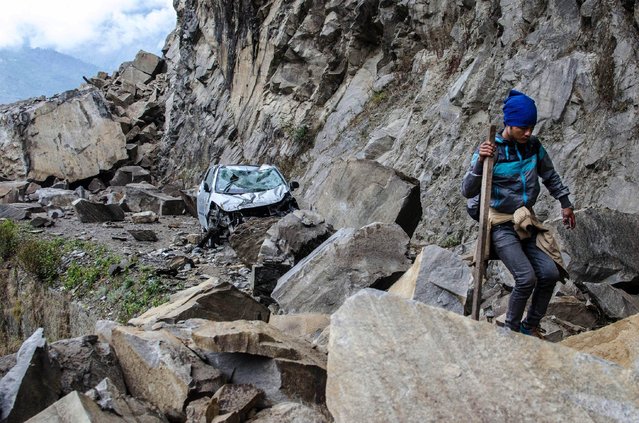
In this Monday, April 27, 2015 photo, a Nepalese man walks over fallen rocks and past a crushed car on the way to Dhunche, Nepal, a village in Langtang National Park, two days after a 7.8-magnatude earthquake hit the region. (Photo by Joe Sieder via AP Photo)

In this Monday, April 27, 2015 photo, a Nepalese man walks over fallen rocks and past a crushed car on the way to Dhunche, Nepal, a village in Langtang National Park, two days after a 7.8-magnatude earthquake hit the region. The photographer, Joe Sieder, said the man was part of a group of Nepalese workers and trekkers who left Syabrubesi earlier that day and hiked about 30 km (19 miles) for 13 hours, mostly over boulder-strewn roads with some small landslides along the way to make their way to a passable road. (Photo by Joe Sieder via AP Photo)
Details
30 Apr 2015 10:54:00
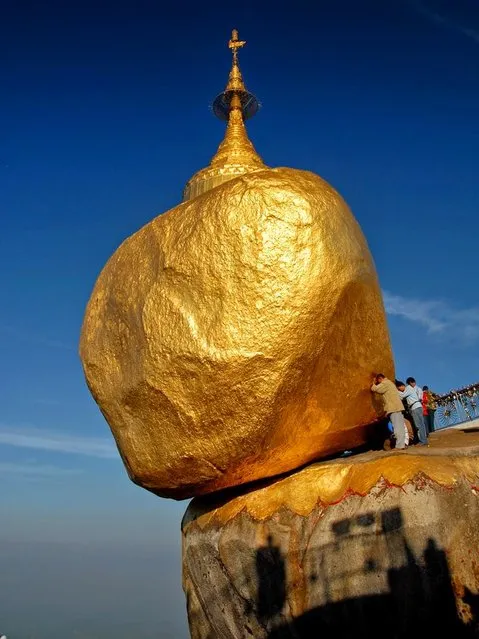
 Kyaiktiyo Pagoda AKA  Golden Rock In Burma

Kyaiktiyo Pagoda, also known as Golden Rock is a well-known Buddhist pilgrimage site in Mon State, Burma. It is a small pagoda (7.3 metres (24 ft)) built on the top of a granite boulder covered with gold leaves pasted on by devotees. According to legend, the Golden Rock itself is precariously perched on a strand of the Buddha's hair. The balancing rock seems to defy gravity, as it perpetually appears to be on the verge of rolling down the hill. The rock and the pagoda are at the top of Mt. Kyaiktiyo. It is the third most important Buddhist pilgrimage site in Burma after the Shwedagon Pagoda and the Mahamuni Pagoda. A glimpse of the "gravity defying" Golden Rock is believed to be enough of an inspiration for any person to turn to Buddhism.
Details
04 Jun 2015 11:42:00