Loading...
Done
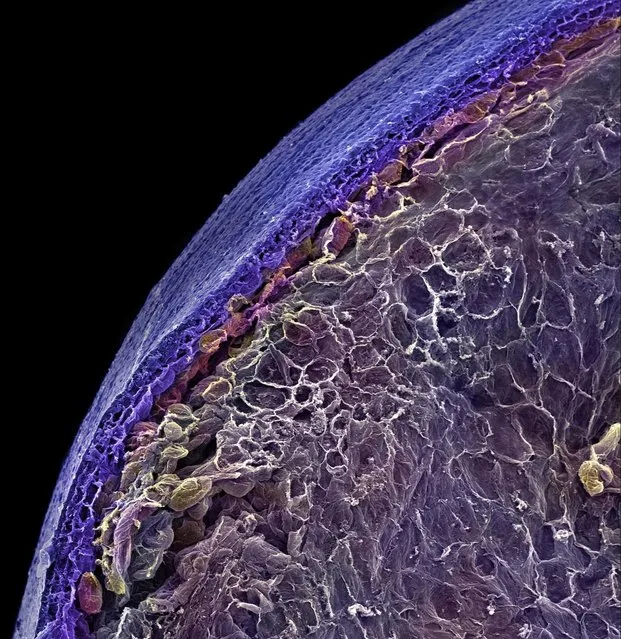
Blueberry. (Photo by SPL/Barcroft Media)

Scientists have captured these images in laboratories during research into what makes our daily food. Photo: Blueberry. (Photo by SPL/Barcroft Media)
Details
11 Oct 2013 08:10:00
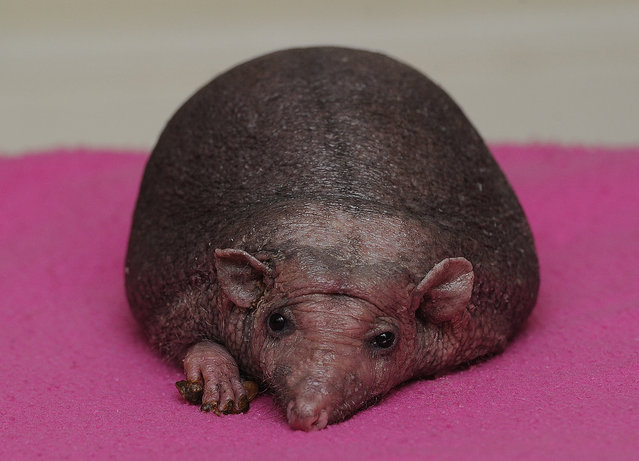
Meet the world's smoothest cuddliest hedgehog. Names after brave hero, but Nelson is completely bald so when curled up he looks like an egg. Doesn't have a single prickle or strand of hair. Thought to be suffering a stress related alopecia following a trauma in the wild. Volunteers have been massaging him for half an hour a day for the last year to encourage spikes to grow. Now given up but he still gets daily massages because he enjoys them so much and to keep his cuddle skin soft and smooth. Unlike his namesake Nelson could not defend himself so will live out his days at the Foxy Lodge Wildlife Rescue in Hemsby, England. (Photo by Jeremy Durkin)

Meet the world's smoothest cuddliest hedgehog. Names after brave hero, but Nelson is completely bald so when curled up he looks like an egg. Doesn't have a single prickle or strand of hair. Thought to be suffering a stress related alopecia following a trauma in the wild. Volunteers have been massaging him for half an hour a day for the last year to encourage spikes to grow. Now given up but he still gets daily massages because he enjoys them so much and to keep his cuddle skin soft and smooth. Unlike his namesake Nelson could not defend himself so will live out his days at the Foxy Lodge Wildlife Rescue in Hemsby, England. (Photo by Jeremy Durkin)
Details
23 Oct 2016 11:33:00
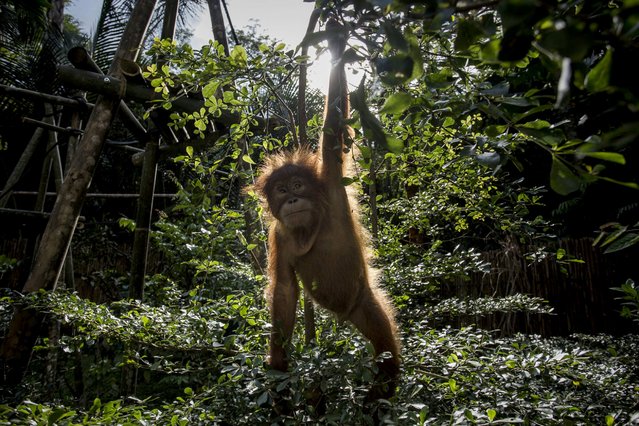
A Baby sumatran orangutan (Pongo abelii) plays around in a tree as they train at Sumatran Orangutan Conservation Programme's rehabilitation center on November 12, 2016 in Kuta Mbelin, North Sumatra, Indonesia. The Orangutans in Indonesia have been known to be on the verge of extinction as a result of deforestation and poaching. Found mostly in South-East Asia, where they live on the islands of Sumatra and Borneo, the endangered species continue to lose their habitat as a result of corporate expansion in a developing economy. Indonesia approved palm oil concessions on nearly 15 million acres of peatlands over the past years and thousands of square miles have been cleared for plantations, including the lowland areas that are the prime habitat for orangutans. (Photo by Ulet Ifansasti/Getty Images)

A Baby sumatran orangutan (Pongo abelii) plays around in a tree as they train at Sumatran Orangutan Conservation Programme's rehabilitation center on November 12, 2016 in Kuta Mbelin, North Sumatra, Indonesia. The Orangutans in Indonesia have been known to be on the verge of extinction as a result of deforestation and poaching. Found mostly in South-East Asia, where they live on the islands of Sumatra and Borneo, the endangered species continue to lose their habitat as a result of corporate expansion in a developing economy. Indonesia approved palm oil concessions on nearly 15 million acres of peatlands over the past years and thousands of square miles have been cleared for plantations, including the lowland areas that are the prime habitat for orangutans. (Photo by Ulet Ifansasti/Getty Images)
Details
16 Nov 2016 11:14:00
In this Thursday, December 1, 2016 photo, Cat Bigney, part of the Oglala Native American tribe, waits on the shore of the Cannonball river for travelers to arrive by canoe at the Oceti Sakowin camp where people have gathered to protest the Dakota Access oil pipeline in Cannon Ball, N.D. So far, those at the camp have shrugged off the heavy snow, icy winds and frigid temperatures. But if they defy next week's government deadline to abandon the camp, demonstrators know the real deep freeze lies ahead. Life-threatening wind chills and towering snow drifts could mean the greatest challenge is simple survival. (Photo by David Goldman/AP Photo)

In this Thursday, December 1, 2016 photo, Cat Bigney, part of the Oglala Native American tribe, waits on the shore of the Cannonball river for travelers to arrive by canoe at the Oceti Sakowin camp where people have gathered to protest the Dakota Access oil pipeline in Cannon Ball, N.D. So far, those at the camp have shrugged off the heavy snow, icy winds and frigid temperatures. But if they defy next week's government deadline to abandon the camp, demonstrators know the real deep freeze lies ahead. Life-threatening wind chills and towering snow drifts could mean the greatest challenge is simple survival. (Photo by David Goldman/AP Photo)
Details
06 Dec 2016 10:22:00
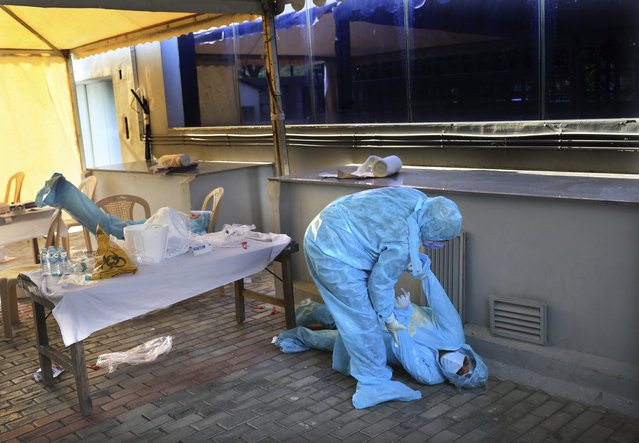
In this April 27, 2020 photo, a health worker helps another as she fainted because of exhaustion and long working hours during a swab test drive for COVID 19, in New Delhi, India. Two and a half months of nationwide lockdown kept numbers of infections relatively low in India. But with restrictions easing in recent weeks, cases have shot up, raising questions about whether authorities have done enough to avert catastrophe. Half of Delhi’s 8,200 hospital beds dedicated to COVID-19 patients are already full and officials are projecting more than half a million cases in the city alone by July 31. (Photo by Manish Swarup/AP Photo)

In this April 27, 2020 photo, a health worker helps another as she fainted because of exhaustion and long working hours during a swab test drive for COVID 19, in New Delhi, India. Two and a half months of nationwide lockdown kept numbers of infections relatively low in India. But with restrictions easing in recent weeks, cases have shot up, raising questions about whether authorities have done enough to avert catastrophe. Half of Delhi’s 8,200 hospital beds dedicated to COVID-19 patients are already full and officials are projecting more than half a million cases in the city alone by July 31. (Photo by Manish Swarup/AP Photo)
Details
08 Jan 2021 00:01:00
A patient solves a rubik's cube at a temporary hospital converted from “Wuhan Livingroom” in central China's Hubei Province on February 10, 2020. In face of the outbreak of the novel coronavirus pneumonia epidemic, Wuhan authorities have transformed public venues such as exhibition centers and gymnasiums into temporary hospitals. The hospitals have a large capacity of treating patients with mild symptoms and play an important role in isolating the source of infection and cutting off the routes of infection during epidemic prevention. The first batch of patients was hospitalized on Feb. 5. (Photo by Chine Nouvelle/SIPA Press/Rex Features/Shutterstock)

A patient solves a rubik's cube at a temporary hospital converted from “Wuhan Livingroom” in central China's Hubei Province on February 10, 2020. In face of the outbreak of the novel coronavirus pneumonia epidemic, Wuhan authorities have transformed public venues such as exhibition centers and gymnasiums into temporary hospitals. The hospitals have a large capacity of treating patients with mild symptoms and play an important role in isolating the source of infection and cutting off the routes of infection during epidemic prevention. The first batch of patients was hospitalized on Feb. 5. (Photo by Chine Nouvelle/SIPA Press/Rex Features/Shutterstock)
Details
17 Feb 2020 00:07:00
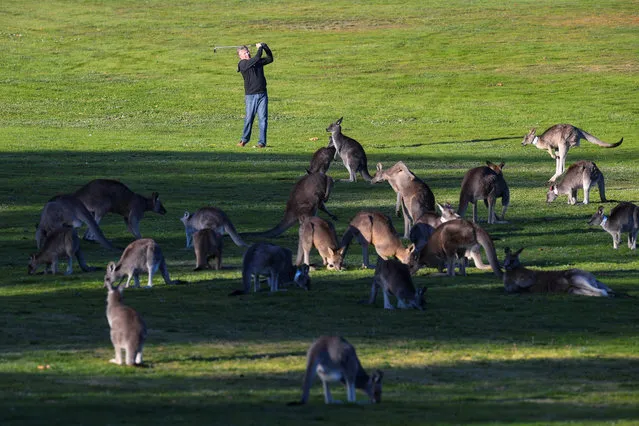
Canberra resident Bruce Gibbons is seen surrounded by grazing kangaroos as he plays a shot during a session on a practice fairway at Gold Creek Golf Club in Canberra, Australia, May 16, 2017. (Photo by Lukas Coch/Reuters/AAP)

Canberra resident Bruce Gibbons is seen surrounded by grazing kangaroos as he plays a shot during a session on a practice fairway at Gold Creek Golf Club in Canberra, Australia, May 16, 2017. (Photo by Lukas Coch/Reuters/AAP)
Details
18 May 2017 09:08:00
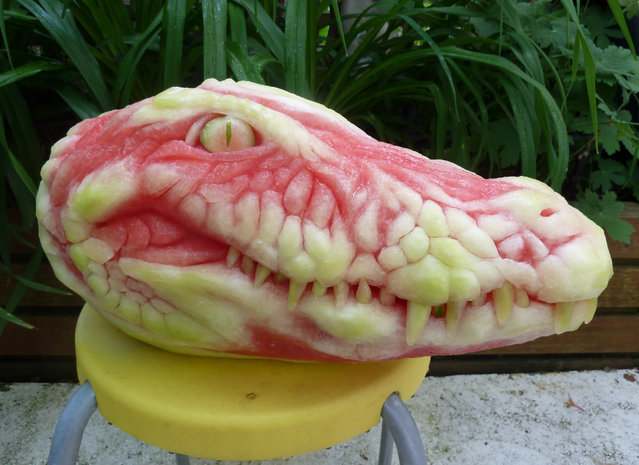
Watermelons are one of the sweetest parts of summer, but there’s no reason not to have some fun with them before you start eating. Artist Clive Cooper of Sparksfly Design saw beauty in the rinds and got to work carving sculptures out of the fruit before digging in.

Watermelons are one of the sweetest parts of summer, but there’s no reason not to have some fun with them before you start eating. Artist Clive Cooper of Sparksfly Design saw beauty in the rinds and got to work carving sculptures out of the fruit before digging in. (Photo by Clive Cooper)
Details
30 Jun 2014 12:12:00