Loading...
Done
Dancers audition for a post as cheerleaders of the Miami Dolphins, in Rio de Janeiro, Brazil, Thursday, March 3, 2016. Brazilian dancers audition in the first international cheerleader recruitment for the Miami Dolphins in Rio de Janeiro. The Dolphins will also hold auditions in Colombia, Argentina, Mexico and South of Florida. (Photo by Felipe Dana/AP Photo)

Dancers audition for a post as cheerleaders of the Miami Dolphins, in Rio de Janeiro, Brazil, Thursday, March 3, 2016. Brazilian dancers audition in the first international cheerleader recruitment for the Miami Dolphins in Rio de Janeiro. The Dolphins will also hold auditions in Colombia, Argentina, Mexico and South of Florida. (Photo by Felipe Dana/AP Photo)
Details
05 Mar 2016 12:23:00
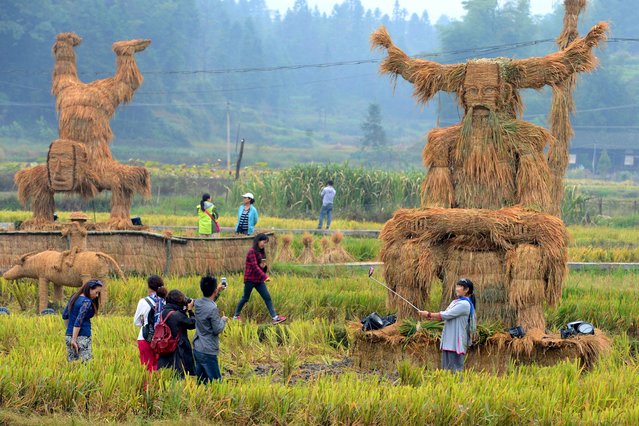
Tourists take pictures of straw figurines of traditional deities Shennong (R) and Zhang Wulang (L back) during China's National Day Holiday, in Xinhua county, Hunan province, October 4, 2015. (Photo by Reuters/China Daily)

Tourists take pictures of straw figurines of traditional deities Shennong (R) and Zhang Wulang (L back) during China's National Day Holiday, in Xinhua county, Hunan province, October 4, 2015. (Photo by Reuters/China Daily)
Details
07 Oct 2015 08:08:00
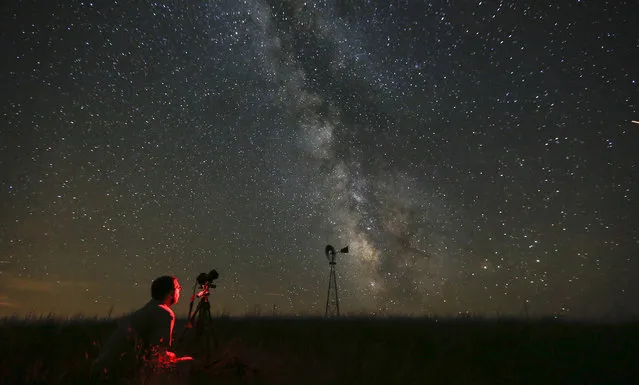
In this Wednesday, July 23, 2014 file photo, Omaha photographer Lane Hickenbottom photographs the night sky in a pasture near Callaway, Neb. With no moon in the sky, the Milky Way was visible to the naked eye. More than one-third of the world’s population can no longer see the Milky Way because of man-made lights, according to a scientific paper by Light Pollution Science and Technology Institute's Fabio Falchi and his team members, published on Friday, June 10, 2016. (Photo by Travis Heying/The Wichita Eagle via AP Photo)

In this Wednesday, July 23, 2014 file photo, Omaha photographer Lane Hickenbottom photographs the night sky in a pasture near Callaway, Neb. With no moon in the sky, the Milky Way was visible to the naked eye. More than one-third of the world’s population can no longer see the Milky Way because of man-made lights, according to a scientific paper by Light Pollution Science and Technology Institute's Fabio Falchi and his team members, published on Friday, June 10, 2016. (Photo by Travis Heying/The Wichita Eagle via AP Photo)
Details
11 Jun 2016 12:37:00
Shipping containers sit idle at the ports of Los Angeles and Long Beach, California in this aerial photo taken February 6, 2015. (Photo by Bob Riha, Jr./Reuters)

Shipping containers sit idle at the ports of Los Angeles and Long Beach, California in this aerial photo taken February 6, 2015. The loading and unloading of cargo freighters has been suspended at all 29 U.S. West Coast ports this weekend because of chronic slowdowns on the docks that shippers and terminal operators have blamed on the dockworkers' union, the companies said Friday. (Photo by Bob Riha, Jr./Reuters)
Details
10 Feb 2015 12:24:00
Chris Hondros RetrospectivePart2

Chris Hondros, a Getty Images photographer, was fatally wounded on April 20, 2011, in a mortar attack by government forces while covering the civil war in Libya. Hondros' work is woven in our history as he covered everything from politics to marathons. A new film will focus on his life as told through his images. Here's a look at some of his finest and final work. Some of these images are graphic in nature
Details
23 Aug 2013 17:38:00
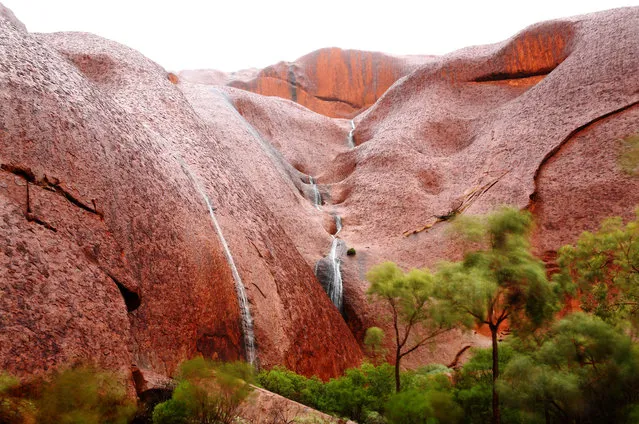
A general view of Uluru is seen as it rains on November 28, 2013 in Uluru-Kata Tjuta National Park, Australia. Uluru/ Ayers Rock is a large sandstone formation situated in central Australia approximately 335km from Alice Springs. The site and its surrounding area is scared to the Anangu people, the Indigenous people of this area and is visited by over 250,000 people each year.  (Photo by Mark Kolbe/Getty Images)

A general view of Uluru is seen as it rains on November 28, 2013 in Uluru-Kata Tjuta National Park, Australia. Uluru/ Ayers Rock is a large sandstone formation situated in central Australia approximately 335km from Alice Springs. The site and its surrounding area is scared to the Anangu people, the Indigenous people of this area and is visited by over 250,000 people each year. (Photo by Mark Kolbe/Getty Images)
Details
30 Jan 2014 13:27:00
Uranjargal, a leader of the Mongolian neo-Nazi group Tsagaan Khass, stands next to a statue of Chingunjav, a Mongolian national hero, in Ulan Bator June 22, 2013. (Photo by Carlos Barria/Reuters)

Uranjargal, a leader of the Mongolian neo-Nazi group Tsagaan Khass, stands next to a statue of Chingunjav, a Mongolian national hero, in Ulan Bator June 22, 2013. The group has rebranded itself as an environmentalist organisation fighting pollution by foreign-owned mines, seeking legitimacy as it sends Swastika-wearing members to check mining permits. Over the past years, ultra-nationalist groups have expanded in the country and among those garnering attention is Tsagaan Khass, which has recently shifted its focus from activities such as attacks on women it accuses of consorting with foreign men to environmental issues, with the stated goal of protecting Mongolia from foreign mining interests. This ultra-nationalist group was founded in the 1990s and currently has 100-plus members. (Photo by Carlos Barria/Reuters)
Details
09 Jul 2013 07:23:00
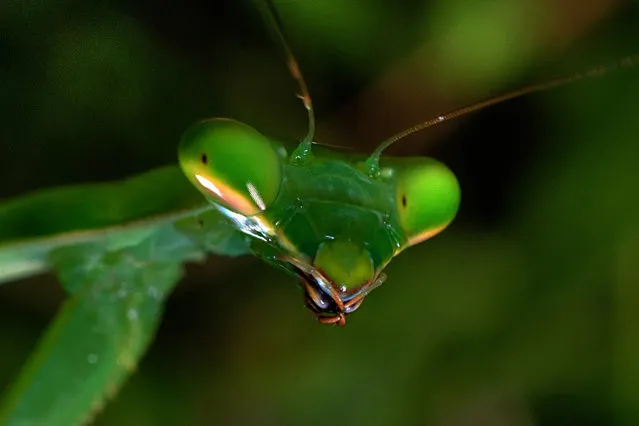
Close Encounter of the Insect Kind: Check out the awesome face on this praying mantis. I can't get over the mouth, it's like something from a science fiction movie. Of all photographic styles macro is definitely my favorite. I am constantly amazed, in every photo that I take, by the intricate level of detail that exists on even the smallest of creatures. It's a stark reminder that a very complex and infinitely beautiful world exists just beyond our human-sized level of perception. Photo taken in Donnybrook, Queensland, Australia. (Photo by Andrew Young/National Geographic Photo Contest

Close Encounter of the Insect Kind: “Check out the awesome face on this praying mantis. I can't get over the mouth, it's like something from a science fiction movie. Of all photographic styles macro is definitely my favorite. I am constantly amazed, in every photo that I take, by the intricate level of detail that exists on even the smallest of creatures. It's a stark reminder that a very complex and infinitely beautiful world exists just beyond our human-sized level of perception. Photo taken in Donnybrook, Queensland, Australia” – Andrew Young. (Photo by Andrew Young/National Geographic Photo Contest via The Atlantic)
Details
24 Sep 2012 09:18:00