Loading...
Done
On August 31, 2012, a long filament of solar material that had been hovering in the sun's atmosphere, the corona, erupted out into space at 4:36 p.m. EDT. The coronal mass ejection, or CME, traveled at over 900 miles per second. The CME did not travel directly toward Earth, but did connect with Earth's magnetic environment, or magnetosphere, causing aurora to appear on the night of Monday, September 3. (Photo by NASA/GSFC/SDO)

On August 31, 2012, a long filament of solar material that had been hovering in the sun's atmosphere, the corona, erupted out into space at 4:36 p.m. EDT. The coronal mass ejection, or CME, traveled at over 900 miles per second. The CME did not travel directly toward Earth, but did connect with Earth's magnetic environment, or magnetosphere, causing aurora to appear on the night of Monday, September 3. (Photo by NASA/GSFC/SDO via The Atlantic)
Details
14 Sep 2012 09:01:00
Athlets run during the women's 3000 meter steeplechase at the International Athletics Meeting in Lucerne, Switzerland, 14 June 2016. (Photo by Alexandra Wey/EPA)

Athlets run during the women's 3000 meter steeplechase at the International Athletics Meeting in Lucerne, Switzerland, 14 June 2016. (Photo by Alexandra Wey/EPA)
Details
16 Jun 2016 12:55:00
A love story with two log choppers. “In 1993, I was working on a project about life in the Olomouc region of Czechoslovakia. One day, I came to the village of Dlouhá Loučka-Křivá and went into a courtyard where I saw two old people, a husband and wife, sawing firewood for winter. They were working quietly, concentrating. I watched them fetch a beam from a wrecked barn, but they didn’t discuss how they planned to carry it to the saw. The woman faced one way, the man the other. When they realised, the woman eventually turned and followed her husband. The picture I took is the picture of many relationships – when each partner wants something different, but they have to come to an agreement, pull together eventually”. (Photo by Jindrich Streit)

A love story with two log choppers. “In 1993, I was working on a project about life in the Olomouc region of Czechoslovakia. One day, I came to the village of Dlouhá Loučka-Křivá and went into a courtyard where I saw two old people, a husband and wife, sawing firewood for winter. They were working quietly, concentrating. I watched them fetch a beam from a wrecked barn, but they didn’t discuss how they planned to carry it to the saw. The woman faced one way, the man the other. When they realised, the woman eventually turned and followed her husband. The picture I took is the picture of many relationships – when each partner wants something different, but they have to come to an agreement, pull together eventually”. (Photo by Jindrich Streit)
Details
04 Aug 2016 12:34:00
Rooftops of solar powered houses are pictured in Ota, 80 km northwest of Tokyo in this October 28, 2008 file photo. One by one, Japan is turning off the lights at the giant oil-fired power plants that propelled it to the ranks of the world's top industrialised nations. With nuclear power in the doldrums after the Fukushima disaster, it's solar energy that is becoming the alternative. (Photo by Yuriko Nakao/Reuters)

Rooftops of solar powered houses are pictured in Ota, 80 km northwest of Tokyo in this October 28, 2008 file photo. One by one, Japan is turning off the lights at the giant oil-fired power plants that propelled it to the ranks of the world's top industrialised nations. With nuclear power in the doldrums after the Fukushima disaster, it's solar energy that is becoming the alternative. Solar power is set to become profitable in Japan as early as this quarter, according to the Japan Renewable Energy Foundation (JREF), freeing it from the need for government subsidies and making it the last of the G7 economies where the technology has become economically viable. (Photo by Yuriko Nakao/Reuters)
Details
24 Nov 2015 08:04:00
A boy looks for sellable materials close to the burning garbage in the permanent waste land under Sylhet City Corporation for a living, on January 15, 2015. (Photo by Md. Akhlas Uddin/Pacific Press)

A boy looks for sellable materials close to the burning garbage in the permanent waste land under Sylhet City Corporation for a living, on January 15, 2015. (Photo by Md. Akhlas Uddin/Pacific Press)
Details
18 Feb 2015 13:32:00
In this Sunday, March 29, 2015 photo, a young performer from the Parinacochas district of Ayacuhco dances in the Vencedores de Ayacucho dance festival, in the Acho bullring in Lima, Peru. The performers sang in the Quechua language, portraying the planting of corn and potatoes. From very young children to elderly people dressed as farmers, tigers, and foxes, as well as members of auto-defense groups, soldiers and police officers, to portray the violence that tore apart their families and communities. (Photo by Rodrigo Abd/AP Photo)

In this Sunday, March 29, 2015 photo, a young performer from the Parinacochas district of Ayacuhco dances in the Vencedores de Ayacucho dance festival, in the Acho bullring in Lima, Peru. The performers sang in the Quechua language, portraying the planting of corn and potatoes. From very young children to elderly people dressed as farmers, tigers, and foxes, as well as members of auto-defense groups, soldiers and police officers, to portray the violence that tore apart their families and communities. (Photo by Rodrigo Abd/AP Photo)
Details
01 Apr 2015 12:07:00
“Another Day in Paradise”. (Joel Goodman)

“Another Day in Paradise”. (Photo and caption by Joel Goodman)
Details
26 Sep 2013 08:43:00
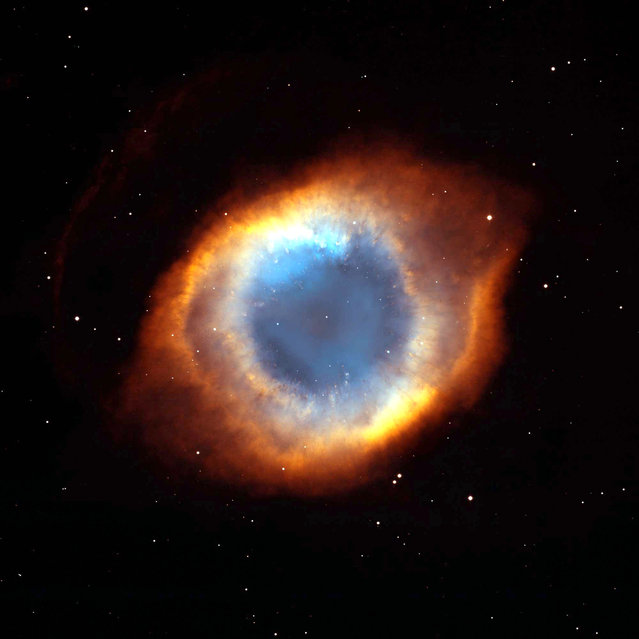
A coil-shaped Helix Nebula showing a fine web of filamentary “bicycle-spoke” features embedded in the colorful red and blue ring of gas. At 650 light-years away, the Helix is one of the nearest planetary nebulae to Earth. A planetary nebula is the glowing gas around a dying, Sun-like star. (Photo by Reuters/NASA)

A coil-shaped Helix Nebula showing a fine web of filamentary “bicycle-spoke” features embedded in the colorful red and blue ring of gas. At 650 light-years away, the Helix is one of the nearest planetary nebulae to Earth. A planetary nebula is the glowing gas around a dying, Sun-like star. (Photo by Reuters/NASA)
Details
22 Oct 2014 14:01:00