Loading...
Done
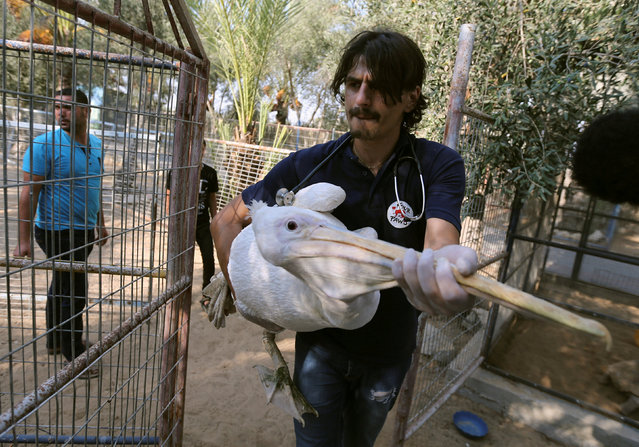
A member of Four Paws International team carries a pelican to be taken out of Gaza, at a zoo in Khan Younis in the southern Gaza Strip August 23, 2016. Fifteen animals including a bengal tiger were removed from “the world’s worst zoo” in the Gaza town of Khan Younis as it was finally closed down. Animal welfare group, Four Paws International, will help bring most of the refugees to a zoo in Jordan, but the tiger will be taken to a refuge in South Africa. Five monkeys, a porcupine, an emu and the tiger, among others, crossed from the occupied territory into Israel after the zoo suffered from years of difficulty. With lack of awareness of animal welfare in Gaza, the densely-populated territory has previously made headlines after another zoo painted donkeys with stripes to resemble zebras in 2009. (Photo by Ibraheem Abu Mustafa/Reuters)

A member of Four Paws International team carries a pelican to be taken out of Gaza, at a zoo in Khan Younis in the southern Gaza Strip August 23, 2016. Fifteen animals including a bengal tiger were removed from “the world’s worst zoo” in the Gaza town of Khan Younis as it was finally closed down. Animal welfare group, Four Paws International, will help bring most of the refugees to a zoo in Jordan, but the tiger will be taken to a refuge in South Africa. (Photo by Ibraheem Abu Mustafa/Reuters)
Details
26 Aug 2016 10:22:00
A man poses with a hyena along a street in Lagos, Nigeria November 4, 2008. (Photo by Akintunde Akinleye/Reuters)

A man poses with a hyena along a street in Lagos, Nigeria November 4, 2008. (Photo by Akintunde Akinleye/Reuters)
Details
23 Apr 2015 11:47:00
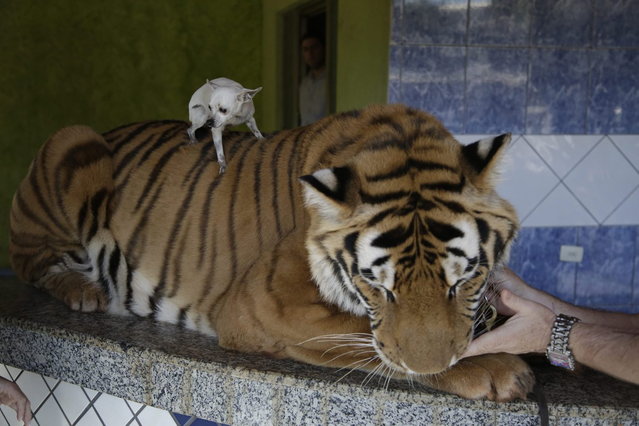
The Borges' family pet dog, Little, is placed on the back of Tom, their tiger, for a photo to be taken, in Maringa, Brazil, Friday, September 27, 2013. The Brazilian family is now locked in a legal dispute for the big cats, they have eight tigers and two lions, with federal wildlife officials working to take them away. While Borges does have a license to raise the animals, Brazilian wildlife officials say he illegally bred the cats, creating a public danger. (Photo by Renata Brito/AP Photo)

“Ary Borges and his family live in southern Brazil like most families the Borges' love animals and have an array of cats living in their home. The only difference between the cats owned by the Borges family and the cat that is cuddled up on your lap as you read this is the Borges' cats weigh over 700 pounds and could kill you just as soon as look at you. The Borges family shares their home with nine tigers, two lionesses, a chimp and a Chihuahua”. – Amanda Schiavo via Latin Times. Photo: The Borges' family pet dog, Little, is placed on the back of Tom, their tiger, for a photo to be taken, in Maringa, Brazil, Friday, September 27, 2013. (Photo by Renata Brito/AP Photo)
Details
04 Oct 2013 11:51:00
Photographers: Mandy Rosen

“The girl behind the camera and the girl in front of the camera”, May 2012. (Photo by: Mandy Rosen; Source: Flickr)
Details
19 May 2012 13:33:00
A real life Robinson Crusoe – David Glasheen

David Glasheen faces eviction from his remote tropical paradise after losing a Supreme Court legal case.
Details
08 Nov 2012 17:42:00


Japan's electronics equipment maker MuRata Manufacturing Co., Ltd's showcased their bicycle-riding robot “MuRata Boy” during the CEATEC Japan 2006 exhibition on October 3, 2006 in Chiba, Japan. The “MuRata Boy” robot can ride up a 25-degree slope, stop without losing its balance and make an S-curve without falling. (Photo by Koichi Kamoshida/Getty Images)
Details
14 May 2011 13:41:00
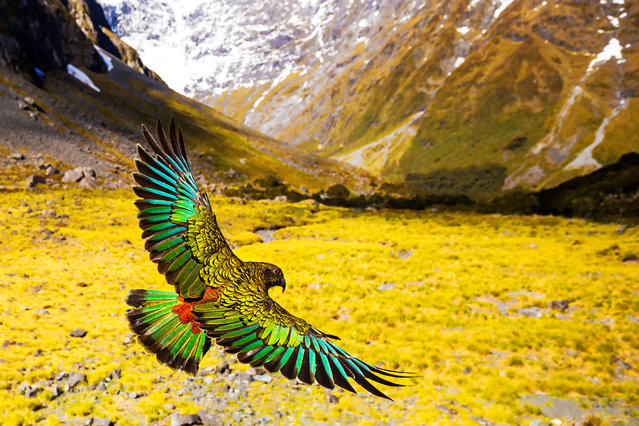
Kea are the only true alpine parrots in the world and thrive as cunning opportunists in the freezing conditions of the Southern Alps. Kea are thought to have developed their wide array of food-finding strategies during the last great ice age, where they learned to adapt using their unusual powers of curiosity. (Photo by Tom Walker/BBC Pictures/The Guardian)

Kea are the only true alpine parrots in the world and thrive as cunning opportunists in the freezing conditions of the Southern Alps. Kea are thought to have developed their wide array of food-finding strategies during the last great ice age, where they learned to adapt using their unusual powers of curiosity. (Photo by Tom Walker/BBC Pictures/The Guardian)
Details
19 Jul 2016 13:03:00
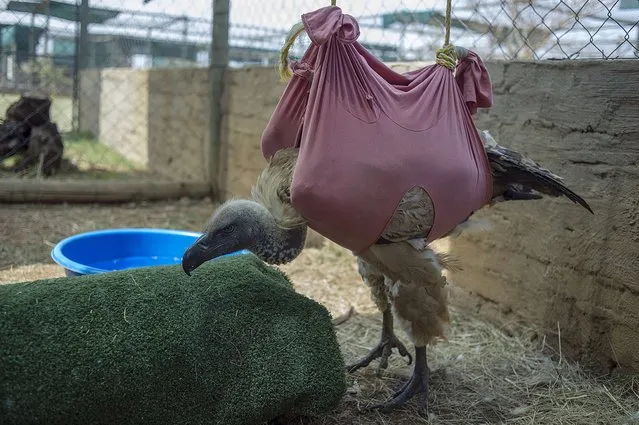
An injured vulture is treated at the VulPro Vulture Rehabilitation Centre in Hartebeepoortdam in the Magalisburg region on September 15, 2015. Confined to southern Africa, just under 4,000 breeding pairs of Cape Vultures remain in the wild, mostly in South Africa, Lesotho and Botswana. Unless conservation efforts are successful, Africa's largest vulture species may be facing eventual extinction. (Photo by Mujahid Safodien/AFP Photo)

An injured vulture is treated at the VulPro Vulture Rehabilitation Centre in Hartebeepoortdam in the Magalisburg region on September 15, 2015. Confined to southern Africa, just under 4,000 breeding pairs of Cape Vultures remain in the wild, mostly in South Africa, Lesotho and Botswana. Unless conservation efforts are successful, Africa's largest vulture species may be facing eventual extinction. (Photo by Mujahid Safodien/AFP Photo)
Details
19 Sep 2015 12:27:00