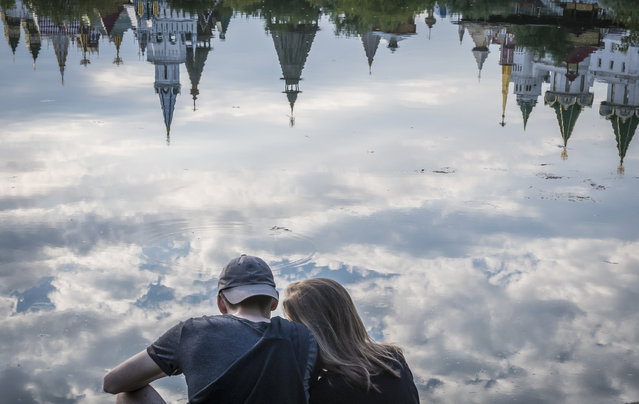
A couple enjoys the view of the ethnographic and amusement center Kremlin in Izmailovo reflected in the Serebryano-Vinogradnii lake in Moscow, Russia on July 30, 2017. (Photo by Mladen Antonov/AFP Photo)
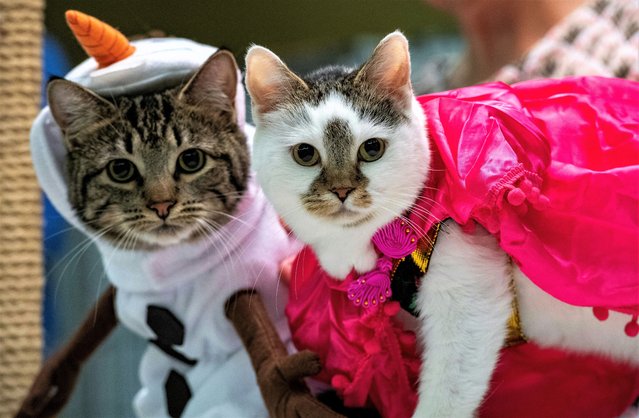
Cats dressed as characters from the film Frozen wait to be judged during the costume contest at the New England Meow Outfit's 10th Annual Allbreed and Household Pet Cat Show in Natick, Massachusetts, on August 27, 2023. (Photo by Joseph Prezioso/AFP Photo)
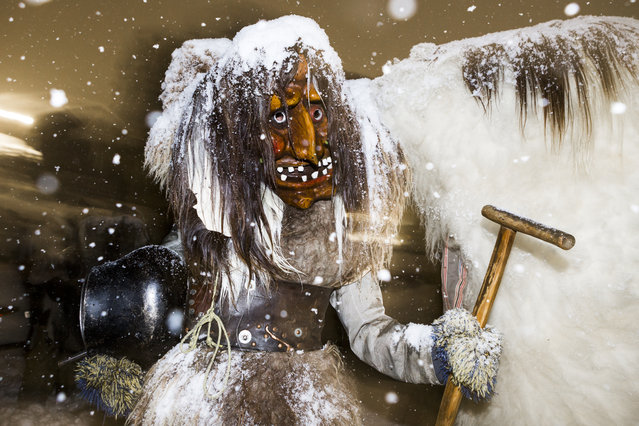
In this February 4, 2016 picture a masked participant of the traditional carnival parade poses in the streets of the village of Kippel in the Loetschental valley, southwestern part of Switzerland. During this sinister carnival, participants wearing wooden masks and animal furs, crowd the streets of the villages to scare the people. (Photo by Dominic Steinmann/Keystone via AP Photo)
Lola, owned by Kate Hansen, of Des Moines, Iowa, waits to be judged at the annual Drake Relays Beautiful Bulldog Contest, Monday, April 25, 2022, in Des Moines, Iowa. The pageant kicks off the Drake Relays festivities at Drake University where a bulldog is the mascot. (Photo by Charlie Neibergall/AP Photo)
A girl dressed up as a emissary of the Three Wise Men poses for a photo as she waits for their arrival in a helicopter to take part in the traditional Epiphany parade in Ronda, Spain, January 5, 2018. (Photo by Jon Nazca/Reuters)
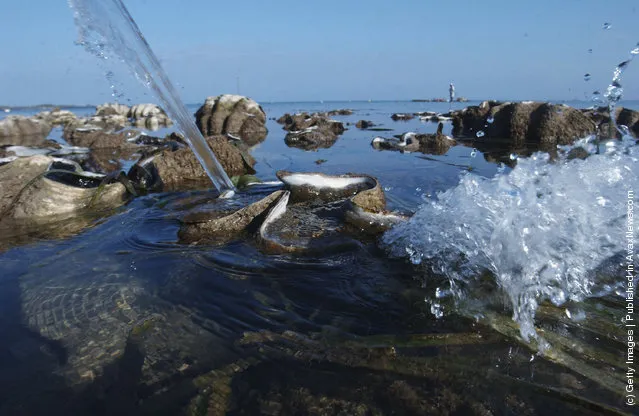
“The giant clam, Tridacna gigas (known as pā’ua in Cook Islands Māori), is the largest living bivalve mollusc. T. gigas is one of the most endangered clam species. It was mentioned as early as 1825 in scientific reports. One of a number of large clam species native to the shallow coral reefs of the South Pacific and Indian oceans, they can weigh more than 200 kilograms (440 lb) measure as much as 120 cm (47 in) across, and have an average lifespan in the wild of 100 years or more”. – Wikipedia
Photo: Tridacna Gigas, or Giant Clams spew water as a traditional fisherman passes by a small sanctuary on January 23, 2004 near Bolinao in the Northern Philippines. The clams, prime builders for coral reefs and providing shelter for spawning fish and other marine life, are exposed by low tides in the sanctuary. Overfishing and pollution throughout the country are not only threatening food security, but are also starting to choke one of the few working clam sanctuaries in the world. (Photo by David Greedy/Getty Images)