Loading...
Done
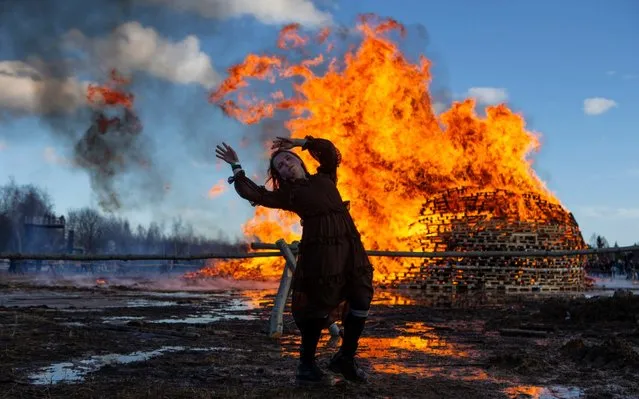
In this photo taken on Saturday, March 9, 2019, a visitor dances in front of a sculpture burning at the Maslenitsa (Shrovetide) festival at the Nikola-Lenivets art park in Nikola-Lenivets village, about 200 kilometers (125 miles) south-west of Moscow, Russia. As part of the celebrations of Maslenitsa (Shrovetide) Holiday in Russian, a folk holiday which heralds the beginning of spring, contemporary artist and park founder Nikolay Polissky built a giant sculpture made of wood and hay which was burnt to ashes during a traditional bonfire. (Photo by Alexander Zemlianichenko Jr./AP Photo)

In this photo taken on Saturday, March 9, 2019, a visitor dances in front of a sculpture burning at the Maslenitsa (Shrovetide) festival at the Nikola-Lenivets art park in Nikola-Lenivets village, about 200 kilometers (125 miles) south-west of Moscow, Russia. As part of the celebrations of Maslenitsa (Shrovetide) Holiday in Russian, a folk holiday which heralds the beginning of spring, contemporary artist and park founder Nikolay Polissky built a giant sculpture made of wood and hay which was burnt to ashes during a traditional bonfire. (Photo by Alexander Zemlianichenko Jr./AP Photo)
Details
27 Jul 2019 00:01:00
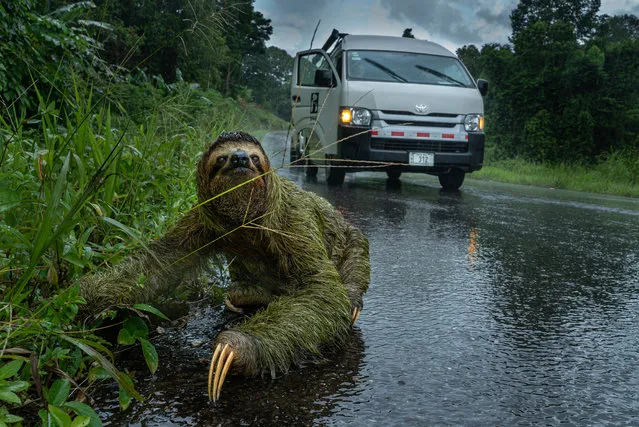
People and Nature category winner: Why did the sloth cross the road? by Andrew Whitworth (Osa Conservation and University of Glasgow), taken in Osa Peninsula, Costa Rica. “I was driving out from the Osa Peninsula, located on the southern Pacific coast of Costa Rica on a dark, stormy day. This female three-toed sloth (Bradypus variegatus) had luckily just about made it across the road, and the drivers of the Toyota on this occasion had spotted her in good time”. (Photo by Andrew Whitworth/2019 British Ecological Society Photography Competition)

People and Nature category winner: Why did the sloth cross the road? by Andrew Whitworth (Osa Conservation and University of Glasgow), taken in Osa Peninsula, Costa Rica. “I was driving out from the Osa Peninsula, located on the southern Pacific coast of Costa Rica on a dark, stormy day. This female three-toed sloth (Bradypus variegatus) had luckily just about made it across the road, and the drivers of the Toyota on this occasion had spotted her in good time”. (Photo by Andrew Whitworth/2019 British Ecological Society Photography Competition)
Details
30 Nov 2019 00:05:00
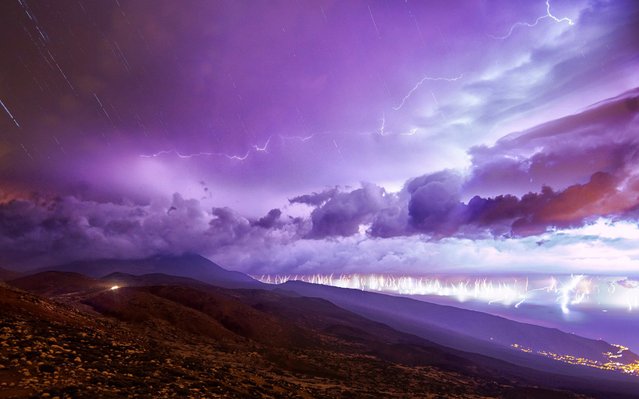
A handout photo made available by TeideLab shows an image composed of 200 pictures that shows the lightning activity between 3 am and 7am during a storm in Izana, Tenerife, Canary Islands, Spain, 27 October 2019. Over 2,000 lighting strikes fell mostly over Tenerife island last 26 October during a strong storm. (Photo by Daniel López/EPA/EFE/TeideLab)

A handout photo made available by TeideLab shows an image composed of 200 pictures that shows the lightning activity between 3 am and 7am during a storm in Izana, Tenerife, Canary Islands, Spain, 27 October 2019. Over 2,000 lighting strikes fell mostly over Tenerife island last 26 October during a strong storm. (Photo by Daniel López/EPA/EFE/TeideLab)
Details
29 Aug 2020 00:03:00
This Thursday, January 22, 2015 photo made with a long exposure shows the glow from a Noctiluca scintillans algal bloom along the seashore in Hong Kong. The luminescence, also called Sea Sparkle, is triggered by farm pollution that can be devastating to marine life and local fisheries, according to University of Georgia oceanographer Samantha Joye. (Photo by Kin Cheung/AP Photo)

This Thursday, January 22, 2015 photo made with a long exposure shows the glow from a Noctiluca scintillans algal bloom along the seashore in Hong Kong. The luminescence, also called Sea Sparkle, is triggered by farm pollution that can be devastating to marine life and local fisheries, according to University of Georgia oceanographer Samantha Joye. Noctiluca itself does not produce neurotoxins like other similar organisms do. But its role as both prey and predator tends can eventually magnify the accumulation of toxins in the food chain, according to R. Eugene Turner at Louisiana State University. (Photo by Kin Cheung/AP Photo)
Details
23 Jan 2015 13:12:00
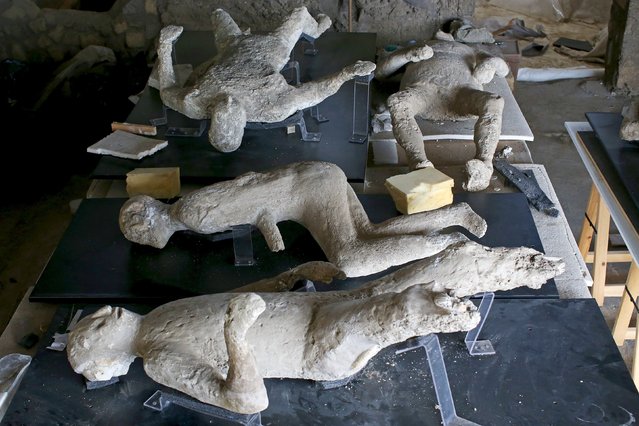
Plaster cast moulds of victims of the Mount Vesuvius eruption lie on a display table in a laboratory at Pompeii October 13, 2015. An expert team made up of archaeologists, radiologists, orthodontists and anthropologists began on September 2015 to use CAT scan technology (computerised axial tomography) to peer inside the plaster cast moulds of Pompeii's victims, in a study that has added more detail to previous findings. (Photo by Alessandro Bianchi/Reuters)

Plaster cast moulds of victims of the Mount Vesuvius eruption lie on a display table in a laboratory at Pompeii October 13, 2015. An expert team made up of archaeologists, radiologists, orthodontists and anthropologists began on September 2015 to use CAT scan technology (computerised axial tomography) to peer inside the plaster cast moulds of Pompeii's victims, in a study that has added more detail to previous findings. A 16-layer scan had to be used in order to penetrate the hardened plaster but the results showed up impressive skeletal remains and near perfect teeth. (Photo by Alessandro Bianchi/Reuters)
Details
22 Oct 2015 08:02:00
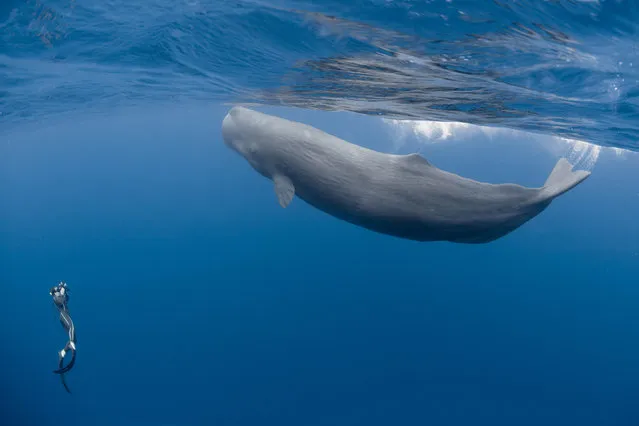
These images show the unique bond a group of free divers formed with gigantic sperm whales. Swimming just inches away from the huge mammals, the divers are dwarfed in size, made to look like specks in comparison. The photos were taken by renowned underwater photographers Alexandre Roubaud and Alexandre Voyer, who are based in Paris but travel the world to capture such stunning imagery. Here: a diver with a sperm whales. (Photo by Alexandre Roubaud/Alexandre Voyer/Caters News)

These images show the unique bond a group of free divers formed with gigantic sperm whales. Swimming just inches away from the huge mammals, the divers are dwarfed in size, made to look like specks in comparison. The photos were taken by renowned underwater photographers Alexandre Roubaud and Alexandre Voyer, who are based in Paris but travel the world to capture such stunning imagery. Here: a diver with a sperm whales. (Photo by Alexandre Roubaud/Alexandre Voyer/Caters News)
Details
16 Nov 2015 08:06:00
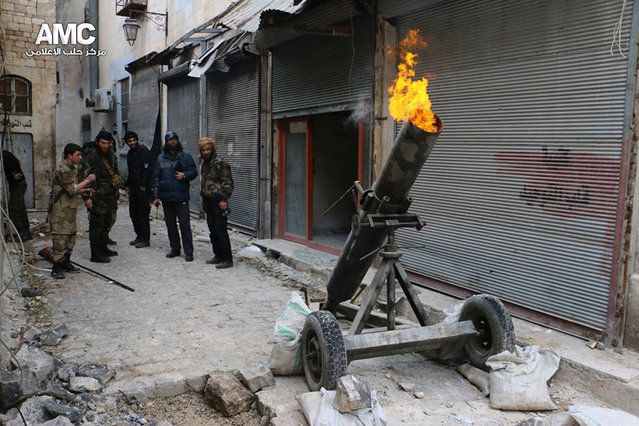
This file photo provided on Sunday February 15, 2015 by the Syrian anti-government activist group Aleppo Media Center (AMC), which has been authenticated based on its contents and other AP reporting, shows Syrian rebels firing locally made shells against the Syrian government forces, in Aleppo, Syria. (Photo by AP Photo/Aleppo Media Center)

This file photo provided on Sunday February 15, 2015 by the Syrian anti-government activist group Aleppo Media Center (AMC), which has been authenticated based on its contents and other AP reporting, shows Syrian rebels firing locally made shells against the Syrian government forces, in Aleppo, Syria. (Photo by AP Photo/Aleppo Media Center)
Details
12 Mar 2016 14:23:00
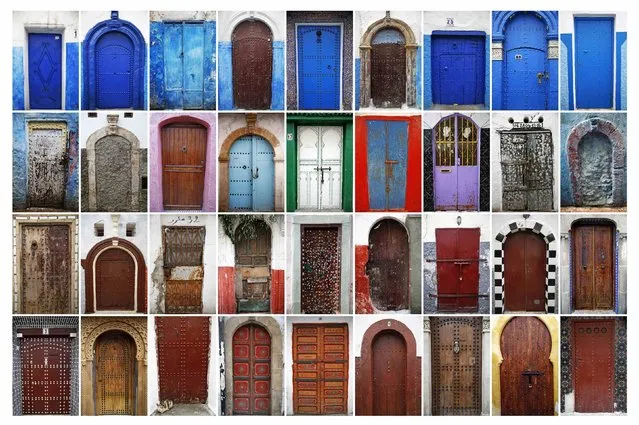
A combination photo shows some of the colourful doors seen in Rabat's Medina and Kasbah of the Udayas, September 2014. UNESCO made Rabat a World Heritage Site two years ago and media and tour operators call it a “must-see destination”. (Photo by Damir Sagolj/Reuters)

A combination photo shows some of the colourful doors seen in Rabat's Medina and Kasbah of the Udayas, September 2014. UNESCO made Rabat a World Heritage Site two years ago and media and tour operators call it a “must-see destination”. But it seems the tourist hordes have yet to find out. While visitors are getting squeezed through the better-known sites of Marrakesh and Fez, the old part of Rabat - with its beautiful Medina and Kasbah of the Udayas - remains an almost unspoiled oasis of calm. Smaller and more compact, its labyrinths of streets, passages and dead ends are a treasure trove of shapes and colours, of moments begging to be caught by the photographer's lens. (Photo by Damir Sagolj/Reuters)
Details
08 Oct 2014 12:08:00