Loading...
Done


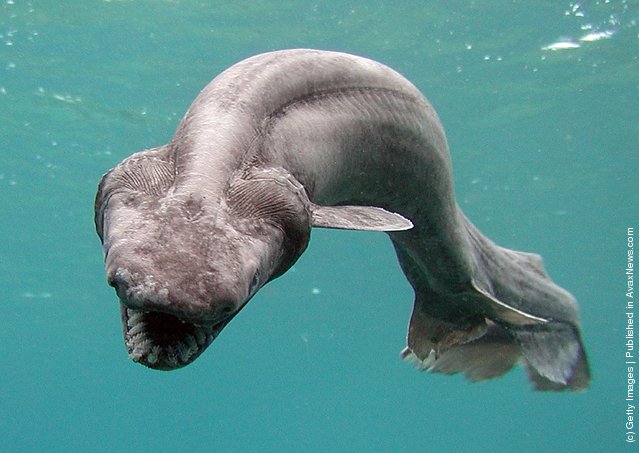
“The frilled shark (Chlamydoselachus anguineus) is one of two extant species of shark in the family Chlamydoselachidae, with a wide but patchy distribution in the Atlantic and Pacific Oceans. This uncommon species is found over the outer continental shelf and upper continental slope, generally near the bottom though there is evidence of substantial upward movements. It has been caught as deep as 1,570 m (5,150 ft), whereas in Suruga Bay, Japan it is most common at depths of 50–200 m (160–660 ft). Exhibiting several “primitive” features, the frilled shark has often been termed a «living fossil»”. – Wikipedia

Photo: A 1.6 meter long Frill shark swims in a tank after being found by a fisherman at a bay in Numazu, on January 21, 2007 in Numazu, Japan. The frill shark, also known as a Frilled shark usually lives in waters of a depth of 600 meters and so it is very rare that this shark is found alive at sea-level. It's body shape and the number of gill are similar to fossils of sharks which lived 350,000,000 years ago. (Photo by Awashima Marine Park/Getty Images)
Details
05 May 2011 10:01:00
Students practice acrobatic skills in the Sichuan Provincial Art School in Chengdu of Sichuan Province, China

Young girls practice acrobatic skills in the Sichuan Provincial Art School July 14, 2008 in Chengdu of Sichuan Province, China. (Photo by China Photos/Getty Images)
Details
07 Dec 2011 13:48:00
Palestinian mother Esma Zuhd cries after her children, Jahan and Ahmed Nasser who died after an Israeli attack at the Nuseirat Refugee Camp in Deir Al-Balah, Gaza on December 29, 2023. (Photo by Ashraf Amra/Anadolu via Getty Images)

Palestinian mother Esma Zuhd cries after her children, Jahan and Ahmed Nasser who died after an Israeli attack at the Nuseirat Refugee Camp in Deir Al-Balah, Gaza on December 29, 2023. (Photo by Ashraf Amra/Anadolu via Getty Images)
Details
05 Jan 2024 21:16:00
A woman visits the exhibition “Pop Air” at the Balloon Museum in Madrid, Spain, 22 March 2023. The exhibition, dedicated to balloons and inflatable arts, opened to the public in Madrid on 18 March and runs through 23 July 2023. (Photo by Alejandro Lopez/EPA)

A woman visits the exhibition “Pop Air” at the Balloon Museum in Madrid, Spain, 22 March 2023. The exhibition, dedicated to balloons and inflatable arts, opened to the public in Madrid on 18 March and runs through 23 July 2023. (Photo by Alejandro Lopez/EPA)
Details
04 Apr 2023 04:17:00
A mock-up of a missile with the inscription reading as “Towards Washington. Threatening U.S. territory is the path to victory” is seen on the roof of a car parked in front of Saint Isaac's Cathedral in Saint Petersburg on January 12, 2025. (Photo by Olga Maltseva/AFP Photo)

A mock-up of a missile with the inscription reading as “Towards Washington. Threatening U.S. territory is the path to victory” is seen on the roof of a car parked in front of Saint Isaac's Cathedral in Saint Petersburg on January 12, 2025. (Photo by Olga Maltseva/AFP Photo)
Details
19 Feb 2025 03:43:00
A Balinese man performs a traditional dance at Art Center Denpasar on Indonesia's resort island of Bali on May 30, 2025. (Photo by Sonny Tumbelaka/AFP Photo)

A Balinese man performs a traditional dance at Art Center Denpasar on Indonesia's resort island of Bali on May 30, 2025. (Photo by Sonny Tumbelaka/AFP Photo)
Details
05 Jul 2025 03:34:00
The First U.S. Spacewalk – Gemini 4 Ed White made the United States' first spacewalk on June 3, 1965 during the Gemini 4 mission. The extra-vehicular activity (EVA) started at 19:45 UT (3:45 p.m. EDT) on the third orbit when White opened his hatch and used the hand-held manuevering oxygen-jet gun to push himself out of the capsule. (Photo by NASA)

The First U.S. Spacewalk – Gemini 4 Ed White made the United States' first spacewalk on June 3, 1965 during the Gemini 4 mission. The extra-vehicular activity (EVA) started at 19:45 UT (3:45 p.m. EDT) on the third orbit when White opened his hatch and used the hand-held manuevering oxygen-jet gun to push himself out of the capsule. (Photo by NASA)
Details
11 Apr 2014 08:40:00


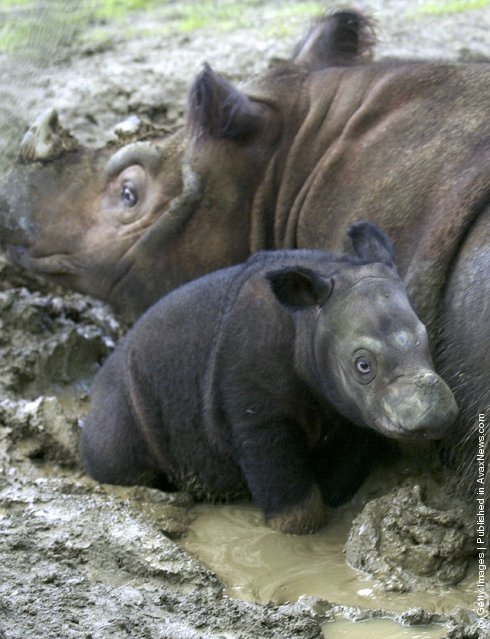
“The Sumatran Rhinoceros (Dicerorhinus sumatrensis) is a member of the family Rhinocerotidae and one of five extant rhinoceroses. It is the only extant species of the genus Dicerorhinus. It is the smallest rhinoceros, standing about 120–145 centimetres (3.9–4.76 ft) high at the shoulder, with a body length of 250 centimetres (8.2 ft) and weight of 500–800 kilograms (1,100–1,800 lb). Like the African species, it has two horns; the larger is the nasal horn, typically 15–25 centimetres (5.9–9.8 in), while the other horn is typically a stub. A coat of reddish-brown hair covers most of the Sumatran Rhino's body”. – Wikipedia

Photo: Emi, a Sumatran rhinoceros lies in the mud with her three-week-old female calf at the Cincinnati Zoo and Botanical Garden August 19, 2004 in Cincinnati, Ohio. Emi made history by becoming the first Sumatran rhino to produce two calves in captivity. (Photo by Mike Simons/Getty Images)
Details
22 Jun 2011 12:37:00