Loading...
Done
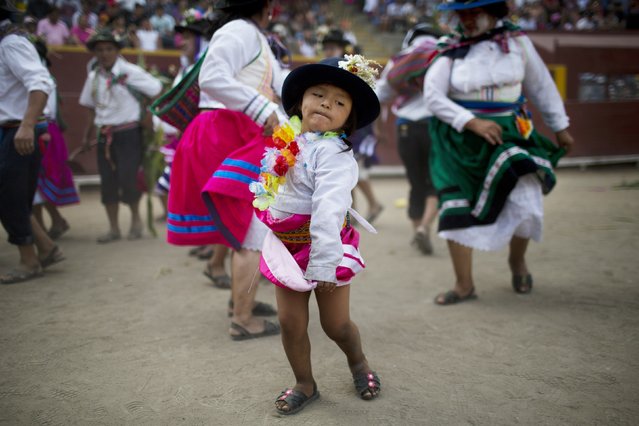
In this Sunday, March 29, 2015 photo, a young performer from the Parinacochas district of Ayacuhco dances in the Vencedores de Ayacucho dance festival, in the Acho bullring in Lima, Peru. The performers sang in the Quechua language, portraying the planting of corn and potatoes. From very young children to elderly people dressed as farmers, tigers, and foxes, as well as members of auto-defense groups, soldiers and police officers, to portray the violence that tore apart their families and communities. (Photo by Rodrigo Abd/AP Photo)

In this Sunday, March 29, 2015 photo, a young performer from the Parinacochas district of Ayacuhco dances in the Vencedores de Ayacucho dance festival, in the Acho bullring in Lima, Peru. The performers sang in the Quechua language, portraying the planting of corn and potatoes. From very young children to elderly people dressed as farmers, tigers, and foxes, as well as members of auto-defense groups, soldiers and police officers, to portray the violence that tore apart their families and communities. (Photo by Rodrigo Abd/AP Photo)
Details
01 Apr 2015 12:07:00
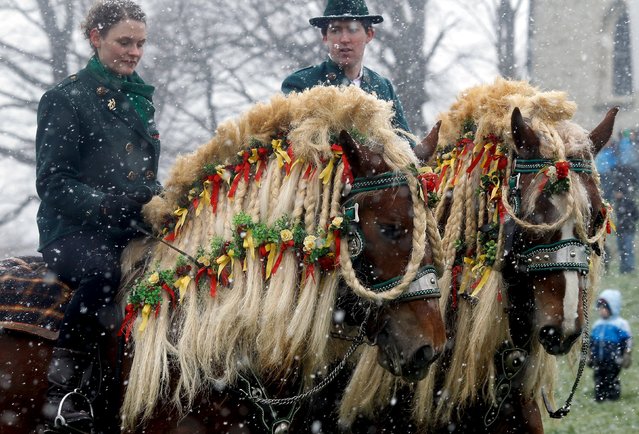
Pilgrims dressed in traditional Bavarian clothes attend the traditional Georgi horse riding procession on Easter Monday in heavy snowfall, in the southern Bavarian town of Traunstein April 6, 2015. Since the early 16th century, farmers have taken part in the pilgrimage to bless their horses. This tradition, the “Georgiritt”, goes back to the legend of Saint George, the horsemen's patron saint. (Photo by Michael Dalder/Reuters)

Pilgrims dressed in traditional Bavarian clothes attend the traditional Georgi horse riding procession on Easter Monday in heavy snowfall, in the southern Bavarian town of Traunstein April 6, 2015. Since the early 16th century, farmers have taken part in the pilgrimage to bless their horses. This tradition, the “Georgiritt”, goes back to the legend of Saint George, the horsemen's patron saint. (Photo by Michael Dalder/Reuters)
Details
07 Apr 2015 12:03:00
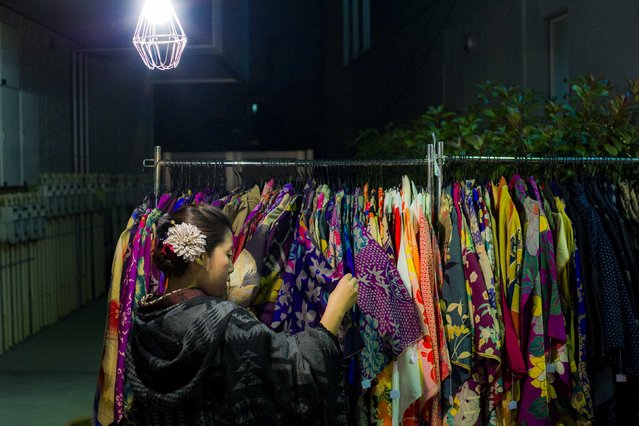
A woman browses through kimonos for sale at Boroichi flea market in Tokyo December 15, 2014. In the 16th century, Boroichi was a place for farmers to buy and sell rags, known as boro, for mending clothes and weaving sandals. Now in its 436th year, the original spirit lingers, with about 700 stands hawking fabric, used clothes and piles of rags. Others sell kitchen tools, pottery, seaweed and spices. (Photo by Thomas Peter/Reuters)

A woman browses through kimonos for sale at Boroichi flea market in Tokyo December 15, 2014. In the 16th century, Boroichi was a place for farmers to buy and sell rags, known as boro, for mending clothes and weaving sandals. Now in its 436th year, the original spirit lingers, with about 700 stands hawking fabric, used clothes and piles of rags. Others sell kitchen tools, pottery, seaweed and spices. About 200,000 people flock to the market, which is only open for four mid-winter days a year – two in December and two in January. (Photo by Thomas Peter/Reuters)
Details
19 Dec 2014 12:50:00
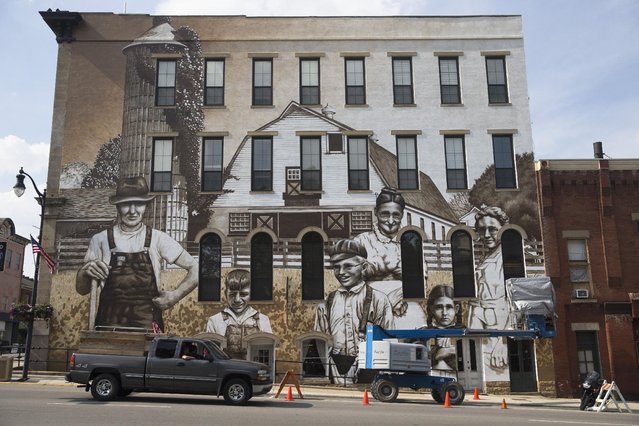
Artist Jason Morgan works on a mural named "Heritage Harvesters" as commissioned by a building owner to depict farmers from the community, Thursday, June 11, 2015, in Wilmington, Ohio. Locals were asked to send photographs of their ancestors who lived in the Wilmington area to adorn the edifice that sits along the town's main drag. (AP Photo/John Minchillo)

Artist Jason Morgan works on a mural named "Heritage Harvesters" as commissioned by a building owner to depict farmers from the community, Thursday, June 11, 2015, in Wilmington, Ohio. Locals were asked to send photographs of their ancestors who lived in the Wilmington area to adorn the edifice that sits along the town's main drag. (AP Photo/John Minchillo)
Details
22 Jun 2015 12:05:00
An Indian girl cries as a medical worker collect her swab sample for COVID-19 test at a rural health center in Bagli, outskirts of Dharmsala, India, Monday, September 7, 2020. India's coronavirus cases are now the second-highest in the world and only behind the United States. (Photo by Ashwini Bhatia/AP Photo)

An Indian girl cries as a medical worker collect her swab sample for COVID-19 test at a rural health center in Bagli, outskirts of Dharmsala, India, Monday, September 7, 2020. India's coronavirus cases are now the second-highest in the world and only behind the United States. (Photo by Ashwini Bhatia/AP Photo)
Details
09 Sep 2020 00:07:00
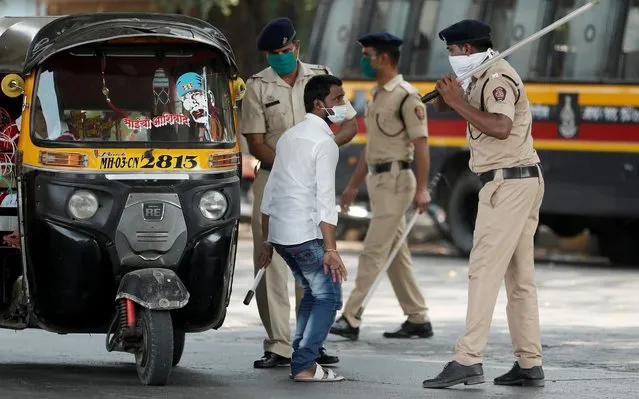
A policeman wields his baton at an autorickshaw rider as punishment for breaking the lockdown rules, after India ordered a 21-day nationwide lockdown to limit the spreading of coronavirus disease (COVID-19) in Mumbai, India on March 25, 2020. (Photo by Francis Mascarenhas/Reuters)

A policeman wields his baton at an autorickshaw rider as punishment for breaking the lockdown rules, after India ordered a 21-day nationwide lockdown to limit the spreading of coronavirus disease (COVID-19) in Mumbai, India on March 25, 2020. (Photo by Francis Mascarenhas/Reuters)
Details
26 Mar 2020 00:07:00
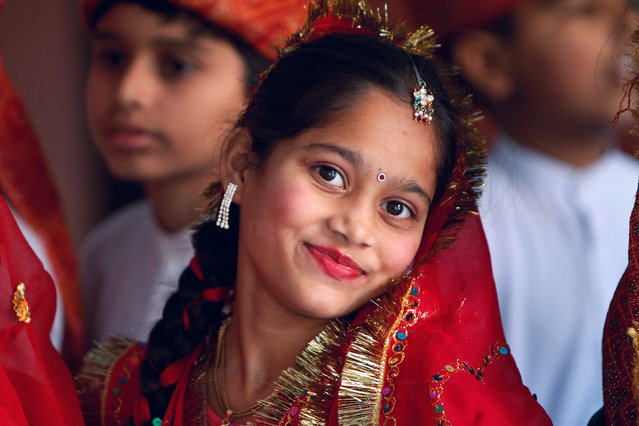
An Indian girl dressed in traditional attire reacts to camera as she watches a cultural performance during Lohri festival in Jammu, India, Monday, January 13, 2014. Lohri is a celebration of the winter solstice observed by Hindus and Sikhs in northern India. (Photo by Channi Anand/AP Photo)

An Indian girl dressed in traditional attire reacts to camera as she watches a cultural performance during Lohri festival in Jammu, India, Monday, January 13, 2014. Lohri is a celebration of the winter solstice observed by Hindus and Sikhs in northern India. (Photo by Channi Anand/AP Photo)
Details
18 Jan 2014 13:28:00
Rammehar Punia A Rubber Man

35-year old farmer Rammehar Punia has been named as ‘Rubber Man’. Thanks to his remarkable ability to make his shoulders meet in front of his chest. He has used his flex!bil!ty to smash the Guinness World record for the number of CD’s broken between the shoulders. He broke 60 CDs in just a minute.
Details
10 Aug 2015 10:45:00